Scientists solve 30-year-old aurora borealis mystery
July 24, 2008
Scientists solve 30-year-old aurora borealis mystery

Enlarge

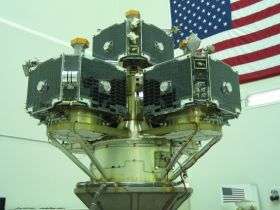
THEMIS (Time History of Events and Macroscale Interactions during Substorms) is funded by NASA. (Credit: NASA/JPL/GSFC, UCB)

UCLA space scientists and colleagues have identified the mechanism that triggers substorms in space; wreaks havoc on satellites, power grids and communications systems; and leads to the explosive release of energy that causes the spectacular brightening of the aurora borealis, also known as the northern lights.

For 30 years, there have been two competing theories to explain the onset of these substorms, which are energy releases in the Earth's magnetosphere, said Vassilis Angelopoulos, a UCLA professor of Earth and space sciences and principal investigator of the NASA-funded mission known as THEMIS (Time History of Events and Macroscale Interactions during Substorms).

One theory is that the trigger happens relatively close to Earth, about one-sixth of the distance to the moon. According to this theory, large currents building up in the space environment, which is composed of charged ions and electrons, or "plasma," are suddenly released by an explosive instability. The plasma implodes toward Earth as the space currents are disrupted, which is the start of the substorm.

A second theory says the trigger is farther out, about one-third of the distance to the moon, and involves a different process: When two magnetic field lines come close together due to the storage of energy from the sun, a critical limit is reached and the magnetic field lines reconnect, causing magnetic energy to be transformed into kinetic energy and heat. Energy is released, and the plasma is accelerated, producing accelerated electrons.

Which theory is right?

"Our data show clearly and for the first time that magnetic reconnection is the trigger," said Angelopoulos, who reports the research in the July 24 online issue of the journal Science. "Reconnection results in a slingshot acceleration of waves and plasma along magnetic field lines, lighting up the aurora underneath even before the near-Earth space has had a chance to respond. We are providing the evidence that this is happening."

Previous studies of the Earth's magnetosphere and space weather have been unable to pinpoint the origin of substorms, which are large magnetic disturbances. Ionized gas emitted from the sun's surface speeds up as it moves away from the sun, attaining speeds of 1 million mph and interacting with the Earth's upper atmosphere, which is also ionized, Angelopoulos said. Substorms are building blocks of larger storms.

"We need to understand this environment and eventually be able to predict when these large energy releases will happen so astronauts can go inside their spacecraft and we can turn off critical systems on satellites so they will not be damaged," Angelopoulos said. "This has been exceedingly difficult in the past, because previous missions, which measured the plasma at one location, were unable to determine the origin of the large space storms. To resolve this question properly requires correlations and signal-timing at multiple locations. This is precisely what was missing until now."

At high northern latitudes in the northern U.S. and Canada, shimmering bands of light called the aurora borealis, or northern lights, stretch across the sky from the east to the west. During the geomagnetically disturbed periods known as substorms, these bands of light brighten. These multicolored light shows are generated when showers of high-speed electrons descend along magnetic field lines to strike the Earth's upper atmosphere. Scientists want to learn when, where and why solar wind energy stored within the Earth's magnetosphere is explosively released to accelerate these electrons.

THEMIS is establishing for the first time when and where substorms begin, determining how the individual components of substorms interact, and discovering how substorms power the aurora borealis.

"We discovered what sparks the magnificent light show of the aurora," Angelopoulos said.

THEMIS has five satellites — with electric, magnetic, ion and electron detectors — in carefully chosen orbits around the Earth and an array of 20 ground observatories with automated, all-sky cameras located in the northern U.S. and Canada that catch substorms as they happen. The ground observatories take images of the aurora in white light. One satellite is a third of the distance to the moon, one is about a fourth of the distance and three are about a sixth of the distance. The outermost satellite takes four days to orbit the Earth, the next one two days, and the closest ones orbit the Earth in just one day. Every four days, the satellites line up.

As the satellites are measuring the magnetic and electric fields of the plasma above the Earth's atmosphere once every four days, the ground-based observatories are imaging the auroral lights and the electrical currents from space that generate them.

THEMIS was launched on Feb. 17, 2007, from Cape Canaveral, Fla., and is expected to observe approximately 30 substorms in its nominal lifetime.

"Armed with this knowledge, we are not only putting to rest age-old questions about the origin of the spectacular auroral eruptions but will also be able to provide statistics on substorm evolution and model its effects on space weather," Angelopoulos said.

Source: University of California - Los Angeles

4.1 /5 (40 votes)  

Filter


Move the slider to adjust rank threshold, so that you can hide some of the comments.


Display comments: newest first

EarthScientist
Jul 24, 2008

Rank: 1 / 5 (2)
Ya really need a grid science man,UCLA men,make it simple for ya
Mercury_01
Jul 24, 2008

Rank: not rated yet
Hey earth scientist, are you scottish?
Alburton
Jul 24, 2008

Rank: not rated yet


I know and can handle Maxwell's equations up to a certain point, (well,im on my 4th year in industrial engineering,so I know more or less as much as a physicist from the end of the XIX century =P) but I have no idea how magnetic fields manage to store energy from the Sun.Looks like particles interacting with the atmosphere creating currents?? Seems strange... I dont know where Earth's magnetic field comes from but I thought it had to do with currents at the core....

Could you lend me a hand with this?

Thanks a lot,Alvaro
earls
Jul 24, 2008

Rank: 5 / 5 (7)
Hi Alvaro.

As far as the dynamo theory (effect) goes, check out this page:

http://abyss.uore...ect.html

Our ball of iron (Earth) flies through the Sun's magnetic field and induces a current through itself spawning it's own magnetic field.

As far as the magnetic field "storing energy" - The amount of energy stored correlates to the size of the magnetic field which is correlates to the strength of the electric current.

As the electric current grows stronger, the magnetic field increases in size and is vulnerable to twisting and turning upon itself. When the magnetic field interacts with itself or another magnetic field, it may "explosively" release its energy kinetically (accelerating charged particles) and shrinking in size or possibly disappearing.

Rudimentary and slightly repetitive, but that's the gist.

All too often magnetic effects are mentioned without an explanation of the currents driving them or vice versa.
aufever
Jul 24, 2008

Rank: 3 / 5 (2)
You forgot to mention that the magnetic field is best observed as the the reason we have North and South Magnetic Poles.
brant
Jul 24, 2008

Rank: not rated yet
Pretty simple. The substorms are tied to flux tubes that run through the magnetosphere.
When the current draw through the flux tubes changes(gets larger), the flux tubes pinch(reconnect) and emit particles.
EarthScientist
Jul 24, 2008

Rank: not rated yet
Mercury ,I am not Scottish,would it help??
EarthScientist
Jul 24, 2008

Rank: 1.7 / 5 (6)
When you can observe ad assimilate the process of the grid,some of the statements you folks make will make you chuckle.

The funny thing is that you can see the effects of the cymatic grid everywhere with just a few clues.

Pyramids built here on cymatic grid nodes to bring the aether and connected weather to that ground. The chambers within were used to artificially engage different tones into the grid field to have many different effects. It really is a simple system. Even the Crop circles made by the HAARP or a "ToneWagon" put the process on a node.

That pyramid that is the shape of the phi mathematical,geometric relationship "Rings" in the key of "A". The zero line of compass deviation in the US draws the weather to it,and it really should not be just classed as a magnetosphere because the grids energy comes from off planet processes. That magma heats becuse of the draw of the ammonia crystal that is our core mass that is powered by the grid field being drawn to it.

The energetic sun spots task up the earths grid energy and the solar min-max cycles enhance our weather,this year is the 10.5 process.

Its not carbon eating at the glaciers,it is magma heat from another periodicity that has engaged us for many years now.

That long term revv will abate and it will get cooler again and you suckers will have given Al Gores group all of your money for carbon credits and other such nonsense and us grid scientists will just keep laughing our A s--es off at your incompleteness and inability to dis-engage yourselves from the Hanson-esque minions who really do not have proper climate science in their portfolio,and scream and scream that grid science does not exist,and as I said ,have very little actual power of observation as the revv period has been a great field for the observations needed to teach grid science.
seanpu
Jul 25, 2008

Rank: 3 / 5 (3)
one serious flaw in this conclusion, Magnetic Field Lines do not exist. they are an abstraction to help human minds visualize whats happening. They "appear" when charges move, and around objects like bar magnets. they are not entities in themselves, they are reactions of the space around a charge to the charge(s) and follow the charge and influence the charges' motion in a complex way explained by plasma physicists.

its surprising that a man of his caliber entertains that magnetic field line and physical objects. maybe its the only way he could get his research published but knows the cause is more fundamental.
am_Unition
Jul 26, 2008

Rank: 5 / 5 (1)
Our ball of iron (Earth) flies through the Sun's magnetic field and induces a current through itself spawning it's own magnetic field.


In fact, this is not the prevailing theory.

Correct me if I'm wrong, but the geodynamo is thought to originate from the turbulence at the mantle/core boundary resulting from convection currents in the mantle. The heat necessary to drive the convection currents is supposedly leftover energy from the planetary accretion process and energy from the radioactive decay of heavier elements.

That said, I agree with your view - that the geodynamo's ongoing process is largely a result of induction from the Interplanetary Magnetic Field and solar wind.

Now, as to why the other terrestrial planets differ vastly from Earth and each other is something I'd like to know. The gas giants are another story altogether.
EarthScientist
Jul 27, 2008

Rank: 1 / 5 (2)
Its really simple,some planets make the gases and some planets make the different cymatic processes,i.e. triangles,circles,hexagons with their size giving us the amount and their speed giving us the frequency.

The funny thing about math idiots is that they will sit in a barber shop and keep the bugs from others off theirselves by the barber keeping his cutting instruments in a light field that makes ozone ,and sit in their (possibly,if they have any oomph at all) Hot tub with an O3 generator that kills bacteria,just as the O3 coming down our nodes and cannot put anything together.

Light frequency boys,light frequency.

Heres another tidbit for ya, there are stripes of metal grown into our planet about every 175 iles for the induction pull of our motor.

And if you math morons had an oomph at all you would see the weather process flows going towards the grounds,and if you were even a vbit less moronic,you would see the salt deposits on the main triangle ground lines on the way to the pins.

It will never happen though will it??

I start giving out protocol information bit by bit and the idiot trolls come out of the woodwork to prove to us that the planets science boys have been depleted to just a ball of goo.
Pharago
Nov 12, 2008

Rank: not rated yet
...they are an abstraction to help human minds visualize whats happening

ferrofluids are a perfect example of magnetic lines being much more than a simple drawing aid for physics books, look at this picture and tell me that the fluid isn't pointing where the magnetic lines are laid in this piece of magnet:
http://en.wikiped...edit.jpg
Pharago
Nov 12, 2008

Rank: not rated yet
Rank 4.1 /5 (40 votes)
Relevant PhysicsForums posts
  • Titan's lack of impact craters
    created21 hours ago
  • Real pictures of black hole eating a star?
    createdFeb 08, 2012
  • Hypothetical way to travel faster than light, but not technically exceed lightspeed
    createdFeb 06, 2012
  • How do scientists monitor the Sun's activity?
    createdFeb 05, 2012
  • Search patterns in observational studies
    createdFeb 05, 2012
  • Derivation of Pogson's law
    createdFeb 03, 2012
  • More from Physics Forums - General Astronomy

More news stories

Mars Science Laboratory computer issue resolved

(PhysOrg.com) -- Engineers have found the root cause of a computer reset that occurred two months ago on NASA's Mars Science Laboratory and have determined how to correct it.

Space & Earth / Space Exploration

created 43 minutes ago | popularity 5 / 5 (1) | comments 1 | with audio podcast

Clam fields found at deep, low-temperature Mariana vents

(PhysOrg.com) -- Scientists have marveled at the unusual life forms thriving at high temperature hydrothermal vents of the deep ocean.

Space & Earth / Earth Sciences

created 18 minutes ago | popularity not rated yet | comments 0 | with audio podcast

Streams need trees to withstand climate change

(PhysOrg.com) -- More than twenty years of biological monitoring have confirmed the importance of vegetation for protecting Australia's freshwater streams and rivers against the ravages of drought and climate ...

Space & Earth / Environment

created 27 minutes ago | popularity not rated yet | comments 0

The turbulent birth of super star clusters in galaxy mergers

By combining two of the most advanced telescopes in the world -- the new Atacama Large Millimeter Array (ALMA) and the Very Large Telescope (VLT) of ESO -- a team of French astronomers from the Institut d'astrophysique ...

Space & Earth / Astronomy

created 9 minutes ago | popularity not rated yet | comments 0

Putin receives 'prehistoric' water from Antarctic lake

Prime Minister Vladimir Putin was given a water sample Friday taken from a pristine lake hidden under Antarctic ice for over a million years, after Russian scientists drilled down to its surface.

Space & Earth / Earth Sciences

created 49 minutes ago | popularity 5 / 5 (1) | comments 0


A frank discussion of the power law and linking correlation to causation

(PhysOrg.com) -- Michael Stumpf a mathematics professor at Imperial College in London, and Mason Porter a lecturer at Oxford have teamed together to write and publish a perspective piece in Science regarding the in ...

Advanced power-grid model finds low-cost, low-carbon future in West

(PhysOrg.com) -- The least expensive way for the Western U.S. to reduce greenhouse gas emissions enough to help prevent the worst consequences of global warming is to replace coal with renewable and other ...

Small modular reactor design could be a 'SUPERSTAR'

(PhysOrg.com) -- Though most of today's nuclear reactors are cooled by water, we've long known that there are alternatives; in fact, the world's first nuclear-powered electricity in 1951 came from a reactor ...

Seeing colors in music, tasting flavors in shapes may happen in life's early months

Famed violinist Itzhak Perlman sees a deep forest green whenever he plays a B-flat on his Stradivarius' G string. The A on the E string is red.

The question of life in the ancient world

There’s a general feeling that we don’t get the Greeks – ancient or modern. Many, including heads of state like Angela Merkel, visibly shake their head in exasperation, rightly or wrongly, at ...

Study suggests girls can 'rewire' brains to ward off depression

(Medical Xpress) -- What if you could teach your brain to respond differently to things that make you feel sad, down or stressed out? What if doing that helped ward off depression?