Trench on Mars Ready for Next Sampling by NASA Lander
July 24, 2008 Trench on Mars Ready for Next Sampling by NASA Lander

Enlarge

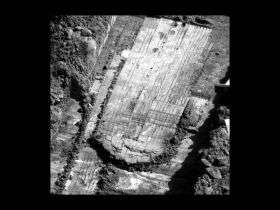
This view from the Surface Stereo Imager on NASA's Phoenix Mars Lander shows the trench informally named "Snow White."

(PhysOrg.com) -- NASA's Phoenix Mars Lander has groomed the bottom of a shallow trench to prepare for collecting a sample to be analyzed from a hard subsurface layer where the soil may contain frozen water.

Images received Thursday morning confirmed that the lander's robotic arm had scraped the top of the hard layer clean during activities of Phoenix's 58th Martian day, or sol, corresponding to overnight Wednesday to Thursday.

The Phoenix team developed commands for sending to the spacecraft Thursday to complete two remaining preparations necessary before collecting a sample and delivering it to the lander's Thermal and Evolved-Gas Analyzer (TEGA). One part of the plan for Sol 59 (overnight Thursday to Friday) would assure that the scoop is empty of any soil collected earlier. Another would complete a final cleaning of any volatile materials from the oven that will receive the sample.

In the past two weeks, the team has refined techniques for using a powered rasp on the back of the arm's scoop to cut and collect shavings of material from the bottom of the trench. The trench, informally named "Snow White," is 4 to 5 centimeters deep (about 2 inches), about 23 centimeters wide (9 inches), and about 60 centimeters long (24 inches) long.

"The rasped material ends up in the back of the scoop, and we have to transfer it to the front through a pathway. That takes a series of arm moves to be sure the material gets through the pathway," said Robert Bonitz of NASA's Jet Propulsion Laboratory, Pasadena, Calif., manager for the robotic arm. "The reason we're doing it today is we want to be sure the pathway is free of any material collected previously before we collect the next sample for delivery to TEGA."

The planned activity would repeat the series of pathway-clearing moves twice, and check visually to be sure the front of the scoop is empty. It is also important to get the background counts as low as possible in TEGA's evolved-gas analyzer, which receives vapors emitted from the oven. The instrument was heated repeatedly before launch and during the flight to Mars to drive off any volatile material in it, such as water and carbon-dioxide gases that tend to stick on surfaces. It got another heating on Sol 58.

"The baking last night was to remove background volatiles stuck on the walls of the instrument," said William Boynton of the University of Arizona, Tucson, lead scientist for TEGA. "What we're planning today is pumping out any gas we might have released with the baking."

Other activities in the plan for the sol beginning today include weather monitoring and photography of several areas. Some planned use of the Surface Stereo Imager would record the same view consecutively through 15 different filters. Each filter lets through only a limited band of wavelengths of visible or infrared light. Using just red, green and blue filters allows the team to make full-color images. Using the additional filters provides more information useful for interpreting geological or atmospheric qualities of the image target.

Provided by NASA


print this article email this article download pdf blog this article bookmark this article     Stumble it Digg this share on Facebook retweet share on Reddit add to delicious
Rate this story - 4.3 /5 (3 votes)


July 24, 2008 all stories

Comments: 0

4.3 /5 (3 votes)
  • Stumble this up

  • Digg this

  • share this

  • hide
  • Related Stories

  • Phoenix Lander Digs and Analyzes Soil as Darkness Gathers
    created Oct 09, 2008 | popularity not rated yet | comments 0
  • Next Mars Soil Scoop Slated for Last of Lander's Wet Lab Cells
    created Sep 10, 2008 | popularity not rated yet | comments 0
  • Analysis Begins on Deepest Martian Soil Sample
    created Sep 02, 2008 | popularity not rated yet | comments 0
  • Phoenix Mars Lander Digs Deeper as Third Month Nears End
    created Aug 26, 2008 | popularity not rated yet | comments 0
  • Soil Studies Continue at Site of Phoenix Mars Lander
    created Aug 11, 2008 | popularity not rated yet | comments 0


  • hide
  • Relevant PhysicsForums posts

  • Question about 2-body gravity
    created 20 hours ago
  • life on Mars
    created 22 hours ago
  • Semi-major axis from cartesian co-ordinates
    created Nov 23, 2009
  • Primary Mirror grinding
    created Nov 23, 2009
  • More from Physics Forums - General Astronomy

Other News

America's increasing food waste is laying waste to the environment

Space & Earth / Environment

created 4 seconds ago | popularity not rated yet | comments 0

Food waste contributes to excess consumption of freshwater and fossil fuels which, along with methane and carbon dioxide emissions from decomposing food, impacts global climate change. In a new paper published in the open-access, ...


Shuttle Atlantis leaves space station, headed home (AP)

Shuttle Atlantis leaves space station, headed home

Space & Earth / Space Exploration

created 10 minutes ago | popularity not rated yet | comments 0

(AP) -- Atlantis and its seven astronauts have left the International Space Station.


First black holes may have incubated in giant, starlike cocoons, says CU-Boulder study

First black holes may have incubated in giant, starlike cocoons

Space & Earth / Astronomy

created 15 hours ago | popularity 4.4 / 5 (10) | comments 15

(PhysOrg.com) -- The first large black holes in the universe likely formed and grew deep inside gigantic, starlike cocoons that smothered their powerful x-ray radiation and prevented surrounding gases from ...


Cassini Captures Ghostly Dance of Saturn's Northern Lights

Cassini Captures Ghostly Dance of Saturn's Northern Lights (w/ Video)

Space & Earth / Space Exploration

created 12 hours ago | popularity 5 / 5 (4) | comments 0

(PhysOrg.com) -- In the first video showing the auroras above the northern latitudes of Saturn, Cassini has spotted the tallest known "northern lights" in the solar system, flickering in shape and brightness ...


ET: Check your voicemail

ET: Check your voicemail

Space & Earth / Space Exploration

created 12 hours ago | popularity 3.4 / 5 (5) | comments 5

(PhysOrg.com) -- Alien beings on faraway planets may not have noticed, but it’s been 35 years since human beings made the first deliberate effort to send them a message.