Scientists search for answers from the carbon in the clouds
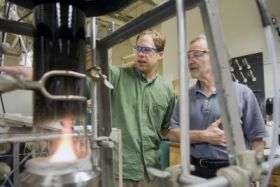
An aerosol mass spectrometer developed by chemists from Aerodyne Research Inc. and Boston College is giving scientists who study airborne particles the technology they need to examine the life cycles of atmospheric aerosols – such as soot – and their impact on issues ranging from climate change to public health.
BC Chemistry Professor Paul Davidovits and Aerodyne Principal Scientist Timothy B. Onasch say their novel spectrometer allows researchers to better understand what happens to these sub-microscopic particles that can absorb and scatter light and influence the lifetime of clouds.
"For scientists looking at climate change, the biggest uncertainty has to do with the effect of aerosol particles in the air," says Davidovits. "The issue is made that much more complex because aerosols can have different effects on climate. That means the target is constantly shifting."
The historic role of carbon-laden soot in climate change has been identified by researchers, particularly through ice samples taken from glaciers. Now scientists are focusing on tiny airborne particles of black carbon released into the atmosphere today in order to better understand the lifecycle of these aerosols in the atmosphere.
To that end, nearly 20 researchers from across the country brought other devices to the Davidovits lab this month to test and fine-tune these new tools developed by scientists from universities, industry and national laboratories at the forefront of this path-breaking science of the sky.
Hosted by Davidovits and Onasch, also an associate research professor at BC, the visiting researchers ran streams of laboratory-generated soot through devices able to analyze minute aerosol particles by mass, shape, chemical make-up, even the sound they make when warmed by light – a "pop" inaudible to the human ear.
"This is the cutting edge," says Dan Lack, a research scientist with the National Oceanic and Atmospheric Administration's Earth System Research Laboratory in Boulder, Colo. "Much of the technology in this room didn't exist until a few years ago. And there isn't another place in the country where you have all this technology running together in concert. It's a rare opportunity."
Among the 18 devices involved in the project are Billerica, MA-based Aerodyne's Aerosol Mass Spectrometer, Boulder-based Droplet Technologies' Single Particle Soot Photometer, and the NOAA-developed Cavity Ring-Down Aerosol Extinction and Photoacoustic Spectrometers, which shoot a laser beam into black carbon, causing the particle to "pop", emitting a frequency that's measured to gauge how much light carbon absorbs.
A technological focal point is a unique soot-particle generating apparatus operated by doctoral student Eben Cross, undergraduate Adam Ahern '09 and recent graduate Billy Wrobel '08. The design, construction, and operation of the device were funded by the atmospheric chemistry programs of the Department of Energy and the National Science Foundation.
In the race to determine the scope and speed of climate change and the influence of human activities on it, huge scientific efforts have focused on carbon dioxide gasses emitted largely from the burning of fossil fuels. Scientists believe particulates like black carbon may also contribute significantly to global warming.
For more than 15 years, Davidovits and his Aerodyne colleagues have pioneered the study of soot particles and gas-particle interactions, strengthening an understanding of the role of cloud and aerosol chemistry in acid rain, ozone depletion and climate change.
Aerosols raise temperatures, such as when black particles of soot rise in the sky, absorb sunlight and turn it into heat. Aerosols also can cool by reflecting light away from the earth. Clouds overstuffed with aerosols can inhibit rainfall.
While soot emitted from sources like diesel engines and electric power plants is a focus of study, not all aerosols are man-made. The deserts and arid landscapes of the world produce an estimated 10 to 20 billion tons of mineral aerosols a year. The air is full of biological aerosols as well – microbes, cells, and particles containing organic compounds.
Aerosols are somewhat fleeting. Unlike carbon dioxide, which can remain in the atmosphere for years, aerosols have an atmospheric life of about 10 to 20 days. In that time, they can absorb other molecules that alter their original state.
Measuring the many forms of atmospheric aerosols has led researchers to invent new devices, known as research-grade aerosol particle characterizing instruments, says Davidovits. The challenge now is to fine-tune those instruments in concert with each other in order to set reliable scientific benchmarks for future study.
Linked closely to the atmospheric effects of aerosols is a range of public health concerns, says Onasch.
"There is a need on many fronts – from the climate to public health – for greater understanding of the role aerosol particles play in our lives and what's happening here is the scientific community rising to meet those needs," says Onasch.
Source: Boston College


