'Impressionist' Spacecraft to View Solar System's Invisible Frontier
(PhysOrg.com) -- At the edge of our solar system in December 2004, the Voyager 1 spacecraft encountered something never before experienced during its then 26-year cruise through the solar system — an invisible shock formed as the solar wind piles up against the gas in interstellar space. This boundary, called the termination shock, marks the beginning of our solar system's final frontier, a vast expanse of turbulent gas and twisting magnetic fields.
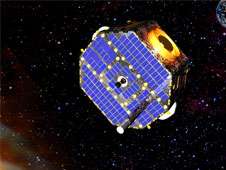
A NASA-sponsored team is developing a way to view this chaotic but unseen realm for the first time. Just as an impressionist artist makes an image from countless tiny strokes of paint, NASA’s new Interstellar Boundary Explorer (IBEX) spacecraft will build up an image of the termination shock and areas beyond by using hits from high-speed atoms that are radiating out of this region.
"IBEX will let us make the first global observations of the region beyond the termination shock at the very edges of our solar system. This region is critical because it shields out the vast majority of the deadly cosmic rays that would otherwise permeate the space around the Earth and other planets," says Dr. David J. McComas, IBEX principal investigator from the Southwest Research Institute (SwRI) in San Antonio, Texas. "IBEX will let us visualize our home in the galaxy for the first time and explore how it may have evolved over the history of the solar system. Ultimately, by making the first images of the interstellar boundaries neighboring our solar system, IBEX will provide a first step toward exploring the galactic frontier."
Space is not empty. The sun exhales a thin, hot wind of electrically conducting gas, called plasma, into space at about a million miles per hour. This solar wind forms a large plasma bubble, called the heliosphere, in space around the Sun. Beyond the orbit of Pluto, the solar wind gradually slows as it interacts with inflowing neutral gases from interstellar space, and then abruptly drops in speed at a thin, invisible boundary around our solar system called the termination shock.
A simple kitchen demonstration illustrates how this shock forms. When water runs at high speed from a kitchen faucet down to the bottom surface of the sink, the water hitting this surface first flows quickly and smoothly away from the impact point, but then runs into a circular boundary with slower, more turbulent flow beyond this boundary.
In the kitchen sink demonstration, the circular boundary is the termination shock. The turbulent region beyond the shock boundary corresponds to a layer in the outer heliosphere of turbulent plasma flows and magnetic fields called the heliosheath. The boundary of this turbulent layer with the interstellar plasma environment, not so easily seen in the kitchen sink experiment because of the turbulence, is called the heliopause. The heliopause is the end of our solar system’s frontier. Beyond that is interstellar space.
IBEX will make pictures of the heliosheath region and determine the termination shock’s strength. It will also discover what happens when the solar wind clashes with interstellar space by observing how the solar wind is flowing in the heliosheath and how the interstellar gas interacts with the heliopause. IBEX will determine how high-speed atoms are accelerated within the termination shock and heliosheath.
A cosmic game of tag allows IBEX to make its pictures. First, some background on the players: an atom needs to be electrically charged to feel magnetic force and be influenced by the magnetic fields in space. Normally, the positive electric charges in the central part of the atom, called the nucleus, are balanced by an equal number of negatively charged electrons swirling around it. In this case, the atom is electrically neutral overall and does not respond to magnetic fields. However, sometimes an atom gains or loses an electron. The electric charges are no longer in balance; gaining an electron gives the atom an extra negative charge, while losing an electron leaves the atom with a positive charge. The charged atom, called an ion, can now be deflected or accelerated by magnetic fields.
Most of the ions in interstellar space are deflected around our solar system by the magnetic field carried by the solar wind. Energetic neutral atoms (ENAs) are created when low-energy neutral atoms floating in from the interstellar medium "tag" energetic protons that are gyrating around the magnetic field lines in the solar wind. They charge exchange (since opposite charges attract, an electron jumps from the neutral atom to the positively charged proton if the two pass each other very closely). The proton now has an electron to balance its charge, and it becomes an Energetic Neutral Atom. The ENAs that happen to be pointing in the direction of Earth at the moment of charge-exchange will then propagate back in toward the Earth where IBEX can detect them.
Since the ENAs no longer feel magnetic force, they travel in a nearly straight line, only slightly deflected by the sun's gravity. Their straightforward path allows ENAs that hit IBEX's two sensors to be traced back to their origin near the termination shock. This lets the IBEX team gradually build up a picture of the termination shock using the incoming neutral atoms, since the majority of Earthward-directed ENAs are believed to result from heating of the solar wind as it crosses the termination shock. Six months into the mission, IBEX will have observed the entire sky, and will reveal the global structure of the heliosheath and termination shock for the first time.
IBEX is scheduled to be launched on a Pegasus rocket on October 5, 2008. It needs to go beyond the region of space controlled by Earth's magnetic field, called the magnetosphere, because this region generates radiation and the same high-speed atoms (ENAs) that IBEX will use to make its pictures. To avoid contamination from local ENAs produced in the magnetosphere, IBEX's orbit will take it up to 200,000 miles from Earth.
"The solar system's frontier is billions of miles away, so it's difficult for us to go there, but interesting things happen at boundaries, and with IBEX, we will see them for the first time," said Dr. Robert MacDowall, IBEX Mission Scientist at NASA's Goddard Space Flight Center in Greenbelt, Md.
The IBEX mission is funded by NASA's Small Explorer program. It is a PI-led mission being run by SwRI, which is responsible for all aspects of the mission. Orbital Science Corporation in Dulles, Virginia, is SwRI’s sub-contractor for the IBEX spacecraft and also provides the Pegasus launch. The Explorer Project Office at NASA Goddard oversees all Small Explorer missions, including IBEX.
Proveded by NASA's Goddard Space Flight Center, by Bill Steigerwald


