Scientists demonstrate highly directional semiconductor lasers
July 27, 2008
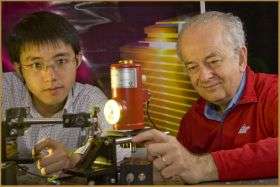
Graduate student Nanfang Yu and Professor Federico Capasso. Photo by Eliza Grinnell/SEAS
Applied scientists at Harvard collaborating with researchers at Hamamatsu Photonics in Hamamatsu City, Japan, have demonstrated, for the first time, highly directional semiconductor lasers with a much smaller beam divergence than conventional ones.
The innovation opens the door to a wide range of applications in photonics and communications. Harvard University has also filed a broad patent on the invention.
Spearheaded by graduate student Nanfang Yu and Federico Capasso, Robert L. Wallace Professor of Applied Physics and Vinton Hayes Senior Research Fellow in Electrical Engineering, all of Harvard's School of Engineering and Applied Sciences (SEAS), and by a team at Hamamatsu Photonics headed by Dr. Hirofumi Kan, General Manager of the Laser Group, the findings were published online in the July 28th issue of Nature Photonics and will appear in the September print issue.
"Our innovation is applicable to edge-emitting as well as surface-emitting semiconductor lasers operating at any wavelength—all the way from visible to telecom ones and beyond," said Capasso. "It is an important first step towards beam engineering of lasers with unprecedented flexibility, tailored for specific applications. In the future, we envision being able to achieve total control of the spatial emission pattern of semiconductor lasers such as a fully collimated beam, small divergence beams in multiple directions, and beams that can be steered over a wide angle."
While semiconductor lasers are widely used in everyday products such as communication devices, optical recording technologies, and laser printers, they suffer from poor directionality. Divergent beams from semiconductor lasers are focused or collimated with lenses that typically require meticulous optical alignment—and in some cases bulky optics.
To get around such conventional limitations, the researchers sculpted a metallic structure, dubbed a plasmonic collimator, consisting of an aperture and a periodic pattern of sub-wavelength grooves, directly on the facet of a quantum cascade laser emitting at a wavelength of ten microns, in the invisible part of the spectrum known as the mid-infrared where the atmosphere is transparent. In so doing, the team was able to dramatically reduce the divergence angle of the beam emerging from the laser from a factor of twenty-five down to just a few degrees in the vertical direction. The laser maintained a high output optical power and could be used for long range chemical sensing in the atmosphere, including homeland security and environmental monitoring, without requiring bulky collimating optics.
"Such an advance could also lead to a wide range of applications at the shorter wavelengths used for optical communications. A very narrow angular spread of the laser beam can greatly reduce the complexity and cost of optical systems by eliminating the need for the lenses to couple light into optical fibers and waveguides," said Dr. Kan.
Source: Harvard University
-
Many bodies make one coherent burst of light: Researchers see superfluorescence from solid-state material
Jan 30, 2012 |
4.8 / 5 (4) |
5
-
Physicists cool semiconductor by laser light
Jan 22, 2012 |
4.5 / 5 (11) |
2
-
High-power, 532 nm-wavelength compact green laser module with high efficiency, high-speed modulation capability
Jan 19, 2012 |
5 / 5 (2) |
1
-
Trillion-frame-per-second video
Dec 13, 2011 |
4.8 / 5 (41) |
31
-
First electronic optical fibers with hydrogenated amorphous silicon are developed
Dec 13, 2011 |
5 / 5 (2) |
0
-
Engineers build first sub-10-nm carbon nanotube transistor
Feb 01, 2012 |
4.9 / 5 (31) |
30
-
Something old, something new: Evolution and the structural divergence of duplicate genes
Jan 31, 2012 |
4.6 / 5 (7) |
1
-
The hidden nanoworld of ice crystals: Revealing the dynamic behavior of quasi-liquid layers
Jan 30, 2012 |
5 / 5 (3) |
1
-
Stock market network reveals investor clustering
Jan 27, 2012 |
3.9 / 5 (23) |
8
-
Of microchemistry and molecules: Electronic microfluidic device synthesizes biocompatible probes
Jan 26, 2012 |
5 / 5 (1) |
0
-
Does light travel for ever?
1 hour ago
-
Infinity by Particles
2 hours ago
-
what does negative resistivity mean
2 hours ago
-
Calculating Electrostatic force between parallel plates
4 hours ago
-
Strength of induced magnetic field inside an inductor
7 hours ago
-
increasing time of daylight
8 hours ago
- More from Physics Forums - General Physics
More news stories
Putting the squeeze on planets outside our solar system
(PhysOrg.com) -- Using high-powered lasers, scientists at Lawrence Livermore National Laboratory and collaborators discovered that molten magnesium silicate undergoes a phase change in the liquid state, abruptly ...
7 hours ago |
4.8 / 5 (4) |
0
|
Hovering not hard if you're top-heavy, researchers find
Top-heavy structures are more likely to maintain their balance while hovering in the air than are those that bear a lower center of gravity, researchers at New York University's Courant Institute of Mathematical Sciences ...
8 hours ago |
5 / 5 (1) |
1
|
SLAC, Stanford team focuses on high-energy electrons to treat cancer
Accelerator physicists at SLAC and cancer specialists from Stanford are working on a new technology that could dramatically reduce the time needed for cancer radiation treatments. The team ran an initial experiment ...
11 hours ago |
5 / 5 (1) |
0
Measurements from high-energy collisions lead to better understanding of why meson particles disappear
For several years, physicists at the Relativistic Heavy Ion Collider (RHIC) at Brookhaven National Laboratory (BNL), USA, have studied an unusual state of matter called the quarkgluon plasma, which they ...
11 hours ago |
5 / 5 (1) |
0
Explained: Sigma
It's a question that arises with virtually every major new finding in science or medicine: What makes a result reliable enough to be taken seriously? The answer has to do with statistical significance -- but ...
Feb 09, 2012 |
5 / 5 (16) |
48
Google users warned of threat to smartphone wallets
Users of Google smartphone wallets were being warned on Friday that there is a way to crack pass codes intended to thwart thieves from going on illicit shopping sprees.
Anonymous knocks CIA website offline (Update)
The website of the Central Intelligence Agency was inaccessible on Friday after the hacker group Anonymous claimed to have knocked it offline.
Complex wiring of the nervous system may rely on a just a handful of genes and proteins
Researchers at the Salk Institute have discovered a startling feature of early brain development that helps to explain how complex neuron wiring patterns are programmed using just a handful of critical genes. ...
New error-correcting codes guarantee the fastest possible rate of data transmission
Error-correcting codes are one of the triumphs of the digital age. Theyre a way of encoding information so that it can be transmitted across a communication channel such as an optical fiber o ...
The power of estrogen -- male snakes attract other males
A new study has shown that boosting the estrogen levels of male garter snakes causes them to secrete the same pheromones that females use to attract suitors, and turned the males into just about the sexiest ...
NASA sees wide-eyed cyclone Jasmine
Cyclone Jasmine's eye has opened wider on NASA satellite imagery, as it moves through the Southern Pacific Ocean.
Jul 29, 2008
Rank: 5 / 5 (1)