The Lightness of Electrons in a Twisting Metal Crystal
July 25th, 2008 The Lightness of Electrons in a Twisting Metal Crystal

Enlarge

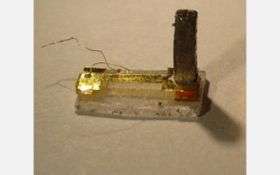
This torque cantilever is used to measure magnetic property of bismuth in intense magnetic fields. The bismuth crystal (5.6 mm tall vertical pillar) is glued to the end of a thin cantilever beam made of gold. Deflections of the cantilever in a field are detected by measuring changes in capacitance. Credit: N. Phuan Ong, Princeton University

(PhysOrg.com) -- A team of researchers at Princeton University's Materials Research Science and Engineering Center has observed electrons moving through a crystal of bismuth metal behaving like light.

This discovery, supported by the National Science Foundation and detailed in today's edition of the journal Science, could lead to new kinds of electronic devices.

Electrons, or the particles of electricity, fly through space like tiny baseballs. Alternatively, when an electron speeds between a crystal's periodic arrangement of atoms it behaves very differently. The fundamental equations that describe its motion in the crystal are very different from those of a free-flying baseball. For example, in bismuth, the fundamental equations of electron motion resemble those that describe the behavior of light. Although the electrons whirl about the crystal slower than at the speed of light, the electrons behave as if they are without mass like photons, the tiniest unit of light.

Over a decade ago, theoretical physicists supported by NSF studied electrons confined to artificial layered structures made of semiconductors--the stuff of which transistors are made of. They predicted that new kinds of electronic matter governed by the rules of quantum mechanics would emerge from the electrons in different layers coordinating their motions. Scientists hypothesized that bismuth crystals should also exhibit analogous electronic states.

The Princeton group, led by physics professor N. Phuan Ong, fixed a crystal of bismuth onto a flexing beam, or cantilever, and then placed this apparatus in a high magnetic field created at the NSF National High Magnetic Field Laboratory, which can generate magnetic fields that are more than a million times stronger than the earth's faint magnetic field.

Under such enormous magnetic fields, the cantilever twists. The way it twists tells the Princeton researchers about the subtle new kind of matter in the bismuth crystal.

In a single crystal of bismuth, electrons are often confined to three valleys in a complex abstract landscape that scientists use to represent an electron's energy in the crystalline structure. Through careful study of the twisting cantilever, they observed a transformation from a state where the electrons prefer to occupy only one valley to a state in which the electrons share their time among all the valleys in a dance choreographed by the fundamental rules of quantum mechanics.

"This is exciting because this was predicted but never shown before, and it may eventually lead to new paradigms in computing and electronics,"said Thomas Rieker, NSF program director for materials research center.

With this work, the theory of electrodynamics suggests a rich landscape of electronic states of semiconductors, and the Princeton researchers are continuing their adventure. Someday, these newly discovered electronic states of matter may enable powerful new electronic devices that exploit the principles of quantum mechanics to compute and communicate. For now we can marvel at the subtle beauty of nature that lives in a universe of electrons that lies beneath the shiny skin of a metal crystal.

Source: National Science Foundation


print this article email this article download pdf blog this article bookmark this article     Digg this Stumble it share on Facebook share on Reddit add to delicious save to Yahoo! bookmarks
4.4/5 after 24 votes

Rank Filter

Move the slider to adjust rank threshold, so that you can hide some of the comments.


Display comments: newest first

  • WorldSci - Jul 25, 2008
    • Rank: not rated yet
    The International Journal of Quantum Information (IJQI) is currently seeking original and unpublished manuscripts for a Theme Issue on Distributed Quantum Computing, scheduled for
    publication in the first quarter of 2009. Interested parties, do feel free to check out the paper submission details at:

    http://www.worlds...608).pdf

    Thanks and Regards:-)

July 25th, 2008 all stories
Physics / General Physics

Comments: 1
Rank: 4.4/5 after 24 votes

  • Stumble this up

  • Digg this

  • Share it:
  • share on Facebook
  • share on MySpace
  • share on Slashdot
  • rss-newsfeed
  • share on Google
  • share on Reddit
  • add to delicious
  • save to Yahoo! bookmarks
  • share on Windows Live
  • Add to Mixx!
Rating: 4.4/5 after 24 votes

  • Related Stories

  • Quantum Twist: Electrons Mimic Presence of Magnetic Field
    created Feb 12, 2009 | popularity not rated yet | comments 0
  • Domain walls that conduct electricity
    created Jan 29, 2009 | popularity not rated yet | comments 0
  • Physicists discover surprising variation in superconductors
    created Jan 28, 2009 | popularity not rated yet | comments 0
  • Scientists discover exotic quantum state of matter
    created Apr 24, 2008 | popularity not rated yet | comments 0
  • Microscope Sees with Nanoscale Resolution
    created Jan 28, 2008 | popularity not rated yet | comments 0

Tags

electrons

  • Physicists Demonstrate Quantum Memory with Matter Qubits
    Physicists Demonstrate Quantum Memory with Matter Qubits
    Physics / General Physics
    created Jul 03, 2009 | popularity 4.4 / 5 (17) | comments 1
  • 'Holey' Nanosheets for Wastewater Dye Removal
    Nanotechnology / Nanomaterials
    created Jul 01, 2009 | popularity 5 / 5 (5) | comments 1
  • Jellyfish Robot Swims Like its Biological Counterpart
    Jellyfish Robot Swims Like its Biological Counterpart
    Electronics / Robotics
    created Jun 26, 2009 | popularity 4.4 / 5 (8) | comments 1
  • Could Maxwell's Demon Exist in Nanoscale Systems?
    Could Maxwell's Demon Exist in Nanoscale Systems?
    Physics / General Physics
    created Jun 24, 2009 | popularity 4.4 / 5 (18) | comments 29
  • Living Safely with Robots, Beyond Asimov's Laws
    Living Safely with Robots, Beyond Asimov's Laws
    Electronics / Robotics
    created Jun 22, 2009 | popularity 4.6 / 5 (54) | comments 40
  • Other News

    Physical reality of string theory demonstrated

    Physics / General Physics

    created 2 hours ago | popularity 4.7 / 5 (15) | comments 10

    String theory has come under fire in recent years. Promises have been made that have not been lived up to. Leiden (The Netherlands) theoretical physicists have now for the first time used string theory to describe a physical ...


    UQ researchers break the law -- of physics

    Physics / General Physics

    created 8 hours ago | popularity 4.6 / 5 (12) | comments 4

    (PhysOrg.com) -- Two UQ Science researchers have proved two famous physical laws that have been widely used for the past 25 years do not always work.


    Scientists create first electronic quantum processor

    Scientists create first electronic quantum processor

    Physics / General Physics

    created Jun 28, 2009 | popularity 4.8 / 5 (55) | comments 44

    A team led by Yale University researchers has created the first rudimentary solid-state quantum processor, taking another step toward the ultimate dream of building a quantum computer.


    Science journals

    How to Spot an Influential Paper Based on its Citations

    Physics / General Physics

    created Jul 04, 2009 | popularity 3.9 / 5 (10) | comments 6

    (PhysOrg.com) -- At first it may seem that the number of citations received by a published scientific paper is directly related to that paper's quality of content. The higher the quality, the more people read ...


    Fermilab's CDF observes Omega-sub-b baryon

    Fermilab's CDF observes Omega-sub-b baryon

    Physics / General Physics

    created Jun 29, 2009 | popularity 4.6 / 5 (19) | comments 7

    (PhysOrg.com) -- At a recent physics seminar at the Department of Energy’s Fermi National Accelerator Laboratory, Fermilab physicist Pat Lukens of the CDF experiment announced the observation of a new particle, ...