A new era in search for 'sister Earths'?
Research presented at a recent astronomical conference is being hailed as ushering in a new era in the search for Earth-like planets by showing that they are more numerous than previously thought and that scientists can now analyze their atmospheres for elements that might be conducive to life.
“This conference was very well timed. People came with new results. It clicked together. There was a lot of excitement,” said Professor of Astronomy Dimitar Sasselov, who heads Harvard’s Origins of Life Initiative and who co-chaired the conference’s Scientific Organizing Committee. “What happened this spring was a tipping point in the field.”
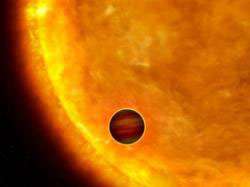
The International Astronomical Union (IAU) symposium, held in May at the American Academy of Arts and Sciences in Cambridge, was sponsored by the Harvard Origins of Life Initiative, the California Institute of Technology’s Michelson Science Center, the Massachusetts Institute of Technology, and the IAU. Its focus was “Transiting Planets,” or the technique of discovering planets by measuring changes in the light of distant suns when a planet passes in front of them.
“The age of the discovery of Earth-like planets started last week,” Sasselov said shortly after the conference concluded. “We can say this is the moment where we started the exploration of planets like Earth.”
Astronomers using a variety of techniques have discovered more than 300 planets circling other stars since 1995, when a Swiss team announced finding the first Jupiter-mass planet orbiting a sun-like star, but few of them bear any resemblance to rocky planets like Earth. Because planets are far smaller and dimmer than the star they circle, most techniques rely on detecting not the planet itself, but its effects on its star, such as changes in the star’s light or wobbles in the star’s rotation due to a planet’s gravitational tug as it circles. Consequently, most of the planets found so far have been large gas giants such as our own solar system’s Jupiter, Saturn, or Neptune, thought to be incapable of sustaining life.
That has been changing since the 2004 announcement of the discovery of the first “super-Earth,” a potentially rocky planet 14 times larger than Earth circling a star in the southern constellation Altar, and with the development of new instruments that astronomers believe will be able to find planets close to Earth’s size.
At the conference, Christophe Lovis, a scientist at the University of Geneva who is collaborating with the Harvard Origins of Life Initiative, announced findings that small, rocky worlds are not only present in the universe, they’re common, outnumbering the large gas giants by as much as a 3-to-1 ratio.
“This finding was not expected and very welcome,” Sasselov said. “It means planets like Earth are abundant and we can study them.”
Sasselov said rocky planets up to five times Earth’s size should be detectable with the new generation of instruments coming on line such as the Harvard Origins of Life Initiative’s spectrometer equipped with the new laser astro-comb, developed at the Harvard-Smithsonian Center for Astrophysics. The spectrometer which will be deployed in the Canary Islands for exoplanet research sometime in 2010.
“Five times larger than Earth is actually pretty good from the point of view of geochemistry and biochemistry,” Sasselov said. “Ultimately, we want to go down to sister Earths, as people call it. It’s my personal belief that super-Earths are as hospitable to life as Earths, but we need to compare them. People want to know if there are planets just like ours out there.”
The second major finding to emerge from the conference shows that researchers can get an idea of conditions on any planets that they do find, Sasselov said. Presented by Harvard’s Cabot Associate Professor of Astronomy David Charbonneau, the results presented the first compilation of the atmospheric spectrum of a planet orbiting another star.
The spectrum, put together for the atmosphere of a gas giant 60 light-years away, uses the light emitted or absorbed by the planet to detect what molecules are present in the atmosphere, in this case, methane, potassium, sodium, water vapor, and small particulate haze, among others. Though researchers have been able to detect single elements that make up the atmosphere of planets since 2001, this is the first time the complete makeup of the atmosphere of an extrasolar planet has been determined.
“We can actually do this; it is amazing,” Sasselov said. “We can look at a planet 60 light-years away and tell you what’s in the atmosphere. This is really a big deal.”
Knowing a planet’s atmospheric makeup can help astronomers determine whether the conditions for life are present.
“What really keeps me up at night is the potential to apply the techniques we’ve developed to study the atmospheres of gas giant exoplanets to the soon-to-be discovered Earth-like exoplanets,” Charbonneau said. “We could conduct a search for the presence of specific molecules indicating biological activity on the planet’s surface.”
Source: Harvard University


