Scientists find unexpected key to flowering plants' diversity
July 28, 2008
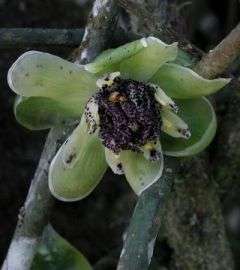
By hand pollinating the rare vine Austrobaileya, whose flower is seen here, University of Tennessee, Knoxville, researcher Joe Williams uncovered new information about the origins of flowering plants' incredible diversity. Image: Joe Williams/University of Tennessee, Knoxville
What began with an off-the-cuff curiosity eventually led Joe Williams to hang from the limbs of a tree 80 feet above the soil of northeastern Australia.
The things Williams, a University of Tennessee, Knoxville, researcher found there may help explain the amazing diversity in the world's flowering plants, a question that has puzzled scientists from the time of Charles Darwin to today.
Williams' findings, published online this week by the Proceedings of the National Academy of Sciences, show that the ability of flowering plants -- known as angiosperms -- to quickly and efficiently move sperm from pollen to egg through a part of the plant was the key to their evolutionary diversity.
His curiosity was based in the time it takes from when pollen lands on a plant to the time that its' seed is fertilized. Williams noticed a recurring theme in the research papers he read:
"They would usually describe how fertilization was occurring, but they never tell you much about timing," said Williams, an assistant professor of ecology and evolutionary biology at UT Knoxville.
For a seeded plant to fertilize, pollen that lands on the flower must grow a tube to carry sperm to the egg. In non-flowering plants, the pathway is usually short, because the pollen tube must destroy cells in its path, which is a time-consuming process. In flowering plants, though, pollen tubes are able to cover longer distances to the egg by essentially "squeezing" between cells. It is a trait that Williams says is vital to their diversification.
"The longer a plant takes to fertilize, for the pollen to reach the egg," said Williams, "the more chance there is for it to die."
When he studied the data he had collected through the years, Williams found that older lineages of flowering plants -- those on lower branches of the angiosperms' evolutionary family tree -- grew shorter tubes of pollen than those that went on to evolve into the diverse array of flowering plants that exist today.
That's what brought Williams to a harness in the rainforest of Australia. To confirm what he found in the data analysis, he pollinated -- by hand -- an ancient vine known as Austrobaileya that grows high in the canopy. He chose that plant, along with another plant found only on the Pacific island of New Caledonia and a water lily that grows high in the Colorado mountains, to test because they developed as species early in flowering plants' evolution.
He found that, when compared to more recently evolved species of angiosperms, the older plants grew shorter pollen tubes and took longer to do so than more diverse modern species. According to Williams, this indicates that these pollen tubes likely played a previously unknown role in spurring the evolution of the roughly 250,000 species of flowering plants we see today.
"As these plants gained the ability to grow pollen tubes faster and over longer distances," said Williams, "It gave them the ability to develop the much larger and more complex flowers as well as deeper ovaries with more seeds -- that is to say, larger fruits -- that we see around us today."
Source: University of Tennessee at Knoxville
-
Where have all the flowers gone?
Dec 03, 2010 |
4 / 5 (1) |
0
-
Ocean Drilling Expedition off Antarctica May Predict Ice Sheet's Response to Warmer Global Temperatures
May 04, 2010 |
4.3 / 5 (6) |
0
-
Saving our bees: Ecologists assess the impact of people on pollinators
Aug 04, 2008 |
4.4 / 5 (22) |
7
-
Our Amorphophallus is smaller: New plant species from Madagascar smells like roadkill
Feb 07, 2012 |
5 / 5 (2) |
0
-
Under the Microscope #5 - Daisy
Feb 06, 2012 |
not rated yet |
0
-
Engineers build first sub-10-nm carbon nanotube transistor
Feb 01, 2012 |
4.9 / 5 (33) |
30
-
Something old, something new: Evolution and the structural divergence of duplicate genes
Jan 31, 2012 |
4.6 / 5 (7) |
1
-
The hidden nanoworld of ice crystals: Revealing the dynamic behavior of quasi-liquid layers
Jan 30, 2012 |
5 / 5 (4) |
1
-
Stock market network reveals investor clustering
Jan 27, 2012 |
3.9 / 5 (23) |
8
-
Of microchemistry and molecules: Electronic microfluidic device synthesizes biocompatible probes
Jan 26, 2012 |
5 / 5 (2) |
0
More news stories
Integrated pest management recommendations for the southern pine beetle
The southern pine beetle, Dendroctonus frontalis Zimmermann, is a chronic insect pest within pine forests in the southeastern United States. Under favorable environmental and host conditions, it is an agg ...
40 minutes ago |
not rated yet |
0
A mitosis mystery solved: How chromosomes align perfectly in a dividing cell
Although the process of mitotic cell division has been studied intensely for more than 50 years, Whitehead Institute researchers have only now solved the mystery of how cells correctly align their chromosomes during symmetric ...
15 hours ago |
4.5 / 5 (22) |
0
|
Researchers find extensive RNA editing in human transcriptome
In a new study published online in Nature Biotechnology, researchers from BGI, the world's largest genomics organization, reported the evidence of extensive RNA editing in a human cell line by analysis of RNA-seq data, demons ...
15 hours ago |
5 / 5 (4) |
0
|
The proteins ensuring genome protection
Researchers from the University of Geneva (UNIGE), Switzerland, have discovered the crucial role of two proteins in developing a cell 'anti-enzyme shield'. This protection system, which operates at the level of molecular ...
15 hours ago |
5 / 5 (3) |
0
|
Entire genome of extinct human decoded from fossil
(PhysOrg.com) -- In 2010, Svante Pääbo and his colleagues presented a draft version of the genome from a small fragment of a human finger bone discovered in Denisova Cave in southern Siberia. The ...
Feb 07, 2012 |
4.7 / 5 (60) |
51
|
Japan's Fukushima reactor may be reheating: operator
Temperature readings at one of the crippled Fukushima nuclear reactors have risen above Japan's stringent new safety standard but there was no immediate danger, its operator said Sunday.
Botox developer rues missing out on billions
Botox developer Alan Scott says he rues the day he handed over rights to the best-selling wrinkle-smoothing drug to a US company for just $4.5 million, saying he might have become a billionaire.
Cognitive impairment in older adults often unrecognized in the primary care setting
A new study published in the Journal of the American Geriatrics Society reveals that brief cognitive screenings combined with offering further evaluation increased new diagnoses of cognitive impairment in older veterans two to ...
AT&T customers surprised by 'unlimited data' limit
(AP) -- Mike Trang likes to use his iPhone 4 as a GPS device, helping him get around in his job. Now and then, his younger cousins get ahold of it, and play some YouTube videos and games.
Australian women reject 'I love u' texts
Australian women may have embraced the digital era, but they prefer a face-to-face declaration of affection to an "I love u" text and find men addicted to their mobile phones a major turnoff.
Many lung cancer patients get radiation therapy that may not prolong their lives
A new study has found that many older lung cancer patients get treatments that may not help them live longer. Published early online in CANCER, a peer-reviewed journal of the American Cancer Society, the findings suggest that p ...
Jul 29, 2008
Rank: not rated yet
Aug 11, 2008
Rank: 1 / 5 (1)
The origin of flowering plants, has long baffled scientists. According to this article, it is still a mystery as to what caused the
explosion of plant diversity - Jeanna Bryner, LiveScience, November 2007
Angiosperms show up complete & fully-formed as the creation model states. The structural design and classification of plants seem to point to creation (evolutionists are having difficulties with their 'plant evolution' model - e.g. see Doyle of UCD where he states "that angiosperms & Gnetales are related but detailed scenarios depend on uncertain relationships of fossils; molecular data are inconsistent but indicate that both groups are monophyletic." Creationist scientists see angiosperms & Gnetales as monophyletic.)