UT Southwestern digestive specialists freeze out esophagus cancer with new therapy
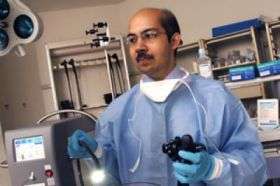
UT Southwestern Medical Center gastroenterologists are using a new method to freeze damaged cells in the esophagus, preventing them from turning cancerous.
The Food and Drug Administration-approved cryoablation therapy helps Barrett's esophagus patients with dysplasia, a condition in which normal cells are transformed into potentially cancerous ones.
"Due to damage from chronic stomach acid, they are people who have a higher risk of developing esophagus cancer," said Dr. Jayaprakash Sreenarasimhaiah, assistant professor of internal medicine in the division of digestive and liver disease at UT Southwestern. "The goal of this therapy is to literally freeze the damage in its tracks and stop it before it turns to cancer."
Gastroenterologists, using a special catheter, spray liquid nitrogen on the damaged tissue to freeze the superficial lining of the esophagus, the long tube that carries food from the throat to the stomach. The treated tissue eventually falls off, allowing normal cells to grow and replace the damaged cells in about six to eight weeks.
"Repeated treatments can actually help get rid of Barrett's esophagus with dysplasia and prevent the progression to cancer," said Dr. Sreenarasimhaiah, a gastroenterologist who specializes in endoscopic technology.
The minimally invasive cryoablation therapy has recently been approved by the FDA for treating Barrett's, but it requires special training and equipment available in only a handful of centers in Texas and a few dozen nationally.
Barrett's esophagus can result from ongoing heartburn, which allows a constant splashing of acid from the stomach into the esophagus. Untreated, it can become Barrett's with dysplasia, in which cells start to transform.
Typical treatment includes endoscopic mucosal resection (EMR), in which the damaged lining is scraped away, a procedure that takes hours and can have side effects such as bleeding or narrowing of the esophagus. The most aggressive approach includes surgery to remove damaged portions of the tube.
Some patients, however, are too sick or elderly to be candidates for surgery. Others simply want another option.
"This is a disease we see in a lot of older patients with other illnesses, so the decision to send them to surgery requires careful consideration," Dr. Sreenarasimhaiah said. "Cryoablation therapy is particularly attractive for older patients who may have complications or other medical issues – such as accompanying heart or lung diseases – that make traditional surgeries for Barrett's with dysplasia too risky."
Cryoablation therapy takes about 30 to 40 minutes and requires sedation. As with an endoscopy, a tube down the patient's throat is used to insert a tiny camera and instruments. No incisions are required.
Early results from studies show the therapy – similar to that used by dermatologists to freeze off warts – works well inside the esophagus, though further study is needed, Dr. Sreenarasimhaiah said.
"Patients may feel a little pain in the first couple of days, like a heartburn-type pain, but that starts to improve after a few days and after that they usually don't feel anything," he said. "They can eat immediately after they wake. They are not on a special diet, but they do continue their anti-reflux medications."
Source: UT Southwestern Medical Center


