Scientists determine strength of 'liquid smoke' with 3D images
July 29, 2008 Scientists determine strength of 'liquid smoke' with 3D images

Enlarge

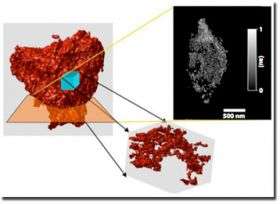
Section and isosurface rendering of a 500 nm cube from the interior of the 3D volume. The foam structure shows globular nodes that are interconnected by thin beam-like struts. Approximately 85% of the total mass is associated with the nodes, and there is no evidence of asignificant fraction of dangling fragments.

(PhysOrg.com) -- Researchers have created a 3D image of a material referred to as "liquid smoke." Aerogel, also known as liquid smoke or "San Francisco fog," is an open-cell polymer with pores smaller than 50 nanometers in diameter.

For the first time, Lawrence Livermore and Lawrence Berkeley scientists have peered into this material and created three-dimensional images to determine its strength and potential new applications.

Aerogel is a form of nanofoam, an engineered material designed for high strengh-to-weight ratio. Such nanofoam structires are also present in the fields of geology, phospholipids, cells, bone structure, polymers and structural materials, wherever lightness and strength are needed.

These mesoporous (2-50 nanometer-sized pores) crystalline materials can be used as catalysts for cleaner fuels and for the diffusion of water and oil in porous rocks. The structure and diffusion properties of nanofoams are determined by their structure.

Aerogels have the highest internal surface area per gram of material of any known materials because of its complicated, cross-linked internal structure. They also exhibit the best electrical, thermal and sound insulation properties of any known solid. It's not easy to see inside aerogel to determine the topology and structure at nanoscale-length scales because the smallest pore is normally too small to be observed internally by any conventional microscope.

But Livermore scientist Anton Barty and Lawrence Berkeley researcher and former LLNL scientist Stefano Marchesini were determined. They inverted coherent X-ray diffraction patterns to capture the three-dimensional bulk lattice arrangement of a micron-sized piece of aerogel.

"By imaging an isolated object at high resolution in three dimensions, we've opened the door to a range of applications in material science, nanotechnology and cellular biology," Barty said.

For about 20 years, Livermore has developed and improved aerogels for national security applications, synthesized electrically conductive inorganic aerogels for use as supercapacitors, and as a water purifier for extracting harmful contaminants from industrial waste or for desalinizing seawater, and even used aerogel to capture stardust particles during NASA's Stardust mission.

The new research shows that the lattice structure within aerogel is weaker than expected. The researchers saw a structure made up of nodes connected by thin beams.

"This blob and beam structure explains why these low-density materials are weaker than predicted and explains the high mass scaling exponent seen in the materials," Barty said.

In the future, the 3D analysis could be applied to other porous materials and could help modeling filtration problems such as oil and water in minerals, Barty said.

The research appears in the July 29 issue of the journal Physical Review Letters.

Provided by Lawrence Livermore National Laboratory


print this article email this article download pdf blog this article bookmark this article     Stumble it Digg this share on Facebook retweet share on Reddit add to delicious
Rate this story - 4.5 /5 (17 votes)

Rank Filter

Move the slider to adjust rank threshold, so that you can hide some of the comments.


Display comments: newest first

  • slh - Jul 29, 2008
    • Rank: 4.3 / 5 (3)
    how much does it cost (the aerogel, that is)?
  • Soylent - Jul 29, 2008
    • Rank: 4.7 / 5 (3)
    how much does it cost (the aerogel, that is)?


    Last I checked it was about $1000/lb.
  • gmurphy - Jul 30, 2008
    • Rank: 4 / 5 (3)
    whats that price in volume?
  • CaptSpaulding - Jul 30, 2008
    • Rank: 5 / 5 (3)
    whats that price in volume?


    depends greatly on the aerogel
  • cjameshuff - Jul 30, 2008
    • Rank: 5 / 5 (2)
    It's sometimes called "frozen smoke", sometimes called "solid smoke", but I have no idea why anyone would ever call a dry, brittle material "liquid smoke", nor have I ever seen that term used for aerogel.
  • YankInOz - Jul 30, 2008
    • Rank: 5 / 5 (2)
    Actually prices for Aerogel are dropping because of various applications and new methods of production. There is a company in Sweden that uses Aerogel as a "clear" insulator in roofing panels that are made of triple pane glass. I have more examples, if you'd like.

    Go to the NASA website and you will find it called "liquid smoke" - it has been called such for years. And it also refers to the process of production.

July 29, 2008 all stories

Comments: 6

4.5 /5 (17 votes)
  • Stumble this up

  • Digg this

  • share this

  • hide
  • Related Stories

  • Freezing: a phenomenon that 'jumps'
    created 2 hours ago | popularity not rated yet | comments 0
  • Researchers take the lead out of piezoelectrics
    created Nov 13, 2009 | popularity not rated yet | comments 0
  • New 'finFETs' promising for smaller transistors, more powerful chips
    created Nov 10, 2009 | popularity not rated yet | comments 0
  • Sculptured materials allow multiple channel plasmonic sensors
    created Nov 10, 2009 | popularity not rated yet | comments 0
  • Engineers image nanostructure of a solid acid catalyst and boost its catalytic activity
    created Nov 09, 2009 | popularity not rated yet | comments 0


  • hide
  • Relevant PhysicsForums posts

  • Semiconductor and p-n junction questions
    created 14 hours ago
  • How to differentiate conductors and semiconductors?
    created 22 hours ago
  • DOS of metallic CNTs
    created Nov 15, 2009
  • bloch oscillator
    created Nov 14, 2009
  • More from Physics Forums - Atomic, Solid State, Comp. Physics

Other News

Building a more versatile laser

Building a more versatile laser

Physics / Optics & Photonics

created 11 hours ago | popularity 4.4 / 5 (8) | comments 0

(PhysOrg.com) -- One of the drawbacks associated with using semiconductor lasers is that many of them can only produce a beam of a single wavelength, and can only send that beam in one direction at a time. ...


Engineer Discovers Why Particles Like Flour Disperse on Liquids

Engineer Discovers Why Particles Like Flour Disperse on Liquids

Physics / General Physics

created 2 hours ago | popularity 4.3 / 5 (6) | comments 0

(PhysOrg.com) -- Even if you are not a cook, you might have wondered why a pinch of flour (or any small particles) thrown into a bowl of water will disperse in a dramatic fashion, radiating outward as if it ...


Measuring Electron Orbitals

Measuring Electron Orbitals

Physics / General Physics

created 12 hours ago | popularity 5 / 5 (4) | comments 0

(PhysOrg.com) -- For the first time, it has been possible to measure electron density in individual molecular states using what is known as the photoelectric effect. Now published in Science, this method repres ...


Scientists demonstrate 'universal' programmable quantum processor

Scientists demonstrate 'universal' programmable quantum processor

Physics / Quantum Physics

created Nov 15, 2009 | popularity 4.6 / 5 (19) | comments 11

Physicists at the National Institute of Standards and Technology have demonstrated the first "universal" programmable quantum information processor able to run any program allowed by quantum mechanics -- th ...


Do we need dark matter?

Do we need dark matter?

Physics / General Physics

created Nov 12, 2009 | popularity 4.1 / 5 (18) | comments 33

It's the biggest problem in physics: the matter we can see in the universe accounts for just five per cent of the observed gravity that holds galaxies together.