'Hidden' Van Gogh painting revealed
July 30, 2008 'Hidden' Van Gogh Painting Revealed

Enlarge

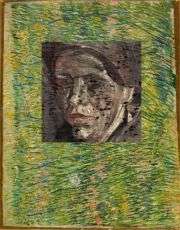
The analysis of the painting 'Patch of Grass' by Vincent Van Gogh by means of an advanced form of non-destructive X-ray analysis allowed to reveal in unprecedented detail the original portrait, also by Van Gogh, over which the landscape was painted. This development will greatly facilitate the study of other 'over painted' works of art in the future. Credit: DESY Hamburg

A new technique allows pictures which were later painted over to be revealed once more. An international research team, including members from Delft University of Technology (The Netherlands) and the University of Antwerp (Belgium), has successfully applied this technique for the first time to the painting entitled Patch of Grass by Vincent van Gogh. Behind this painting is a portrait of a woman.

It is well-known that Vincent van Gogh often painted over his older works. Experts estimate that about one third of his early paintings conceal other compositions under them. A new technique, based on synchrotron radiation induced X-ray fluorescence spectroscopy, reveals this type of hidden painting. The techniques usually used to reveal concealed layers of paintings, such as conventional X-ray radiography, have their limitations.

Together with experts from the Deutsches Elektronen-Synchrotron in Hamburg and the Kröller-Müller Museum, TU Delft materials expert and art historian Dr Joris Dik, and University of Antwerp chemistry professor Koen Janssens therefore chose to adopt a different approach. The painting is subjected to an X-ray bundle from a synchrotron radiation source, and the fluorescence of the layers of paint is measured.

This technique has the major advantage that the measured fluorescence is specific to each chemical element. Each type of atom (e.g. lead or mercury) and also individual paint pigments can therefore be charted individually. The benefit of using synchrotron radiation is that the upper layers of paint distort the measurements to a lesser degree. Moreover, the speed of measurement is high, which allows relatively large areas to be visualised.

Patch of grass

This method was applied to a painting by Vincent van Gogh. The work in question, Patch of Grass, was painted by Van Gogh in Paris in 1887 and is owned by the Kröller-Müller Museum. Previous research had already discovered the vague outline of a head behind the painting. It was scanned at the synchrotron radiation source DORIS at Deutsches Elektronen-Synchrotron DESY in Hamburg using an intense but very small X-ray bundle. Over the course of two days, the area covering the image of a woman's head was scanned, measuring 17.5 x 17.5 cm.

The measurements enabled researchers to reconstruct the concealed painting in unparalleled detail. In particular the combination of the distribution of the elements mercury and antimony (from specific paint pigments) provided a 'colour photo' of the portrait which had been painted over.

The reconstruction enables art historians to understand the evolution of Van Gogh's work better. The applied technique is expected to pave the way for research into many other concealed paintings.

The scientific article can be found at: http://pubs.acs.org/cgi-bin/abstract.cgi/ancham/asap/abs/ac800965g.html

Source: Delft University of Technology


print this article email this article download pdf blog this article bookmark this article     Stumble it Digg this share on Facebook retweet share on Reddit add to delicious
Rate this story - 4.8 /5 (17 votes)


July 30, 2008 all stories

Comments: 0

4.8 /5 (17 votes)
  • Stumble this up

  • Digg this

  • share this

  • hide
  • Related Stories

  • Darwin's Dinobird Fossil Analyzed at SLAC National Accelerator Laboratory
    created Dec 11, 2008 | popularity not rated yet | comments 0
  • Researchers detect fake art from originals
    created Jul 09, 2008 | popularity not rated yet | comments 0
  • Study finds simple recipe for ad success: Just add art
    created Feb 11, 2008 | popularity not rated yet | comments 0
  • Probing Question: Are artists born or taught?
    created Aug 17, 2007 | popularity not rated yet | comments 0
  • Universe will end with a bang, or a whimper, says Vatican astronomer
    created Jan 27, 2006 | popularity not rated yet | comments 0


Other News

Telling an old book by its smell: Aroma hints at ways of preserving treasured documents

Telling an old book by its smell: Aroma hints at ways of preserving treasured documents

Chemistry / Analytical Chemistry

created 10 hours ago | popularity not rated yet | comments 0

Scientists may not be able to tell a good book by its cover, but they now can tell the condition of an old book by its odor. In a report published in the American Chemical Society's Analytical Chemistry they d ...


H1N1 Virus Can Be Killed by Acidic Ozone Water

H1N1 Virus Can Be Killed by Acidic Ozone Water

Chemistry / Biochemistry

created Nov 09, 2009 | popularity 4.8 / 5 (22) | comments 10

(PhysOrg.com) -- Scientists have found that acidic ozone water can deactivate H1N1 viruses very effectively, offering a promising disinfectant for the millions of people trying to avoid the disease. Acidic ...


Toward home-brewed electricity with 'personalized solar energy'

Toward home-brewed electricity with 'personalized solar energy'

Chemistry / Materials Science

created Nov 04, 2009 | popularity 3.4 / 5 (9) | comments 5

New scientific discoveries are moving society toward the era of "personalized solar energy," in which the focus of electricity production shifts from huge central generating stations to individuals in their ...


New imagining technique could lead to better antibiotics and cancer drugs

Chemistry / Biochemistry

created Nov 09, 2009 | popularity 5 / 5 (4) | comments 0

A recently devised method of imaging the chemical communication and warfare between microorganisms could lead to new antibiotics, antifungal, antiviral and anti-cancer drugs, said a Texas AgriLife Research scientist.


Wet ethanol production process yields more ethanol and more co-products

Chemistry / Biochemistry

created Nov 09, 2009 | popularity 1 / 5 (1) | comments 1

Using a wet ethanol production method that begins by soaking corn kernels rather than grinding them, results in more gallons of ethanol and more usable co-products, giving ethanol producers a bigger bang for their buck - ...