July 30, 2008 feature
E-Textile Pants Identify Fall-Prone Elderly
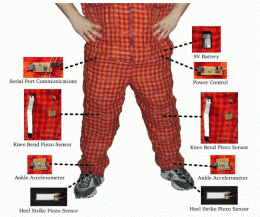
(PhysOrg.com) -- A pair of pants may help determine if elderly individuals have a high risk of slipping and falling by sensing fluctuations in their walking gait.
A Virginia Tech engineering team designed the pants in hopes that, by identifying individuals with a higher risk of falling, it may be possible to reduce the number of injuries associated with fall accidents. According to the Center for Disease Control, about one-third of adults age 70 and over fall every year, with one-fourth of these falls resulting in injuries.
“One of the main issues in developing a wearable system is making sure that people will wear it,” said Thurmon Lockhart, Associate Professor and Director of Locomotion Research Laboratory at Virginia Tech, to PhysOrg.com. “Comfort and technological innovation are keys for future designs of wearable systems.”
The e-textile pants are embedded with several e-TAGS, which are small printed circuit boards containing microcontrollers, sensors, and communication devices (designed by Electrical Engineering professors Tom Martin and Mark Jones of Virginia Tech). The researchers attached four e-TAGs with gyroscopes and accelerometers to each of an individual’s ankles and knees, as well as two e-TAGs with accelerometers to each hip. Also, each foot had a piezoelectric sensor attached to the heel that was connected to an e-TAG on the pants.
The set-up was powered by a 9-volt battery attached near the waist. During walking trials, the data collected by the e-TAGs was transmitted to a single Bluetooth e-TAG, which wirelessly transmitted the data to a host computer.
The researchers tested the feasibility of the pants by comparing measurements from a group of nine healthy individuals (young and old) and a group of four elderly individuals with a medical history of falling. The participants walked on a treadmill at various speeds as the sensors monitored local perturbations at the six joints.
These local instabilities – for example, ankle or knee movements that varied from step to step – differed between the healthy group and the group with a falling history. For two different parameters (angular velocity and vertical acceleration), the researchers determined which joints had significant instabilities at different walking speeds.
Overall, they found that local dynamic stability as measured by the pants varies significantly between the two groups, meaning that the pants can accurately differentiate individuals with a high risk for falling from their healthy counterparts. As the researchers explain, this local instability measurement may indicate how well the human motor control system can compensate for small perturbations between gait cycles, such as uneven surfaces or the individual’s own motor control error.
Because the pants are unobtrusive and can be connected to a remote health care facility, the technology could enable elderly individuals to live independently for longer, with the pants as a safeguard. When the pants detect instabilities in an individual’s gait, the system could notify both the health care facility and the individual, warning them to avoid potentially unsafe walking surfaces.
“In the future, the diagnostic power is going to increase for wearable systems, and may include checking blood pressure, blood oxygen levels, and more,” Lockhart said. “We’re also looking into other designs, such as jewelry which people can wear on the wrist and other small single-node systems.”
Lockhart added that the research team has begun working with several companies to try to bring the wearable sensor system to a reality, possibly in the next few years.
More information: Liu, Jian; Lockhart, Thurmon E.; Jones, Mark; and Martin, Tom. “Local Dynamic Stability Assessment of Motion Impaired Elderly Using Electronic Textile Pants.” IEEE Transactions on Automation Science and Engineering. To be published.
Copyright 2008 PhysOrg.com.
All rights reserved. This material may not be published, broadcast, rewritten or redistributed in whole or part without the express written permission of PhysOrg.com.


