Toolbox
  • User rankingRating: 4.6
  • Add to favoritesBookmark
  • Save as PDFSave as PDF
  • PrintPrint
  • EmailEmail
  • Blog ItBlog It
  • Stumble ItStumble It!
Digg It Reddit del.icio.us Save to Yahoo! bookmarks Save to Windows live Share on facebook Save to MySpace Slashdot it science news feed Add to google
- size +

Prelude to the Higgs: A work for 2 bosons in the key of Z
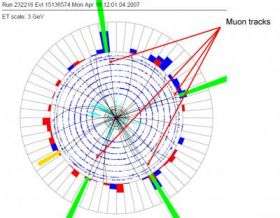
One of the three ZZ events recorded by the DZero experiment at Fermilab: each Z boson decayed into a pair of high-energy muons yielding four muon tracks in the DZero detector. The green bars indicate the energy associated with each muon. Credit: Ferm ...
One of the three ZZ events recorded by the DZero experiment at Fermilab: each Z boson decayed into a pair of high-energy muons, yielding four muon tracks in the DZero detector. The green bars indicate the energy associated with each muon. Credit: Fermilab

Scientists of the DZero collaboration at the US Department of Energy's Fermilab have announced the observation of pairs of Z bosons, force-carrying particles produced in proton-antiproton collisions at the Tevatron, the world's highest-energy particle accelerator. The properties of the ZZ diboson make its discovery an essential prelude to finding or excluding the Higgs boson at the Tevatron.
The observation of the ZZ, announced at a Fermilab seminar on July 25, connects to the search for the Higgs boson in several ways. The process of producing the ZZ is very rare and hence difficult to detect.

The rarest diboson processes after ZZ are those involving the Higgs boson, so seeing ZZ is an essential step in demonstrating the ability of the experimenters to see the Higgs. The signature for pairs of Z bosons can also mimic the Higgs signature for large values of the Higgs mass. For lower Higgs masses, the production of a Z boson and a Higgs boson together, a ZH, makes a major contribution to Higgs search sensitivity, and the ZZ shares important characteristics and signatures with ZH.

The ZZ is the latest in a series of observations of pairs of the so-called gauge bosons, or force-carrying particles, by DZero and its sister Tevatron experiment, CDF. The series began with the study of the already rare production of W bosons plus photons; then Z bosons plus photons; then observation of W pairs; then WZ. The ZZ is the most massive combination and has the lowest predicted likelihood of production in the Standard Model. Earlier this year, CDF found evidence for ZZ production; the DZero results presented on Friday for the first time showed sufficient significance, well above five standard deviations, to rank as a discovery of ZZ production.

"Final analysis of the data for this discovery was done by a thoroughly international team of researchers including scientists of American, Belgian, British, Georgian, Italian and Russian nationalities," said DZero cospokesperson Darien Wood. "They worked closely and productively together to achieve this challenging and exciting experimental result."

DZero searched for ZZ production in nearly 200 trillion proton-antiproton collisions delivered by the Tevatron. Scientists used two analyses that look for Z decays into different combinations of secondary particles. One analysis looked for one Z decaying into electrons or muons, the other decaying into "invisible" neutrinos.

The neutrino signature is challenging experimentally, but worthwhile because it is more plentiful. In the even rarer mode, both Z bosons decay to either electrons or muons. Just three events were observed in this mode, but the signature is remarkably distinctive, with an expected background of only two tenths of one event.

Source: Fermi National Accelerator Laboratory
» Next Article in Physics - Physics: Scientists find quick method to make magnets

would you recommend this story?


User Rating

4.6 out of 5 after 40 total votes
  • not at all
  • 1
  • 2
  • 3
  • 4
  • 5
  • highly

Leave a Comment or

Rank filter

Move the slider to adjust rank threshold, so that you can hide some of the comments.
Posted by jburchel 07/30/08 16:34
Rank: 5/5 after 1 vote
Key of Z?
Posted by D666 07/30/08 18:07
Rank: 5/5 after 1 vote
Small joke. Very small.
Posted by googleplex 07/30/08 19:01
Rank: 3/5 after 2 votes
Wouldn't it be funny if Tevatron found Higgs before the LHC starts operating. Sure would pop a lot of physicists bubbles, not to mention wasting research $$$'s.
Posted by LeeSawyer 07/31/08 07:47
Rank: 4/5 after 3 votes
@googleplex As a physicist working on this experiment (D0) and the ATLAS experiment at LHC, I can assure you that it would please me to no end if we found the Higgs at the Tevatron first. Rather than bursting any bubbles, it would make me extremely proud as an American and provide a little payback over the SSC. The LHC would still provide precision measurements of the Higgs, as well as searching for evidence of a larger theory like supersymmetry.
Posted by googleplex 07/31/08 11:35
Rank: 5/5 after 1 vote
@googleplex As a physicist working on this experiment (D0) and the ATLAS experiment at LHC, I can assure you that it would please me to no end if we found the Higgs at the Tevatron first. Rather than bursting any bubbles, it would make me extremely proud as an American and provide a little payback over the SSC. The LHC would still provide precision measurements of the Higgs, as well as searching for evidence of a larger theory like supersymmetry.

Firstly thank you for your time in working on moving physics forward. Secondly for not selling out like myself and so many other ex-physics students. We need to pay research physicists alot more to address the attrition into private industry.
I was musing whether LHC is over-hyped? I read that it only boosts energy of Tevatron by factor of 7. Yet I never hear about Tevatron in the main stream press even though it keeps cranking out results. LHC has improvements in sensing. However isn't the limiting factor the number of particle physicists available to analyze the scattering images? The amount of data must be tremendous. Perhaps nowadays the pattern recognition is automated instead of eyeballing electronic cloud chamber pictures.