Research shows how insects use trapped oxygen to breathe underwater
July 30, 2008
Research shows how insects use trapped oxygen to breathe underwater

Enlarge

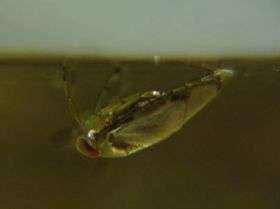
The backswimmer Notonecta hangs inverted from the water's surface. Its respiratory bubble covers the bulk of its body. Photo / John Bush and Morris Flynn

(PhysOrg.com) -- Hundreds of insect species spend much of their time underwater, where food may be more plentiful. MIT mathematicians have now figured out exactly how those insects breathe underwater.

By virtue of their rough, water-repellent coat, when submerged these insects trap a thin layer of air on their bodies. These bubbles not only serve as a finite oxygen store, but also allow the insects to absorb oxygen from the surrounding water.

"Some insects have adapted to life underwater by using this bubble as an external lung," said John Bush, associate professor of applied mathematics, a co-author of the recent study.

Thanks to those air bubbles, insects can stay below the surface indefinitely and dive as deep as about 30 meters, according to the study co-authored by Bush and Morris Flynn, former applied mathematics instructor. Some species, such as Neoplea striola, which are native to New England, hibernate underwater all winter long.

This phenomenon was first observed many years ago, but the MIT researchers are the first to calculate the maximum dive depths and describe how the bubbles stay intact as insects dive deeper underwater, where pressure threatens to burst them.

The new study, which appears in the Aug. 10 issue of the Journal of Fluid Mechanics, shows that there is a delicate balance between the stability of the bubble and the respiratory needs of the insect.

The air bubble's stability is maintained by hairs on the insects' abdomen, which help repel water from the surface. The hairs, along with a waxy surface coating, prevent water from flooding the spiracles--tiny breathing holes on the abdomen.

The spacing of these hairs is critically important: The closer together the hairs, the greater the mechanical stability and the more pressure the bubble can withstand before collapsing.

However, mechanical stability comes at a cost. If the hairs are too close together, there is not enough surface area through which to breathe.

"Because the bubble acts as an external lung, its surface area must be sufficiently large to facilitate the exchange of gases," said Flynn, who is now an assistant professor of mechanical engineering at the University of Alberta.

The researchers developed a mathematical model that takes these factors into account and allows them to predict the range of possible dive depths. They found that there is not only a maximum depth beyond which the bubble collapses, but a minimum depth above which the bubble cannot meet the insect's respiratory needs.

Though the researchers found that the insects can go as deep as 30 meters below the surface, they rarely venture deeper than several meters, due to environmental factors such as amount of sunlight, availability of prey and the presence of predators.

The researchers first took an interest in the external lung phenomenon when they accidentally captured one of the underwater breathers while looking for water striders. A few years ago, Bush and colleagues figured out how the striders use surface tension to glide across the water's surface.

Other researchers have explored systems that could replicate the external lung on a larger scale, for possible use by diving humans. A team at Nottingham Trent University showed that a porous cavity surrounded by water-repellent material is supplied with oxygen by the thin air layer on its surface. The surface area required to support human respiration is impractically large, in excess of 100 square meters; however, other avenues for technological application exist. For example, such a device could supply the oxygen needed by fuel cells to power small autonomous underwater vehicles.

Provided by MIT

4.3 /5 (9 votes)  

Rank 4.3 /5 (9 votes)
Related Stories
Relevant PhysicsForums posts
  • Probability Question - Chances Of Meeting Again
    created6 hours ago
  • Young Diagrams
    created13 hours ago
  • transforming from polar to parametric functions
    created13 hours ago
  • Validity of proof method -- error in book?
    created15 hours ago
  • Finding intersections
    createdFeb 11, 2012
  • Interpreting a function based on it's equation.
    createdFeb 11, 2012
  • More from Physics Forums - General Math

More news stories

Putting the magic into maths

Queen Mary, University of London has developed a new educational resource for teachers to help students use amazing magic tricks to learn about maths.

Other Sciences / Mathematics

created 57 minutes ago | popularity not rated yet | comments 0

New basal beaked ornithurine bird found from the lower cretaceous of Western Liaoning, China

Based on a well-preserved specimen from the Lower Cretaceous Jiufotang Formation in Jianchang, western Liaoning, China, Paleontologists of Institute of Vertebrate Paleontology and Paleoanthropology (IVPP), ...

Other Sciences / Archaeology & Fossils

created 6 minutes ago | popularity not rated yet | comments 0

Australian women reject 'I love u' texts

Australian women may have embraced the digital era, but they prefer a face-to-face declaration of affection to an "I love u" text and find men addicted to their mobile phones a major turnoff.

Other Sciences / Social Sciences

created 4 hours ago | popularity 1 / 5 (1) | comments 1

A frank discussion of the power law and linking correlation to causation

(PhysOrg.com) -- Michael Stumpf a mathematics professor at Imperial College in London, and Mason Porter a lecturer at Oxford have teamed together to write and publish a perspective piece in Science regarding the in ...

Other Sciences / Mathematics

created Feb 10, 2012 | popularity 5 / 5 (5) | comments 11 | with audio podcast report

US workers are 'giving away the store,' costing firms billions

Nearly 70 percent of the nation's service employees give away free goods and services – from hamburgers to cable TV – costing companies billions of dollars a year, according to a groundbreaking study.

Other Sciences / Economics & Business

created Feb 09, 2012 | popularity 3 / 5 (5) | comments 11


Researchers make better heat sensor based on butterfly wings

(PhysOrg.com) -- Scientists have long known that butterfly wings produce their iridescent colors by bouncing light around and between tiny ridges in structures made of chitin. More recently they’ve discovered ...

Manipulating genes with hidden TALENs

(PhysOrg.com) -- A better understanding of gene function in model plant and animal systems could be used to develop useful traits in livestock and crop plants, and might someday lead to developments in stem ...

Alien matter in the solar system: A galactic mismatch

This just in: The Solar System is different from the space just outside it.

Transforming galaxies

(PhysOrg.com) -- Many of the Universe's galaxies are like our own, displaying beautiful spiral arms wrapping around a bright nucleus. Examples in this stunning image, taken with the Wide Field Camera 3 on ...

'Smart' microcapsules in a single step

(PhysOrg.com) -- A new, single-step method of fabricating microcapsules, which have potential commercial applications in industries including medicine, agriculture and diagnostics, has been developed by researchers ...

Don't ignore kids' snores

(Medical Xpress) -- Your ears aren’t playing tricks on you – that is the sound of snoring you hear from the bedroom of your preschooler. Snoring is common in children, but in some cases it can be a symptom of a ...