Researchers root out new and efficient crop plants
July 30, 2008 Researchers root out new and efficient crop plants

Enlarge

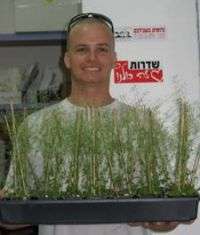
TAU doctoral student Tal Sherman. Credit: American Friends of Tel Aviv University

A part of the global food crisis is the inefficiency of current irrigation methods. More irrigated water evaporates than reaches the roots of crops, amounting to an enormous waste of water and energy.

Tel Aviv University researchers, however, are investigating a new solution that turns the problem upside-down, getting to the root of the issue. They are genetically modifying plants' root systems to improve their ability to find the water essential to their survival.

When it comes to water, every drop counts. "Improving water uptake by irrigated crops is very important," says Prof. Amram Eshel, the study's co-researcher from Tel Aviv University's Plant Sciences Department. His team, with that of Prof. Hillel Fromm, hope to engineer a plant that takes advantage of a newly discovered gene that controls hydrotropism, a plant's ability to send its roots towards water.

Scientists in TAU's lab are observing plants that are grown on moist air in the University's lab, making it possible to investigate how the modified plant roots orient themselves towards water. Until now, aeroponics (a method of growing plants in air and mist) was a benchtop technique used only in small-scale applications. The current research is being done on the experimental model plant Arabidopsis, a small flowering plant related to cabbage and mustard.

"Our aim is to save water," explains Prof. Eshel. "We are increasing a plant's efficiency for water uptake. Plants that can sense water in a better fashion will be higher in economic value in the future."

There can be significant water-saving consequences for farmers around the world. "We are developing plants that are more efficient in sensing water," says research doctoral student Tal Sherman, who is working under Prof. Amram Eshel and Prof. Hillel Fromm. The project is funded by a grant from the Israeli Ministry of Agriculture and Rural Development to Prof. Fromm and Prof. Eshel.

In the nineteenth century, scientists were already observing that plant roots naturally seek out the wetter regions in soil.

Although the phenomenon is well documented, scientists until recently had no clue as to how the mechanism worked, or how to make it better. New insights from the Tel Aviv University study could lead to plants that are super water seekers, say researchers.

Source: American Friends of Tel Aviv University


print this article email this article download pdf blog this article bookmark this article     Stumble it Digg this share on Facebook retweet share on Reddit add to delicious
Rate this story - 4.3 /5 (3 votes)


July 30, 2008 all stories

Comments: 0

4.3 /5 (3 votes)
  • Stumble this up

  • Digg this

  • share this

  • hide
  • Related Stories

  • New technology being developed for use in Jordan desalination plant
    created Aug 19, 2009 | popularity not rated yet | comments 0
  • Desert rhubarb -- a self-irrigating plant
    created Jul 01, 2009 | popularity not rated yet | comments 0
  • The cosmos is green: Researchers catch nature in the act of 'recycling' a star (w/Animations)
    created May 21, 2009 | popularity not rated yet | comments 0
  • Study first to show evolution's impact on ecosystems
    created Apr 01, 2009 | popularity not rated yet | comments 0
  • Turning over a new leaf for future energy supplies
    created Dec 15, 2008 | popularity not rated yet | comments 0


Other News

Scientists successfully reprogram blood cells

Biology / Cell & Microbiology

created 12 hours ago | popularity 5 / 5 (2) | comments 0

Researchers have transplanted genetically modified hematopoietic stem cells into mice so that their developing red blood cells produce a critical lysosomal enzyme -preventing or reducing organ and central nervous system damage ...


Iowa State University researcher discovers key to vital DNA, protein interaction

Researchers discover key to vital DNA, protein interaction

Biology / Other

created 7 hours ago | popularity not rated yet | comments 0

(PhysOrg.com) -- A researcher at Iowa State University has discovered how a group of proteins from plant pathogenic bacteria interact with DNA in the plant cell, opening up the possibility for what the scientist ...


Study shows that some malignant tumors can be shut down after all

Biology / Cell & Microbiology

created 15 hours ago | popularity 5 / 5 (4) | comments 0

Oncologists have had their hands tied because more than half of all human cancers have mutations that disable a protein called p53. As a critical anti-cancer watchdog, p53 masterminds several cancer-fighting operations within ...


UK starts study on using human DNA in animals

Biology / Biotechnology

created 8 hours ago | popularity 5 / 5 (1) | comments 0

(AP) -- British scientists begin a new study on Tuesday to consider how human DNA is used in animal experiments and to determine what the boundaries of such controversial science might be.


New discovery allows scientists for the first time to experimentally annotate genomes

New discovery allows scientists for the first time to experimentally annotate genomes

Biology / Biotechnology

created 10 hours ago | popularity 5 / 5 (3) | comments 0

Over the last 20 years, the sequencing of the human genome, along with related organisms, has represented one of the largest scientific endeavors in the history of mankind. The information collected from genome ...