Viterbi Algorithm goes quantum
July 31, 2008
How Bob Detects Possible Errors in the Coding of Alice's Message

Enlarge

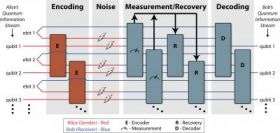
Alice would like to transmit a stream of quantum information to Bob. She shares entanglement in the form of ebits before quantum communication begins. Red qubits belong to Alice and blue qubits belong to Bob. She repeatedly performs a series of encoding operations and transmits her qubits as soon as they are encoded. The noisy quantum communication channel corrupts her transmitted qubits. Bob receives her qubits and combines them with his half of the ebits. He performs measurements and Viterbi processing of the measurement results to diagnose the channel errors and performs recovery operations based on the results of the Viterbi algorithm. He then performs a decoding circuit and finally possesses the qubits that Alice first sent. Credit: USC Viterbi School of Engineering

The Viterbi Algorithm, the elegant 41-year-old logical tool for rapidly eliminating dead end possibilities in data transmission, has a new application to go alongside its ubiquitous daily use in cell phone communications, bioinformatics, speech recognition and many other areas of information technology.

In a recent set of papers two investigators from the University of Southern California school that bears the name of the algorithm's inventor say it can play a key role in quantum communication.

Mark Wilde, a graduate student in the USC Viterbi School of Engineering, collaborated with his faculty advisor Todd Brun on the work. The research is also his thesis, for which he will receive a PhD from the School's Ming Hsieh Department of Electrical Engineering in August.

Brun, an associate professor in the Hsieh Department, is also deputy director of the USC Center for Quantum Information Science & Technology.

The quantum communication applications Wilde and Brun explored are for an environment in which a sender "Alice" (the traditional sender name) is trying to send a quantum message to a receiver named (again by tradition) "Bob" using a stream of pairs of "entangled" photons.

"Such [entangled] photons," in the words of the recent New Scientist story, "obey the strange principles of quantum physics, whereby disturbing the state of one will instantly disturb the other, no matter how much distance there is in between them."

Use of such a system has been proposed for a variety of uses, including space based communication, and progress is being made on the physical devices that might create entanged photons for messages. But noise is created in the transmission of quantum data, an issue the USC work addresses using the time-hallowed Viterbi algorithm.

In the system considered by Wilde and Brun, Alice encodes each quantum bit of the message with the help of an ebit, an entangled qubit. She sends her part of the encoded quantum message over a noisy quantum communication channel, a process that can introduce errors.

From his side, Bob receives what Alice sent and combines her transmitted qubits with his half of the ebits. He measures all of the qubits, processes the results of the measurements, performs recovery operations, and finally decodes them, receiving the message qubits Alice sent. At the conclusion of the process Bob will have the transmitted quantum information error-free.

The above description is a condensed and simplified paraphrase of what is in fact a much more complex process, a ballet in which Alice and Bob can exploit ancilla or helper qubits, gauge or noisy qubits, and ebits to transmit both quantum and classical information.

But the bottom line question coming out remains, how does Bob know that the dancers were following the music, that the message he now has was transmitted correctly?

The fact that the noisy quantum communication channel can be modeled as a sequential process of steps, each step of which changes the state of the system, offers an opening. The Viterbi algorithm is, precisely, a way of analyzing the products of such progressions, called "Markov processes."

In Wilde and Brun's analysis, Bob watches the step coming out of his measurement process, testing them against statistical probabilities, using standard Viterbi tools.

Cell phones use similar programming to correct for errors in the transmission of digital voice data.

The result: Bob can reliably spot errors, and knows which message qubits are bogus before he opens the message - crucial, because opening it destroys it; and if it is garbled, he has nothing.

References:

M.M. Wilde and T.A. Brun, "Unified quantum convolutional coding," in IEEE International Symposium on Information Theory (arXiv:0801.0821), July 2008.

M.M. Wilde, Quantum Coding with Entanglement, Ph.D. Thesis, University of Southern California, arXiv:0806.4214, August 2008.

M.M. Wilde and T.A. Brun, Quantum convolutional coding with shared entanglement: general structure, submitted to IEEE Transactions on Information Theory (arxiv:0807.3803), 2007.

M.M. Wilde and T.A. Brun, Entanglement-Assisted Quantum Convolutional Coding, submitted to IEEE Transactions on Information Theory (arXiv:0712.2223), 2007.

M.M. Wilde, H. Krovi and T.A. Brun, Convolutional Entanglement Distillation, submitted to IEEE Transactions on Information Theory (arxiv:0708.3699), 2007.

Source: University of Southern California

4.8 /5 (11 votes)  

Rank 4.8 /5 (11 votes)
Relevant PhysicsForums posts

More news stories

Rapunzel, Leonardo and the physics of the ponytail

(PhysOrg.com) -- New research provides the first mathematical understanding of the shape of a ponytail and could have implications for the textile industry, computer animation and personal care products.

Physics / General Physics

created 2 hours ago | popularity 4 / 5 (1) | comments 0 | with audio podcast

Explained: Sigma

It's a question that arises with virtually every major new finding in science or medicine: What makes a result reliable enough to be taken seriously? The answer has to do with statistical significance -- but ...

Physics / General Physics

created Feb 09, 2012 | popularity 5 / 5 (21) | comments 87

Quantum physicist explains $100K offer for proof scaled-up quantum computing is impossible

(PhysOrg.com) -- MIT researcher Scott Aaronson has certainly riled the physics community with his offer this past Friday, of $100,000 to anyone who can prove that scaled-up quantum computing is impossible. ...

Physics / Quantum Physics

created Feb 08, 2012 | popularity 4.3 / 5 (15) | comments 37 | with audio podcast weblog

Hovering not hard if you're top-heavy, researchers find

Top-heavy structures are more likely to maintain their balance while hovering in the air than are those that bear a lower center of gravity, researchers at New York University's Courant Institute of Mathematical Sciences ...

Physics / General Physics

created Feb 10, 2012 | popularity 5 / 5 (4) | comments 5 | with audio podcast

Physicists build highly efficient 'no-waste' laser

A team of University of California, San Diego researchers has built the smallest room-temperature nanolaser to date, as well as an even more startling device: a highly efficient, "thresholdless" laser that ...

Physics / General Physics

created Feb 08, 2012 | popularity 4.9 / 5 (21) | comments 5 | with audio podcast


New molecule has potential to help treat genetic diseases and HIV

(PhysOrg.com) -- Chemists at The University of Texas at Austin have created a molecule that's so good at tangling itself inside the double helix of a DNA sequence that it can stay there for up to 16 days before ...

Social psychologist: Lust makes you smarter and evidence that seven deadly sins are good for you

(Medical Xpress) -- Good news for lovers on Valentine’s Day - the seven deadly sins, including Lust, are good for you. University of Melbourne social psychologist Dr Simon Laham uses modern research to make a compelling ...

The joy of cheques

An electronic cheque which eliminates the need for costly processing by banks but preserves the simplicity and ease of a traditional cheque book has been designed by a team of academics in the UK.

Research shows promise in converting camelina oil into jet fuel

(PhysOrg.com) -- Researchers at Montana State University-Northern have developed a process to convert camelina oil to jet fuel and other high-value chemicals. MSU has applied for a U.S. patent and research is ongoing.

Researchers make breakthrough in stem cell research

(Medical Xpress) -- University of Queensland scientists have developed a world-first method for producing adult stem cells that will substantially impact patients who have a range of serious diseases.

Georgia Tech develops software for the rapid analysis of foodborne pathogens

2011 brought two of the deadliest bacterial outbreaks the world has seen during the last 25 years. The two epidemics accounted for more than 4,200 cases of infectious disease and 80 deaths. Software developed at Georgia Tech ...