Exercise in a Pill
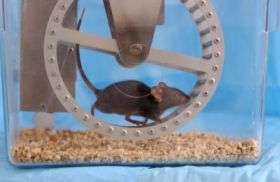
Trying to reap the health benefits of exercise? Forget treadmills and spin classes, researchers at the Salk Institute for Biological Studies may have found a way around the sweat and pain. They identified two signaling pathways that are activated in response to exercise and converge to dramatically increase endurance.
The team of scientists, led by Howard Hughes Medical Investigator Ronald M. Evans, Ph.D., a professor in the Salk Institute's Gene Expression Laboratory report in the July 31 advance online edition of the journal Cell that simultaneously triggering both pathways with oral drugs turned laboratory mice into long-distance runners and conferred many of exercise's other benefits.
In addition to their allure for endurance athletes, drugs that mimic the effects of exercise have therapeutic potential in treating certain muscle diseases, such as wasting and frailty, hospital patients unable to exercise, veterans and others with disabilities as well as obesity and a slew of associated metabolic disorders where exercise is known to be beneficial.
Previous work with genetically engineered mice in the Evans lab had revealed that permanently activating a genetic switch known as PPAR delta turned mice into indefatigable marathon runners. In addition to their super-endurance, the altered mice were resistant to weight gain, even when fed a high-fat diet that caused obesity in ordinary mice. On top of their lean and mean physique, their response to insulin improved, lowering levels of circulating glucose.
"We wanted to know whether a drug specific for PPAR delta would have the same beneficial effects," says Evans. "Genetic engineering in humans, commonly known as gene doping when mentioned in connection with athletic performance, is certainly feasible but very impractical."
An investigational drug, identified only as GW1516 (and not commercially available), fit the bill. When postdoctoral researcher and lead author Vihang A. Narkar, Ph.D., fed the substance to laboratory mice over a period of four weeks, the researchers were in for a surprise.
"We got the expected benefits in lowering fatty acids and blood glucose levels but no effect, absolutely none, on exercise performance," says Narkar. Undeterred, he put mice treated with GW1516 on a regular exercise regimen and every day had them run up to 50 minutes on a treadmill.
Now the exact same drug that had shown no effect in sedentary animals improved endurance by 77 percent over exercise alone and increased the portion of "non-fatiguing" or "slow twitch" muscle fibers by 38 percent. The result, while very dramatic, gave rise to a vexing question: Why is exercise so important?
First and foremost, exercise depletes muscles' energy store, a chemical known as ATP. In times of high demand, ATP releases all its energy and forms AMP. Rising AMP levels alert AMPK, a metabolic master regulator, which acts like a gas gauge that the cell is running on empty and revs up the production of ATP. "That led us to consider whether AMPK activation was the critical trigger that allowed PPAR delta to work," recalls Narkar.
Usually, AMPK can be found in the cytoplasm, the compartment that surrounds the nucleus, but the Salk researchers' experiment revealed that some exercise-activated AMPK molecules slip into the nucleus. There they physically interact with PPAR delta and increase its ability to turn on the genetic network that increases endurance.
"It essentially puts a turbo charge on PPAR delta, which explains why exercise is so important," says Evans.
Then came the ultimate couch potato experiment. The researchers fed untrained mice AICAR, a synthetic AMP analog that directly activates AMPK. After only four weeks and without any prior training, these mice got up and ran 44 percent longer than untreated, untrained mice. "That's as much improvement as we get with regular exercise," says Narkar.
"Exercise in a pill" might sound tempting to couch potatoes and Olympic contenders alike, but the dreams of the latter might be cut short. Evans developed a test that can readily detect GW1516 and its metabolites as well as AICAR in blood and urine and is already working with officials at the World Anti-Doping Association, who are racing to have a test in place in time for this year's Summer Olympics.
Source: Salk Institute


