Dust and gas in the early universe
July 31, 2008
A Cosmic Rosetta Stone

Enlarge

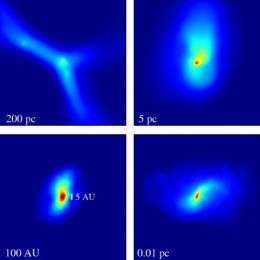
The computer simulation designed by Dr. Yoshida et al. demonstrates how gas and dust came together in the early universe to form the first stars after the Big Bang. Photo provided by Dr. Naoki Yoshida of Nagoya University in Japan via Science-AAAS

Researchers believe that our universe began with the Big Bang about 13 billion years ago, and that soon after that event, matter began to form as small dust grains and gases. How the first stars formed from this dust and gas has been a burning question for years, but a state-of-the-art computer simulation now offers the most detailed picture yet of how these first stars in the universe came into existence, researchers say.

These findings will be published by the journal Science on Friday, 1 August.

The composition of the early universe was quite different from that of today, and the physics that governed the early universe were also somewhat simpler. Dr. Naoki Yoshida and colleagues in Japan and the U.S. incorporated these conditions of the early universe, sometimes referred to as the "cosmic dark ages," to simulate the formation of an astronomical object that would eventually shine its light into this darkness.

The result is a detailed description of the formation of a protostar -- the early stage of a massive primordial star of our universe -- and the researchers' computer simulation, which has been called a "cosmic Rosetta Stone," sets the bar for further investigation into the star formation process. The question of how the first stars evolved is so important because their formations and eventual explosions provided the seeds for subsequent stars to come into being.

According to their simulation, gravity acted on minute density variations in matter, gases, and the mysterious "dark matter" of the universe after the Big Bang in order to form this early stage of a star -- a protostar with a mass of just one percent of our sun. The simulation reveals how pre-stellar gases would have actually evolved under the simpler physics of the early universe to form this protostar. Dr. Yoshida's simulation also shows that the protostar would likely evolve into a massive star capable of synthesizing heavy elements, not just in later generations of stars, but soon after the Big Bang.

"This general picture of star formation, and the ability to compare how stellar objects form in different time periods and regions of the universe, will eventually allow investigation into the origins of life and planets," said Lars Hernquist, a Professor of Astronomy at Harvard University and a co-author of this latest report. "The abundance of elements in the universe has increased as stars have accumulated," he says, "and the formation and destruction of stars continues to spread these elements further across the universe. So when you think about it, all of the elements in our bodies originally formed from nuclear reactions in the centers of stars, long ago."

Their simulation of the birth of a protostar in the early universe signifies a key step toward the ambitious goal of piecing together the formation of an entire primordial star and of predicting the mass and properties of these first stars of the universe. More powerful computers, more physical data, and an even larger range will be needed for further calculations and simulations, but these researchers hope to eventually extend this simulation to the point of nuclear reaction initiation -- when a stellar object becomes a true star.

"Dr. Yoshida has taken the study of primordial star formation to a new level with this simulation, but it still gets us only to the halfway point towards our final goal. It is like laying the foundation of a skyscraper," said Volker Bromm, Assistant Professor of Astronomy at the University of Texas, Austin and the author of a companion article. "We must continue our studies in this area to understand how the initially tiny protostar grows, layer by layer, to eventually form a massive star. But here, the physics become much more complicated and even more computational resources are needed."

Source: American Association for the Advancement of Science

4.5 /5 (14 votes)  

Filter


Move the slider to adjust rank threshold, so that you can hide some of the comments.


Display comments: newest first

vidyunmaya
Aug 06, 2008

Rank: 1 / 5 (1)
SUB: BIG BANG IN QUESTION- DARK ENERGY UNDEFINED
Why not search Cosmology with proper Comprehension. New Knowledge dawns.
COSMOLOGY DEFINITION:
Cosmology is a borderland between science and Philosophy
Cosmology deals with Multi-Universe concepts and the Universe as part of Cosmos.
Cosmology details Creation, stability and dissolution of the Universe or parts thereof.
Cosmology covers broad Prime drive functions and links :
COSMOLOGY FROM PHILOSOPHY TO VEDAS
1. Cosmology in Vedas 2.Cosmology in Philosophy 3.Science of Philosophy
4. Basic Philosophy
FROM SCIENCE TO COSMOLOGY
1. Basic Science 2. Philosophy of Science 3.Cosmogony-Astrophysics
4. Cosmology -Present Day under Revision
NATURE TO COSMIC DIVINE
1.Nature 2.Divine Function in Nature 3. Divine Universe 4.Cosmos Divine

Key Words: Cosmology Definition, Cosmology Primer, Cosmology Drive,
Cosmology Science, cosmology Vedas, Cosmology Philosophy, Cosmology Nature,
Cosmic Divine Function, Cosmology interlinks, Cosmology Space Science,
Cosmology Knowledge Base, Knowledge Expansion, creation in the Universe,
Stability of the Universe , Dissolution of the part of the Universe
Ref:COSMIC YOGA VISION SERIES-II:
Heart of the Universe-Nov 2006 -Book By Vidyardhi Nanduri
Copy Rights TXU 1-364-245 -
The Science in Philosophy- Pridhvi Viswam Asya Dharineem Cosmos yoga vision series-II-
cover upto 10^5 Light Years %u2014 Centre of the Universe [Vidyardhi Nanduri]
Dynamic Universe beyond the Centre of the Universe introduces new concepts as well
COSMOLOGY VEDAS-Interlinks-FREE DOWNLOAD : http://www.buymye...kId=1422
http://www.earthp...ri3.html
Rank 4.5 /5 (14 votes)
Relevant PhysicsForums posts
  • Never ending outer space.....
    created8 hours ago
  • Neutron Star fragments?
    created10 hours ago
  • stationary or not?
    created14 hours ago
  • Scale of the Universe
    createdFeb 10, 2012
  • Titan's lack of impact craters
    createdFeb 09, 2012
  • Real pictures of black hole eating a star?
    createdFeb 08, 2012
  • More from Physics Forums - General Astronomy

More news stories

Latin America mining boom clashes with conservation

Latin America is experiencing a mining boom as prices rise fuelled by a hike in global demand, but the region is also being hit by a wave of violent protests, strikes and rallies by environmentalists.

Space & Earth / Environment

created 1 hour ago | popularity not rated yet | comments 0

Europe stakes billion-dollar bet on new rocket

A pencil-slim rocket is scheduled to lift into space from South America on Monday, carrying a billion-dollar bet that Europe can grab a juicy slice of the market to place satellites in low orbit.

Space & Earth / Space Exploration

created 21 hours ago | popularity 4 / 5 (3) | comments 0

Political leaders play key role in how worried Americans are by climate change: study

More than extreme weather events and the work of scientists, it is national political leaders who influence how much Americans worry about the threat of climate change, new research finds.

Space & Earth / Environment

created Feb 06, 2012 | popularity 5 / 5 (6) | comments 72

NASA budget will axe Mars deal with Europe: scientists

US President Barack Obama's budget proposal to be submitted next week for 2013 will cut NASA's budget by 20 percent and eliminate a major partnership with Europe on Mars exploration, scientists said Thursday.

Space & Earth / Space Exploration

created Feb 10, 2012 | popularity 5 / 5 (3) | comments 55

Humans may have helped the decline of African rainforests 3000 years ago

(PhysOrg.com) -- Large areas of rainforests in Central Africa mysteriously disappeared over three thousand years ago, to be replaced by savannas. The prevailing theory has been that the cause was a change ...

Space & Earth / Environment

created Feb 10, 2012 | popularity 4.1 / 5 (14) | comments 20 | with audio podcast report


Google might launch Drive for cloud storage soon

(PhysOrg.com) -- Google's next big move, according to the Wall Street Journal, is a cloud storage service called Drive. Hardly first to the plate, Google is simply catching up to introducing its cloud reposi ...

Love a click away in Indonesia's Twitter Republic

He was a geeky kid from Yogyakarta, she a glamorous city girl in Jakarta. In a country with one of the world's most vibrant social networking scenes they fell in love on Twitter.

Walney offshore wind farm is world's biggest (for now)

(PhysOrg.com) -- The Walney wind farm on the Irish Sea--characterized by high tides, waves and windy weather--officially opened this week. The farm is treated in the press as a very big deal as the Walney ...

GPS court ruling leaves US phone tracking unclear

A US Supreme Court decision requiring a warrant to place a GPS device on the car of a criminal suspect leaves unresolved the bigger issue of police tracking using mobile phones, legal experts say.

Europeans protest controversial Internet pact

Tens of thousands of people marched in protests in more than a dozen European cities Saturday against a controversial anti-online piracy pact that critics say could curtail Internet freedom.

Study finds that anti-diabetic medication can prevent the long-term effects of maternal obesity

In a study to be presented today at the Society for Maternal-Fetal Medicine's annual meeting, The Pregnancy Meeting, in Dallas, Texas, researchers will report findings that show that short therapy with the anti-diabetic medication ...