Researchers analyze material with 'colossal ionic conductivity'
July 31, 2008 Researchers analyze material with 'colossal ionic conductivity'

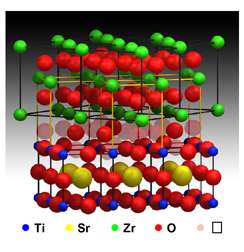
The molecular model of the ion-conducting material shows that numerous vacancies at the interface between the two layers create an open pathway through which ions can travel. Image: Oak Ridge National Laboratory

A new material characterized at the Department of Energy's Oak Ridge National Laboratory could open a pathway toward more efficient fuel cells.

The material, a super-lattice developed by researchers in Spain, improves ionic conductivity near room temperature by a factor of almost 100 million, representing "a colossal increase in ionic conduction properties," said Maria Varela of ORNL's Materials Science and Technology Division, who characterized the material's structure with senior researcher Stephen Pennycook.

The paper, a collaboration between researchers at the Universities of Madrid and at ORNL, was published today in Science.

The analysis was done with ORNL's 300 kilovolt Z-contrast scanning transmission electron microscope, which can achieve aberration-corrected resolutions near 0.6 angstrom, until recently a world record. The direct images show the crystal structure that accounts for the material's conductivity.

"It is amazing," Varela said. "We can see the strained, yet still ordered, interface structure that opens up a wide pathway for ions to be conducted."

Solid oxide fuel cell technology requires ion-conducting materials -- solid electrolytes -- that allow oxygen ions to travel from cathode to anode. However, existing materials have not provided atom-scale voids large enough to easily accommodate the path of a conducted ion, which is much bigger than, for example, an electron.

"The new layered material solves this problem by combining two materials with very different crystal structures. The mismatch triggers a distortion of the atomic arrangement at their interface and creates a pathway through which ions can easily travel," Varela said.

Other fuel cell materials force ions to travel through tight pathways with few spaces for the ions to occupy, slowing their progress. Rather than forcing the ions to jump from hole to hole, the new material has "lots of vacant spaces to be occupied," said Varela, so the ions can travel much more quickly.

Unlike previous fuel cell materials, which have to achieve high temperatures to conduct ions, the new material maintains ionic conductivity near room temperatures. High temperatures have been a major roadblock for developers of fuel cell technology.

The research team with Spain's Universidad Complutense de Madrid and Universidad Politécnica de Madrid produced the material and observed its outstanding conductivity properties, but the structural characteristics that enable the material to conduct ions so well were not known until the material was put under the ultra-high resolution microscopes at ORNL.

Source: Oak Ridge National Laboratory


print this article email this article download pdf blog this article bookmark this article     Stumble it Digg this share on Facebook retweet share on Reddit add to delicious
Rate this story - 4.8 /5 (46 votes)

Rank Filter

Move the slider to adjust rank threshold, so that you can hide some of the comments.


Display comments: newest first

  • irjsi - Jul 31, 2008
    • Rank: 3 / 5 (2)
    Bravo! Bravisimo ! ! !
    Get the lattices into pilot
    production facilities for cost/scale
    evaluations and into fuel cells.
    The World is Hungry for energy and motive
    power.
    Saludes Ustedes
    Rogelio Stewart,
    Phoenix AZ
  • Bruggeling - Aug 01, 2008
    • Rank: not rated yet
    Why isn't the title of this article : "Spanish scientists develop material with 'colossal ionic conductivity'" ?

    I am a long time reader of this site and now and then I am a bit annoyed with the Anglo-American bias. There, I said it :)
  • earls - Aug 01, 2008
    • Rank: not rated yet
    There are two different parties. The Spanish that developed the material and the US (ORNL) that analyzed it. This article is geared towards the latter.

    On the ORNL page there's an image of the superlattice: http://www.ornl.g...80731-02
  • Bruggeling - Aug 01, 2008
    • Rank: not rated yet
    With two thirds of the article describing the properties of the material we can safely say this is chauvinistic bias. But I suppose that is to be expected in view of the readership ?
  • Eco_R1 - Aug 04, 2008
    • Rank: not rated yet
    whats the use, we will only get to see it in like a 100 years!!!

July 31, 2008 all stories

Comments: 5

4.8 /5 (46 votes)
  • Stumble this up

  • Digg this

  • share this

  • hide
  • Related Stories

  • H1N1 Virus Can Be Killed by Acidic Ozone Water
    created Nov 09, 2009 | popularity not rated yet | comments 0
  • Hunting for new zeolites
    created Nov 02, 2009 | popularity not rated yet | comments 0
  • Scientists witness nature's complexity unfold in self-assembling quasicrystals
    created Oct 31, 2009 | popularity not rated yet | comments 0
  • Transforming nanowires into nano-tools using cation exchange reactions
    created Oct 23, 2009 | popularity not rated yet | comments 0
  • Improved Electric Propulsion Could Boost Satellite Lifetimes
    created Oct 21, 2009 | popularity not rated yet | comments 0


  • hide
  • Relevant PhysicsForums posts

Other News

A mechanical model of vocalization

Physics / General Physics

created 23 minutes ago | popularity not rated yet | comments 0

When people speak, sing, or shout, they produce sound by pushing air over their vocal folds -- bits of muscle and tissue that manipulate the air flow and vibrate within it. When someone has polyps or some other problem with ...


In the Brain, Seven Is A Magic Number

In the Brain, Seven Is A Magic Number

Physics / General Physics

created 1hour ago | popularity 4.2 / 5 (6) | comments 0

Having a tough time recalling a phone number someone spoke a few minutes ago or forgetting items from a mental grocery list is not a sign of mental decline; in fact, it's natural.


Scientists react as they stand in front of a screen at CERN

First atoms reported smashed in Large Hadron Collider (Update)

Physics / General Physics

created 3 hours ago | popularity 4.8 / 5 (12) | comments 2

Two circulating beams on Monday produced the first particle collisions in the world's biggest atom smasher, the Large Hadron Collider (LHC), three days after its restart, scientists announced.


Visual assistance for cosmic blind spots

Visual assistance for cosmic blind spots

Physics / General Physics

created 4 hours ago | popularity 4 / 5 (1) | comments 0

A bit of imagination on the part of a measuring instrument wouldn't be a bad thing. It could help to add data from areas where the instrument is unable to measure. However, it must do so constructively. In ...


Big Bang atom smasher sends beams in 2 directions (AP)

Large Hadron Collider sends beams in 2 directions

Physics / General Physics

created 7 hours ago | popularity 5 / 5 (7) | comments 0

(AP) -- The world's largest atom smasher made another leap forward Monday by circulating beams of protons in opposite directions at the same time in the $10 billion machine after more than a year of repairs, ...