Ivory poaching at critical levels: Elephants on path to extinction by 2020?
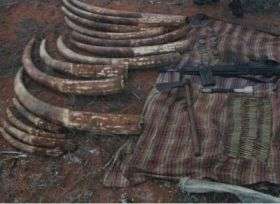
African elephants are being slaughtered for their ivory at a pace unseen since an international ban on the ivory trade took effect in 1989. But the public outcry that resulted in that ban is absent today, and a University of Washington conservation biologist contends it is because the public seems to be unaware of the giant mammals' plight.
The elephant death rate from poaching throughout Africa is about 8 percent a year based on recent studies, which is actually higher than the 7.4 percent annual death rate that led to the international ivory trade ban nearly 20 years ago, said Samuel Wasser, a UW biology professor.
But the poaching death rate in the late 1980s was based on a population that numbered more than 1 million. Today the total African elephant population is less than 470,000.
"If the trend continues, there won't be any elephants except in fenced areas with a lot of enforcement to protect them," said Wasser.
He is lead author of a paper in the August issue of Conservation Biology that contends elephants are on a course that could mean most remaining large groups will be extinct by 2020 unless renewed public pressure brings about heightened enforcement.
Co-authors are William Clark of the Interpol Working Group on Wildlife Crime and the Israel Nature and Parks Authority, Ofir Drori of the Last Great Ape Organization in Cameroon, Emily Kisamo of the Lusaka Agreement Task Force in Kenya, Celia Mailand of the UW, Benezeth Mutayoba of Sokoine University in Tanzania and Matthew Stephens of the University of Chicago.
Wasser's laboratory has developed DNA tools that can determine which elephant population ivory came from. That is important because often poachers attack elephants in one country but ship the contraband ivory from an adjacent nation to throw off law enforcement.
For instance, 6.5 tons of ivory seized in Singapore in 2002 were shipped from Malawi, but DNA tracking showed the ivory came originally from an area centered on Zambia. Similarly, a 2006 shipment of 3.9 tons seized in Hong Kong had been sent from Cameroon, but DNA forensics showed it came from an area centered on Gabon.
Evidence gathered from recent major ivory seizures shows conclusively that the ivory is not coming from a broad geographic area but rather that hunters are targeting specific herds. With such information, Wasser said, authorities can beef up enforcement efforts and focus them in specific areas where poaching is known to occur as a means of preventing elephants from being killed. But that will only happen if there is sufficient public pressure to marshal funding for a much larger international effort to halt the poaching.
In 1989, most international ivory trade was banned by the Convention on International Trade in Endangered Species of Wild Fauna and Flora (www.cites.org/), which regulates trade in threatened and endangered species. The restrictions banned ivory trade except for ivory from elephants that nations legally culled from their herds or those that died naturally.
At the time the treaty was enacted, poachers were killing an average of 70,000 elephants a year. The ban instigated much stronger enforcement efforts, nearly halting poaching almost immediately. However, that sense of success resulted in waning enforcement. Western aid was withdrawn four years after the ban was enacted and poaching gradually increased to the current alarming rates, Wasser said.
"The situation is worse than ever before and the public is unaware," he said, "It's very serious because elephants are an incredibly important species. They keep habitats open so other species that depend on such ecosystems can use them. Without elephants, there will be major habitat changes, with negative effects on the many species that depend on the lost habitat.
"Elephants also are a major part of ecotourism, which is an important source of hard currency for many African countries."
The illegal ivory trade is being carried out mostly by large crime syndicates, Wasser believes, and is being driven by growing markets in China and Japan, where ivory is in demand for carvings and signature stamps called hankos.
In addition, in the last few years demand has risen sharply in the United States, where much of the ivory is used to make knife handles and gun grips. In fact, a May report from the Care for the Wild International, a not-for-profit British natural protection organization, ranks the U.S. second behind China as a marketplace for illegal ivory.
But the illegal ivory trade has gotten relatively low priority from prosecutors, and new laws promoting global trade have created "a policing nightmare," Wasser says, which makes ivory poaching a high-profit, low-risk endeavor.
The only way to curb the trade, he believes, is to focus enforcement in areas where the ivory comes from in the first place, before it enters the complex, global crime trade network. Public support is crucial to helping reduce demand and to spur the needed enforcement help from the West.
However, Wasser believes that news reports about the need to cull excess elephants from managed populations in three or four countries have led many people to believe incorrectly that there are too many elephants in Africa. Those managed populations are confined by fences that limit the elephants' natural movements.
"Public support stopped the illegal ivory trade back in 1989 and can do so again," Wasser said. "The work with DNA sampling allows us to focus law enforcement on poaching hot spots.
"It forces countries to take more responsibility for what goes on within their borders, and it also gives us more insight on where to look so that, hopefully, we can stop the poachers before the elephants are actually killed."
Source: University of Washington


