Scientists mimic essence of plants' energy storage system
July 31, 2008
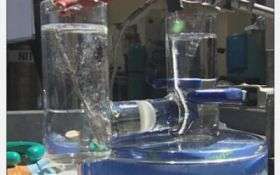
A snapshot showing the new, efficient oxygen catalyst in action in Dan Nocera's laboratory at MIT. Credit: MIT/NSF
In a revolutionary leap that could transform solar power from a marginal, boutique alternative into a mainstream energy source, MIT researchers have overcome a major barrier to large-scale solar power: storing energy for use when the sun doesn't shine.
Until now, solar power has been a daytime-only energy source, because storing extra solar energy for later use is prohibitively expensive and grossly inefficient. With today's announcement, MIT researchers have hit upon a simple, inexpensive, highly efficient process for storing solar energy.
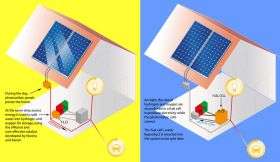
With Daniel Nocera's and Matthew Kanan's new catalyst, homeowners could use their solar panels during the day to power their home, while also using the energy to split water into hydrogen and oxygen for storage. At night, the stored hydrogen and oxygen could be recombined using a fuel cell to generate power while the solar panels are inactive. Graphic / Patrick Gillooly, MIT
Requiring nothing but abundant, non-toxic natural materials, this discovery could unlock the most potent, carbon-free energy source of all: the sun. "This is the nirvana of what we've been talking about for years," said MIT's Daniel Nocera, the Henry Dreyfus Professor of Energy at MIT and senior author of a paper describing the work in the July 31 issue of Science. "Solar power has always been a limited, far-off solution. Now we can seriously think about solar power as unlimited and soon."Inspired by the photosynthesis performed by plants, Nocera and Matthew Kanan, a postdoctoral fellow in Nocera's lab, have developed an unprecedented process that will allow the sun's energy to be used to split water into hydrogen and oxygen gases. Later, the oxygen and hydrogen may be recombined inside a fuel cell, creating carbon-free electricity to power your house or your electric car, day or night.
The key component in Nocera and Kanan's new process is a new catalyst that produces oxygen gas from water; another catalyst produces valuable hydrogen gas. The new catalyst consists of cobalt metal, phosphate and an electrode, placed in water. When electricity — whether from a photovoltaic cell, a wind turbine or any other source — runs through the electrode, the cobalt and phosphate form a thin film on the electrode, and oxygen gas is produced.
Combined with another catalyst, such as platinum, that can produce hydrogen gas from water, the system can duplicate the water splitting reaction that occurs during photosynthesis.
The new catalyst works at room temperature, in neutral pH water, and it's easy to set up, Nocera said. "That's why I know this is going to work. It's so easy to implement," he said.
'Giant leap' for clean energy
Sunlight has the greatest potential of any power source to solve the world's energy problems, said Nocera. In one hour, enough sunlight strikes the Earth to provide the entire planet's energy needs for one year.
James Barber, a leader in the study of photosynthesis who was not involved in this research, called the discovery by Nocera and Kanan a "giant leap" toward generating clean, carbon-free energy on a massive scale.
"This is a major discovery with enormous implications for the future prosperity of humankind," said Barber, the Ernst Chain Professor of Biochemistry at Imperial College London. "The importance of their discovery cannot be overstated since it opens up the door for developing new technologies for energy production thus reducing our dependence for fossil fuels and addressing the global climate change problem."
'Just the beginning'
Currently available electrolyzers, which split water with electricity and are often used industrially, are not suited for artificial photosynthesis because they are very expensive and require a highly basic (non-benign) environment that has little to do with the conditions under which photosynthesis operates.
More engineering work needs to be done to integrate the new scientific discovery into existing photovoltaic systems, but Nocera said he is confident that such systems will become a reality.
"This is just the beginning," said Nocera, principal investigator for the Solar Revolution Project funded by the Chesonis Family Foundation and co-Director of the Eni-MIT Solar Frontiers Center. "The scientific community is really going to run with this."
Nocera hopes that within 10 years, homeowners will be able to power their homes in daylight through photovoltaic cells, while using excess solar energy to produce hydrogen and oxygen to power their own household fuel cell. Electricity-by-wire from a central source could be a thing of the past.
Source: Massachusetts Institute of Technology


The problem with batteries is that they are very inefficient; my guess is this system is more efficient by an order of magnitude or more.
@Googleplex:
The storage and distribution of H2 are valid points, but the difficulty involved is not new and is close to being overcome, as evidenced by the tentative mass production of hydrogen fuel-cell cars by Honda and others, and the availability of hydrogen as fuel in some parts of the world (e.g. southern California). As far as the expense of platinum, it's worth noting that palladium is far more expensive but is commonly used as a catalyst in catalytic converters.
What I think is exciting is this sounds simple enough to be able to reproduce the experiment at home or school!
It's the liquid fuel that can be burned or used to drive a fuel cell. The liquid stores your energy output in a dense transportable form.
Let's not get too carried away.
Solar cell 20% efficient.
Electrolosis probably < 50% efficient.
The article doesn't give efficiency.
Pumps and motors to compress the gasses for storage are probably < 50% efficient.
Fuel cell for home < 50% efficient.
Only high temperature fuel cells even reach 50%.
0.2 * 0.5 * 0.5 * 0.5 = 2.5% overall efficieny.
So at 1KW per sq. meter at noon you will get 25 watts stored and used from the sun.
Integration with solar water heaters seems simpler than photovoltaic cells competing for the same roof space.
Yet they put it into millions and millions of cars...
0.2 * 0.5 * 0.5 = 5% overall efficiency.
So at 1KW per sq. meter at noon you will get 50 watts stored and used from the sun.
http://arstechnic...rgy.html
Oh, and by the way, before anyone objects that his system was *way* too costly for it to ever become commonplace technology, note that the $500k price tag for it was in 2006 prices for the various components (mostly the 56 PV panels, I'm sure). It is now much less costly, according to the article, even without the new technology improvements mentioned in this PhysOrg article and other articles here and elsewhere.
http://www.sciam....en-house
Will this make this the cheapest method of production of hydrogen and oxygen for rocket fuel?
http://www.physor...749.html
More importatly, isn't the article artificually linking solar PV-cells with this new electrolosis method? From my understanding of the article this just improved the electrolisys efficienty, seems like you could use any voltage source.
Good point. This is also a shot in the arm for wind power, for instance, which suffers the same "not always available" problem as solar.
In addition, for those who are still attached to the grid, you could charge up your "batteries" at night using cheaper electricity, and run off them during the day.
70%-92%
Note that the lead acid battery normally does not produce explosive gases.
Producing O2 and H2 gas is an added safety/storage issue. Storing H2 gas and O2 gas is not a trivial matter like piling up coal. You need compressors and steel containers. Compressing gas requires work and generates heat from the change in entropy. Think of having a a mini propane bottling plant at home.
Here in the USA you are required to have a medical reason to be allowed "residential" O2 cylinders.
Photovoltaics is progressing with Moores law so fossil fuel competitive $/W will be achieved soon.
I am hopefull for invention of a nano electric battery/capacitor for electrical energy storage. This would make storing gas appear old fashioned and bulky.
Use solar during day and bateries at night, naw.
Environmental pollution from batteries and their byproducts would add to the speed we are killing our planet, i.e. the people who live here.
Here is one that will do.
http://www.p2pnet...ry/16477
Did you even read the article? Go back and read for comprehension this time. Look for any reference to batteries being needed. Doofus.
Current electrolysers are very cheap and easy to do - just stick two wires into water and you've got yourself one. They also don't require any specific pH.
http://www.wikiho...se-Water
Maybe there are some specific reasons why such simple electrolysis wont work but they should have been put into the article instead of a bunch of lies.
Finally it has NOTHING to do with the way plants store energy since they store it in energetic organic compounds not as an oxygen and hydrogen (they do split water to harvest energy from the sun but not to store it).
2.5% same as plants!!!!!
About 20 yrs ago NASA people developed a brilliant energy storage scheme for solar using Fe(II)/Fe(III)and Cr(III)/Cr(II) solutions. The efficiency was ~70% if I remember correctly but the chromium II/III would drive the EPA crazy because of the posibility of it escaping into the environment and being oxidized to Cr(VI) a potent carcinogen. The neat thin was that for more energy storage all one needed was larger storage tanks (4).
That's an even worse idea than using a product (oil) that is mainly concentrated in several different countries.
Efficiency was never the problem of batteries. Regular lead-acid batteries are 70% efficient, NiCad 70-90%, Nimh 70%, lithium-ion batteries upwards of 90%, vanadium redox 70-80%.
The problem was and continues to be cost, energy density and durability.
Hydrogen fuel cells are typically less than 50% efficient; making it a less efficient storage method than any battery technology in use.
Electrolysis of pure water is very slow. The electrode material won't last very long unless you choose something relatively inert like stainless steel or platinum.
Care must be taken when choosing an electrolyte so that the anion has a lower standard electrode potential than hydroxide, or you won't get any oxygen(e.g. if you use Cl- you'll get chlorine gas instead of oxygen. This is not a bad thing if chlorine gas is captured and put to use). The cation must have a greater electrode potential than H , or you'll reduce it instead and get no hydrogen gas.
Sodium hydroxide, potassium hydroxide and sulfuric acid are the usual candidates for electrolysis of water.
It's sad that the editors on this site allow this myth to persist. Hydrogen production is easy, efficient and scalable right now. The only reason we don't have it being rolled out is the damage it would do to the consumer oil industry.
However this advance in understanding is very good news as we could use solar to generate the hydrogen and rain to replenish the supply of water. That makes pretty much unlimited power available to anyone with half a brain and a bit of spare cash.
Hydrogen ions.
Efficiency and durabillity matters.
There is no such thing as HHO.
Just do a search on youtube and you'll find people talking to ghosts, demonstrating how to heal people with crystals and communicating telepathically with dolphins.
It's a bit like jumping off a 1000 meter cliff without a parachute and talking about how exciting that would be, and how wonderful the view would be.
"gravity? kinetic impact? what's that? No, that's not a problem. You see we'll make our own laws of physics to suit our biases."
Good luck luck with that, 'scientists', but I want nothing to do with it.
This is a little (massive understatement) over the top kind of comment. I'm sure tbp's estimate is high, especially when you have to bring in the reliability of the system to make it possible to mass market it. Combine all of this together and I can probably see a handful of technology demonstrator condos and houses manufactured in 5-10 years using sometype of this technology (assuming that they can get the necessary permits to store the oxygen and hydrogen, both being MAJOR fire hazards, while the O2 isn't technically flammable, many organics readily combust when exposed to that high of a level of oxygen). The likely hood of this eliminating the HOUSEHOLD power grid *might* happen in 50 years, but I SERIOUSLY doubt that industry (and electric cars) will be able to run without some additional help from sometype of large scale power generation. This system looks like it is going to cost almost as much as the average house costs, so it's likely to be largely irrelavent for the near future.
If your neighbour isn't producing power you won't either; weather is extremely well correlated on such small scales.
In order for this approach to work you need to greatly expand the grid to provide significant export/import capacity across several states/countries.
Moore's law has to do with shrinking feature geometry, allowing more transistors per area.
This doesn't help for solar cells.
Its unlikely we will ever be able to affordably get more than a factor of two increase in efficiency over existing cells, although the price may come down.
To clarify... The discovery here is about electrolysis, not solar energy. The discovery is a new catalyst for the oxygen side of the cell that is 90% more efficient than those used currently (platinum). Not only that, but the new catalyst does not require highly corrosive electrolytes for efficient operation, thus a less robust container may be used to house the reaction. Also the new catalyst is cheap. Previously both the oxygen and hydrogen sides of the cell used platinum as a catalyst, but now platinum is only used for the hydrogen side.
Current maximum efficiency for a electrolysis/fuel cell is around 50%, for a total efficiency of 25%. With the new catalyst there is an efficiency of 95%, for a total efficiency of about 90%. This, of course, ignores pressurizing the hydrogen for storage (oxygen can be vented) but the real news here is the increase from 25% to 90%.
So in summary:
H2O electrolysis cells and hydrogen fuel cells can each be 95% efficient by using a new catalyst for the O2 side.
These same cells are also cheaper to build due to:
- Non corrosive electrolyte = simple materials for the cell housing.
- Less platinum used as a catalyst
Interested in your data source?
Here is an article from the hacks at IEEE. http://blogs.spec...tra.html
I am not alone with thinking there is a similarity.
How much platinum is needed ? a few microns of electroplated platinum can't be that expensive.