Cold and ice, not heat, episodically gripped tropical regions 300 million years ago
July 31, 2008 Cold and ice, not heat, episodically gripped tropical regions 300 million years ago

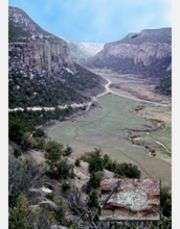
Unaweep Canyon in the Rocky Mountains is the site of a deep gorge that reveals ancient landscapes and sediments. The inset image is of a "dropstone" from an eons-old glacier. Credit: Gerilyn Soreghan

Geoscientists have long presumed that, like today, the tropics remained warm throughout Earth's last major glaciation 300 million years ago.

New evidence, however, indicates that cold temperatures in fact episodically gripped these equatorial latitudes at that time.

Geologist Gerilyn Soreghan of Oklahoma University found evidence for this conclusion in the preservation of an ancient glacial landscape in the Rocky Mountains of western Colorado. Three hundred million years ago, the region was part of the tropics. The continents then were assembled into the supercontinent Pangaea.

Soreghan and colleagues published their results in the August 2008, issue of the journal Geology.

Climate model simulations are unable to replicate such cold tropical conditions for this time period, said Soreghan. "We are left with the prospect that what has been termed our 'best-known' analogue to Earth's modern glaciation is in fact poorly known."

"This study is an example of the wealth of untapped climate information stored in Earth's 'deep time' geologic record millions of years ago," said H. Richard Lane, program director in NSF's Division of Earth Sciences, which funded the research. "These kinds of discoveries may greatly improve our understanding and prediction of modern climate change."

As a result of the close proximity of the ancient tropical glaciers to the sea, the toes of the glaciers were likely less than 500 meters above sea level--much lower than the tropical glaciers of Earth's recent glacial times.

"The Late Paleozoic tropical climate was not buffered against cold from the high latitudes, as everyone had thought," said Soreghan. "The evidence we found indicates that glaciers were common at this time, even in tropical latitudes. This calls into question traditional assumptions of long-lasting equatorial warmth in the Late Paleozoic, and raises the possibility of large-scale and unexpected climate change in the tropics during that time."

Source: National Science Foundation


print this article email this article download pdf blog this article bookmark this article     Stumble it Digg this share on Facebook retweet share on Reddit add to delicious
Rate this story - 4.5 /5 (22 votes)

Rank Filter

Move the slider to adjust rank threshold, so that you can hide some of the comments.


Display comments: newest first

  • out7x - Aug 01, 2008
    • Rank: 3.3 / 5 (3)
    Paleo-Climates are not understood well, due to different continent positions, ocean currents,and atmosphere composition. The antarctic was tropical, eventhough it was high latitude, 40-100Myr ago(cretaceous thru eocene).
  • D666 - Aug 01, 2008
    • Rank: 4.5 / 5 (2)
    I think the title should more accurately read "Cold and ice, AS WELL AS heat, episodically gripped ... etc". By definition, they're hot right now, and this is an episode.
  • jeffsaunders - Aug 04, 2008
    • Rank: 5 / 5 (1)
    I agree with D666 lets get the basics right and go from there.

    Plus. we might want to double check that that location really was in the tropics at that time as geology of drift is not that accurate.

    Plus. There have been times when the planet was complete frozen from pole to pole so it not surprising that at some time there were glaciers in the tropics.

    What we need is a time line image showing average temperatures by location which includes positions of land masses locations.

    Perhaps we should get Google to put one together for us. Probably only take them a few months and Ohhh what a research tool that would be.

July 31, 2008 all stories

Comments: 3

4.5 /5 (22 votes)
  • Stumble this up

  • Digg this

  • share this

  • hide
  • Related Stories

  • Life's Ancient Island in the Ice
    created Oct 29, 2009 | popularity not rated yet | comments 0
  • The first neotropical rainforest was home of the Titanoboa
    created Oct 12, 2009 | popularity not rated yet | comments 0
  • 'Killer' Southeast drought low on scale, says study
    created Oct 01, 2009 | popularity not rated yet | comments 0
  • Ocean acidification: impact on key organisms of oceanic fauna
    created Sep 15, 2009 | popularity not rated yet | comments 0
  • 'Old Farmer's Almanac' still spots cold in Web age
    created Sep 10, 2009 | popularity not rated yet | comments 0


  • hide
  • Relevant PhysicsForums posts

  • cycles
    created 6 hours ago
  • The Origin of the term 'fossil' fuels
    created Nov 05, 2009
  • co2
    created Nov 03, 2009
  • Early Earths Sulfidic Ocean Conditions
    created Oct 30, 2009
  • More from Physics Forums - Earth

Other News

Deep creep means milder, more frequent earthquakes along Southern California's San Jacinto fault

Deep creep means milder, more frequent earthquakes along Southern California's San Jacinto fault

Space & Earth / Earth Sciences

created 5 hours ago | popularity 4.7 / 5 (3) | comments 0

With an average of four mini-earthquakes per day, Southern California's San Jacinto fault constantly adjusts to make it a less likely candidate for a major earthquake than its quiet neighbor to the east, the ...


Success in 'space elevator' competition (AP)

Success in 'space elevator' competition (Update 3)

Space & Earth / Space Exploration

created Nov 05, 2009 | popularity 4.3 / 5 (33) | comments 50

(AP) -- A robot powered by a ground-based laser beam climbed a long cable dangling from a helicopter on Wednesday to qualify for prize money in a $2 million competition to test the potential reality of the ...


'Dropouts' pinpoint earliest galaxies

'Dropouts' pinpoint earliest galaxies

Space & Earth / Astronomy

created Nov 06, 2009 | popularity 4.2 / 5 (10) | comments 12

Astronomers, conducting the broadest survey to date of galaxies from about 800 million years after the Big Bang, have found 22 early galaxies and confirmed the age of one by its characteristic hydrogen signature ...


Space hotel taking bookings for 2012 opening

Space hotel taking bookings for 2012 opening

Space & Earth / Space Exploration

created Nov 05, 2009 | popularity 4.4 / 5 (20) | comments 11

(PhysOrg.com) -- The first orbiting space hotel is on track to open for its first customers in 2012, but hurry, as bookings are filling fast.


In a Galaxy Far, Far Away...

In a Galaxy Far, Far Away...

Space & Earth / Astronomy

created Nov 06, 2009 | popularity 4.8 / 5 (5) | comments 13

(PhysOrg.com) -- Astronomers have published the discovery of the farthest known object in the cosmos: a star that exploded when the universe was only 630 million years old -- only 4.6% of its current age. ...