Neurons created from skin cells of elderly ALS patients
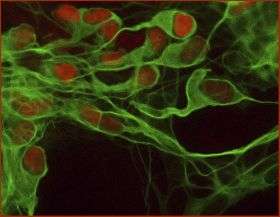
Less than 27 months after announcing that he had institutional permission to attempt the creation of patient and disease-specific stem cell lines, Harvard Stem Cell Institute (HSCI) Principal Faculty member Kevin Eggan today proclaimed the effort a success - though politically imposed restrictions and scientific advances prompted him to use a different technique than originally planned.
The breakthrough by Eggan and colleagues at Harvard and Columbia University marks the first time scientists are known to have produced human stem cell lines coaxed from the cells of adult patients suffering from a genetically-based disease. The affected patients had Amyotrophic Lateral Sclerosis (ALS), commonly known as Lou Gehrig's disease.
The work, published in today's on-line edition of the journal Science, provides "proof of concept" for the belief of scientists and fervent hope of patients that in the not-too-distant future it may be possible to treat patients suffering from chronic diseases with stem cell-based treatments created from their own adult cells. However, Eggan believes that the first therapeutic use of these newly derived stem cells will in fact be to use them to study the root cause of this disease and to screen for drugs that may provide benefit in patients.
The co-lead authors of the Eggan paper are John Dimos, a postdoctoral fellow in Eggan's lab, and Kit Rodolfa, a graduate student in the lab. Dimos and Rodolfa were responsible for the generation of the stem cells as well as their characterization. The Columbia team, which coordinated patient participation and skin sample collection, was lead by Christopher Henderson, co-director of that university's Motor Neuron Center and professor of pathology and cell biology in neurology and neuroscience.
"This finding by Kevin Eggan and his colleagues marks an important step in fulfilling the promise of regenerative medicine," Harvard Provost and neurobiologist Steven E. Hyman said. "It is yet more confirmation that the substantial risks that were taken in forming the Harvard Stem Cell Institute will ultimately pay off for both science and patients," he said.
In the Science paper, the HSCI and Columbia researchers, who were supported by the New York Stem Cell Foundation and Project ALS, describe turning skin cells collected from elderly patients with (ALS) into induced pluripotent stem (iPS) cells, and then directing their differentiation into the type of motor neurons (nerve cells) destroyed by the disease.
"No one has ever managed to isolate these neurons from a patient and grow them in a dish," Eggan said, explaining the significance of the work. "Now we can make limitless supplies of the cells that die in this awful disease. This will allow us to study these neurons - and ALS - in a lab dish, and figure out what's happening in the disease process," said the assistant professor in Harvard's new Department of Stem Cell and Regenerative Biology, and Stowers Medical Institute Investigator.
When Eggan and colleagues first applied to Harvard and Columbia Institutional Review Boards (IRBs) for permission to attempt their experiments, they were planning to reach their goal through somatic cell nuclear transfer (SCNT), which is generally referred to as therapeutic cloning. Going the SCNT route requires obtaining donated ova, removing all the genetic material from the ova and replacing it with the genetic material from the skin cell of a patient whose disease researchers want to study. Stem cells would then be extracted from the fertilized ova after several cell divisions, and the idea would be to induce those stem cells to differentiate into the cell type to be studied.
"Over the last two years we've done everything we could within the law in Massachusetts to recruit women to donate ova. However, we were never able to recruit enough donors because we were legally prevented from providing the same sort of compensation that these women would receive for donating their ova for in vitro fertilization," Eggan said.
"We did make some interesting progress with initial experiments," he continued, "but it's not yet come to fruition. So when Shinya Yamanaka's first creation of iPS cells came along, that opened up a new route for us and we decided to capitalize on that." However, Eggan added that he will continue both his SCNT and iPS work, and believes "it's essential to note that we couldn't possibly be where we are now without first doing extensive work with human embryonic stem cells(hESC). Further, it will be essential to continue to do work with embryonic stem cells as they remain the stem cell gold standard."
The Eggan team used the same four genes to produce iPS cells that Yamanka, of Kyoto University, used to develop his reprogramming method in mice two years ago. However, because one of the four genes is a cancer-promoting gene, this method of reprogramming will for the time being prevent these cells from being transplanted into patients.
In order to perfect these cells for transplantation, scientists will have to come up with a combination of genes or chemicals to induce similar reprogramming events in the skin cells without the use of potentially tumor-causing agents.
The skin cells used in the experiment came from two Columbia patients, one 89 and the other 92. Both patients had a mild form of ALS, but one that is caused by a single genetic mutation. The genetic simplicity of this form of ALS - and the fact that it always inherited - should assure that the neurons produced from these stem cell lines will eventually succumb to the disease.
At this point however, the Eggan group has not yet seen the disease in the dish. "The next step," said Eggan, "is to produce neurons from iPS cells developed from a normal, healthy person, and try to determine what's different about the neurons we have made from the ALS patients."
Source: Harvard University


