The brightest, sharpest, fastest X-ray holograms yet
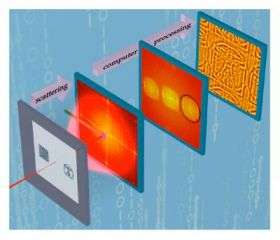
The pinhole camera, a technique known since ancient times, has inspired a futuristic technology for lensless, three-dimensional imaging. Working at both the Advanced Light Source (ALS) at the U.S. Department of Energy's Lawrence Berkeley National Laboratory, and at FLASH, the free-electron laser in Hamburg, Germany, an international group of scientists has produced two of the brightest, sharpest x-ray holograms of microscopic objects ever made, thousands of times more efficiently than previous x-ray-holographic methods.
The x-ray hologram made at ALS beamline 9.0.1 was of Leonardo da Vinci's famous drawing "Vitruvian Man," a lithographic reproduction less than two micrometers (millionths of a meter, or microns) square, etched with an electron-beam nanowriter. The hologram required a five-second exposure and had a resolution of 50 nanometers.
The other hologram, made at FLASH, was of a single bacterium, Spiroplasma milliferum, made at 150-nanometer resolution and computer-refined to 75 nanometers, but requiring an exposure to the beam of just 15 femtoseconds (quadrillionths of a second).
The values for these two holograms are among the best ever reported for micron-sized objects. With already established technologies, resolutions obtained by these methods could be pushed to only a few nanometers, or, using computer refinement, even better.
The researchers were from Berkeley Lab; Lawrence Livermore National Laboratory; the Stanford Linear Accelerator Center; Uppsala University, Sweden; the University of Hamburg and the Deutsches Elektronen-Synchrotron (DESY), Germany; Arizona State University; Princeton University; and the University of California at Berkeley. Their results appear in advanced online publication of Nature Photonics.
The modern pinhole camera
"Our purpose was to explore methods of making images of nanoscale objects on the time scale of atomic motions, a length and time regime that promises to become accessible with advances in free-electron lasers," says Stefano Marchesini of the ALS, who led the research. "The technique we used is called massively parallel x-ray Fourier-transform holography, with 'coded apertures.' What inspired me to try this approach was the pinhole camera."
The ancient Greeks made note of pinhole-camera effects without understanding them; later, pinhole cameras were used by Chinese, Arab, and European scholars. Renaissance painters learned the principals of perspective using the camera obscura, literally a "dark room," with a pinhole in one wall that projected the outside scene onto the opposite wall.
"The room had to be dark for the good reason that a sharp image requires a small pinhole, but a small pinhole also produces a dim image," Says Marchesini. "To get a brighter image without lenses you have to use many pinholes. The problem then becomes how to assemble the information, including depth information, from the overlapping shadow images. This is where 'coded apertures' come in."
By knowing the precise layout of a pinhole array, including the different sizes of the different pinholes, a computer can recover a bright, high-resolution image numerically. Random pinhole arrays were first used in x-ray astronomy but soon evolved into regular rows and columns of tiny square apertures of varying dimension. These coded apertures are called uniformly redundant arrays, or URAs.
Marchesini knew that colleagues at Livermore were using URAs in gamma-ray detectors. He asked himself, "What would happen if we put a URA right next to an object we were imaging with the x-ray beamline? It should allow us to create a holographic image – one with orders of magnitude more intensity than a standard hologram."
Holography with x-rays
Holography was invented over 60 years ago by the physicist Dennis Gabor, but its use has long been limited by technology. Whereas a pinhole camera employs ray optics, in which the photons travel like a stream of particles, holography depends on the wave-like properties of light.
The principle is straightforward: a beam of light illuminates an object, which scatters the light onto a detector such as photographic plate. Meanwhile a second, identical beam of light shines directly on the detector. The scattered light waves from the object beam form interference patterns with the unscattered light waves from the reference beam.
This interference pattern serves to reconstruct an image of the object. One easy way to do so, if the detector is a photo transparency, is for the observer to look through the transparency in the direction of the (now absent) object; if only the reference beam is shining on the detector, the interference pattern serves to "unscatter" (diffract) the wavefront and reconstruct the object's image.
Lasers, which produce coherent light (all the same phase) were the first invention that made holography practical; it is now possible to make small holograms using just a laser pointer. FLASH is a powerful free-electron laser (FEL); a new generation of FELs of much shorter wavelength will be capable of producing coherent light pulses so short they'll be able to freeze atomic motion in the midst of chemical reactions.
Soft x-rays like those from ALS beamline 9.0.1 can also be made coherent, or laser-like, using a pair of pinholes. (The beam is conditioned by these pinholes, but they are not directly involved in imaging, except to make the beam laser-like.) To make a hologram, the beam issuing from the synchrotron scatters from the target object and is collected on a CCD detector. Meanwhile the same beam simultaneously passes through the multiple-"pinhole" URA, mounted on the same plate as the target object, and produces a bright reference beam.
The scattered image of the object and the many overlapping reference beams from the URA combine to make an interference pattern which contains all the information, including the relative depth of individual features, needed to mathematically reconstruct a three-dimensional image of the object.
The hologram of the Spiroplasma bacterium was made in precisely the same way, with much brighter x-ray beams and a much shorter pulse of light. So bright was the flash of light that the sample was vaporized, but not before both the scattered object beam and the reference beams from the URA had been recorded.
Together, the two experiments demonstrate that holographic x-ray images with nanometer-scale resolution can be made of objects measured in microns, in times as brief as femtoseconds. Moreover, sample preparation time is fast and easily repeated for high throughput during repetitive experiments. As the researchers write in their Nature Photonics article, "Imaging with coherent x-rays will be a key technique for developing nanoscience and nanotechnology, and massively parallel holography will be an enabling tool in this quest."
Citation: "Massively parallel x-ray holography," by Stefano Marchesini, Sébastien Boutet, Anne E. Sakdinawat, Michael J. Bogan, Sǎsa Bajt, Anton Barty, Henry N. Chapman, Matthias Frank, Stefan P. Hau-Riege, Abraham Szöke, Congwu Cui, David Shapiro, Malcolm Howells, John Spence, Joshua Shaevitz, Joanna Lee, Janos Hajdu, and Marvin M. Siebert, appears in advanced online publication of Nature Photonics and is available online to subscribers at dx.doi.org/10.1038/nphoton.2008.154 .
Provided by Lawrence Berkeley National Laboratory


