NASA Nanosatellites Catch Ride On Rocket, Demonstrate Technology
(PhysOrg.com) -- NASA will fly two nanosatellites as secondary payloads aboard the SpaceX Falcon 1 rocket planned for launch in August or September.
Spaceflight engineers and project managers at NASA's Ames Research Center, and NASA's Marshall Space Flight Center, Huntsville, Ala., teamed together to arrange a fast-paced, low-cost mission. The mission provides an opportunity to demonstrate NASA-developed spaceflight technologies and the Ames-developed modular approach to constructing the PharmaSat Risk Evaluation (or PRESat) and NanoSail-D satellites. This same approach was used successfully on a previous mission, GeneSat, and will be used for the upcoming PharmaSat mission, scheduled to launch later this year.
"This mission provides NASA with a unique opportunity to evaluate how our nanosatellite spacecraft and its payload perform, while demonstrating our ability to conduct fast turn-around, low-cost spaceflight projects," said John Hines, chief technologist at Ames' Small Spacecraft Division and PRESat-NanoSail-D technical director. "This collaborative mission has enabled NASA to demonstrate and support cutting-edge technologies."
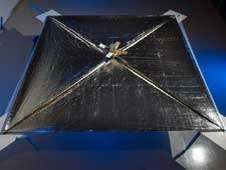
After successfully entering a low Earth orbit, PRESat will create a stable, space science laboratory using innovative environment control and biological detection techniques. NanoSail-D will deploy an ultra-thin, highly reflective solar sail for the first time in history, and validate cutting-edge, propellant-less space propulsion technologies.
"We have an experimental payload loaded into an experimental satellite, onboard a privately developed vehicle," said Edward "Sandy" Montgomery, NanoSail-D payload manager at NASA's Marshall. "We're thrilled with this opportunity to combine our solar sail experience and technology with a new way of doing business."
The PRESat micro-laboratory is a controlled environment with sensors and optical systems that can detect the growth, density and health of yeast cells. PRESat will also monitor the levels of pressure, temperature, and acceleration. This data will be relayed in real-time to mission managers and engineers for further analysis.
Packed inside the NanoSail-D satellite is a 100 square foot sail, made of ultra-thin, light gossamer fabric, coated with a layer of aluminum to enhance its thrust-producing properties. The reflective sails are designed to intercept the constantly streaming solar energy and change the orbit of the spacecraft. If the deployment is successful, the mission team will be able to pick up slight changes in NanoSail's orbit due to solar pressure and aerodynamic drag a few days into the mission.
Marshall Space Flight Center provided materials for the NanoSail-D spacecraft and the solar sail payload, including harvesting the sail material from an earlier Marshall solar sail propulsion mission tested at NASA's Glenn Plum Brook Station in 2005. The team also includes academic and industry partners who provided economical commercial-off-the-shelf components that were quickly configured and integrated to create the satellite.
The Falcon 1 rocket is on the pad at the Marshall Islands launch site, where SpaceX is conducting final checkouts. SpaceX has announced that the rocket could launch at any time during two launch windows: July 31 to Aug. 6 and late August to early September. SpaceX will notify news media 36 hours in advance of a launch.
After both satellites are ejected from the Falcon 1 rocket into orbit, they will activate and begin transmitting radio signals to two ground control stations operated by students from Santa Clara University, Santa Clara, Calif. One station is located at the Universidad Centroamericana in San Salvador, El Salvador. The other is an innovative, mobile station, positioned near the launch site at Kwajalein Atoll in the Marshall Islands. Students will monitor the spacecraft, provide mission data to NASA engineers and coordinate with amateur radio operators around the world to tune in to the satellites' broadcasts.
Provided by NASA


