Unravelling breast cancer susceptibility
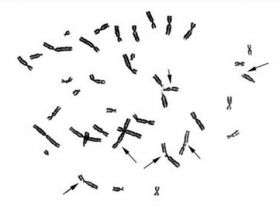
August 1, 2008 Human Chromosomes under the microscope

Enlarge

Human Chromosomes under the microscope. Human blood-cell chromosomes with damage (shown by arrows) caused by low-dose radiation. The number of these ´breaks´ is increased in exposed blood cells from breast cancer cases.

(PhysOrg.com) -- Scientists at St Andrews University's Bute Medical School are investigating a vital link between radiation sensitivity and breast cancer susceptibility.

The study sheds new light on a vital enzyme that enables cells in our bodies to 'unravel' DNA. This enzyme allows the chromosomes to split into two prior to a cell dividing and could be linked to breast cancer susceptibility.

Using a model human cell system in which cells are grown in cultures in the laboratory, researchers have shown that when amounts of the enzyme 'topo-2' are reduced, the cells become resistant to low doses of gamma-rays and less damage to their chromosomes is observed.

Dr Peter Bryant of the Bute Medical School is heading the team. He said, "I believe that these findings could help explain individual susceptibility to sporadic (non-familial) breast cancer, since previous work in the Medical School has demonstrated an on-average higher radiation sensitivity of chromosomes to damage among white blood cells from breast cancer patients, when compared with groups of normal (non-cancer) patients."

Several studies by scientists in Manchester, Athens and Ghent have found a similar link between breast cancer and elevated chromosome radiation sensitivity, and while the underlying mechanism of the link is not yet understood, it is thought that changes in 'low-penetrance' genes could be involved in causing both the radiation sensitivity and breast cancer susceptibility.

The group in the Bute Medical School, including Professor Andrew Riches, PhD student Samantha Terry and technician Olga Shovman, in collaboration with Dr Dougal Adamson at Ninewells Hospital, is currently studying the levels of topo-2 and the effects of low-dose radiation on chromosomes of cells in culture in the laboratory and in white blood cells in samples taken from breast cancer cases.

Dr Bryant said, "The original aim of the laboratory cell culture work was to test a theory as to the way in which low-dose radiation causes damage to our chromosomes. Our published findings support the theory, and suggested a possible way in which this exciting result might help lead us in our ongoing study of patients, to understand more about breast cancer susceptibility."

The research is published in the latest edition of the British Journal of Cancer and is funded by the Breast Cancer Campaign and the Scottish Government.

Provided by St Andrews University


print this article email this article download pdf blog this article bookmark this article     Stumble it Digg this share on Facebook retweet share on Reddit add to delicious
Rate this story - 5 /5 (2 votes)

Rank Filter

Move the slider to adjust rank threshold, so that you can hide some of the comments.


Display comments: newest first

  • E_L_Earnhardt - Aug 02, 2008
    • Rank: not rated yet
    Haven't you heard? Exposing the link between radiation and cancer is now a "No, No!"

August 1, 2008 all stories

Comments: 1

5 /5 (2 votes)
  • Stumble this up

  • Digg this

  • share this

  • hide
  • Related Stories

  • Tissue tension regulates tumor progression
    created 15 hours ago | popularity not rated yet | comments 0
  • Researchers identify role of gene in tumor development, growth and progression
    created Nov 20, 2009 | popularity not rated yet | comments 0
  • A Tiny Cage of Gold Responds to Light, Opening to Empty Its Contents
    created Nov 19, 2009 | popularity not rated yet | comments 0
  • Common pain relief medication may encourage cancer growth
    created Nov 18, 2009 | popularity not rated yet | comments 0
  • Researchers create 'fly paper' to capture circulating cancer cells
    created Nov 18, 2009 | popularity not rated yet | comments 0


  • hide
  • Relevant PhysicsForums posts

  • Has the H1N1 vaccine been scientifically proven to work?
    created 4 hours ago
  • nesfatin
    created Nov 22, 2009
  • Obsessive Compulsive Disorder
    created Nov 20, 2009
  • West's zone 2 starling resistor respiratory physiology
    created Nov 18, 2009
  • More from Physics Forums - Medical Sciences

Other News

Acute stress leaves epigenetic marks on the hippocampus

Medicine & Health / Psychology & Psychiatry

created 1hour ago | popularity not rated yet | comments 0

(PhysOrg.com) -- Scientists are learning that the dynamic regulation of genes -- as much as the genes themselves -- shapes the fate of organisms. Now the discovery of a new epigenetic mechanism regulating genes in the brain ...


Road rage: Fuel vapor heightens aggression

Medicine & Health / Research

created 3 hours ago | popularity not rated yet | comments 0

Outrageous prices may not be the only thing causing anger at the petrol pumps. A new study, published in the open access journal BMC Physiology, has shown that rats exposed to fumes from leaded and unleaded gasoline become ...


'Comfort food' a stress killer: Australian study

Medicine & Health / Health

created 1hour ago | popularity not rated yet | comments 0

A high-fat, high-sugar diet could have the same effect on brain chemistry as mood-altering drugs, giving scientific support to the craving for "comfort food", Australian researchers said Tuesday.


Severe reactions to swine flu vaccine in Canada: WHO

Medicine & Health / Medications

created 2 hours ago | popularity 3.7 / 5 (3) | comments 1

An unusual number of severe allergic reactions to swine flu vaccinations have been recorded in Canada, where a batch of the vaccine from GlaxoSmithKline has been recalled, the WHO said on Tuesday.


Against expectations, genetic variation does not alter asthma treatment response

Medicine & Health / Diseases

created 1hour ago | popularity not rated yet | comments 0

(PhysOrg.com) -- Studies have suggested that asthma patients with a specific genetic variation might not respond as well to certain treatments as those with a different variation. But a new study in this week's edition of ...