August brings the Perseid meteors and a cluster of planets
(PhysOrg.com) -- The annual Perseid meteor shower will peak before dawn on Aug. 12. This year the Perseids will be competing with the nearly full moon at first, but after the moon sets there will be many bright streaks in the sky.
This shower is one of the most popular every year because it happens on warm summer nights, when gazing at the starry sky is a pleasure by itself. Many observers take advantage of this by camping out for the event. After the moon sets around 2 a.m. local time, when viewing conditions are ideal, you can expect to see 60 to 90 bright meteors per hour in a clear sky, some with smoke trails that last several seconds after the meteor has vanished.
The Perseids will be visible for most of August, though there will be fewer meteors to see the farther from the peak date you watch. If the peak on Aug. 12 is hidden by clouds, try looking for meteors again as soon as the night sky is clear.
Avoid artificial lights as much as possible to minimize the effect of local light pollution, which can obscure as many as half of the meteors. Try facing east if you have a clear view in that direction, and look about half-way up the sky from the horizon. You won't need binoculars or a telescope -- the meteors move much too fast for that. The chances of seeing a fireball will be greatest near dawn, when Earth is moving head-on into the meteor stream.
The Perseids may appear anywhere in the sky, but they will seem to originate from a point called the radiant in the constellation Perseus, which gives the meteors their name. The higher the radiant is above the northeastern horizon, the more meteors will be visible. Perseus is just north of the W-shaped constellation Cassiopeia in the Milky Way, with the bright stars Capella and Aldebaran and the Pleiades star cluster below it. Meteors near the radiant will have short trails because we see them nearly end on, while those far from the radiant will look longer because they are seen from the side.
Most meteor showers happen when Earth crosses the orbit of a comet. The meteors are caused by particles released from the comet's nucleus and left behind in space. The Perseids come from Comet Swift-Tuttle. As Earth plows through this stream of comet debris, ranging in size from sand grains to pebbles, each particle slams into our atmosphere at a speed of more than 50 kilometers per second and burns up almost instantly from friction with air molecules. The resulting heat momentarily creates a streak of glowing air that we see as a meteor (sometimes called a "shooting star" or "falling star"). All of this happens about 50 miles above the ground, regardless of how close some meteors may appear.
More information about the Perseids and other meteor showers is available at: www.skyandtelescope.com/observing/objects/meteors .
Planets
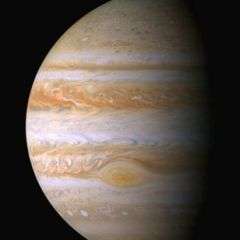
Jupiter will appear in the southeast each night as the sky darkens after sunset, and it will dominate the southern sky all night. Observers with telescopes will have several hours of good viewing before atmospheric disturbances start interfering as the planet sinks lower.
Venus will be the "evening star" low in the west after sunset, easily outshining everything else in that part of the sky. During the first two weeks of August, Venus will close in on Saturn to its upper left (south), passing close by the bright star Regulus on Aug. 5.
Venus and Saturn will be closest on Aug. 13. They will be joined by Mercury between Aug. 14 and 16, when the three planets will form a tight triangle. The triangle will be different each night as the planets change places. For observers at mid-northern latitudes, the whole group will be low in the western sky just 30 minutes after sunset, and only Venus will be easy to find without binoculars. People farther south will see these planets significantly higher above the horizon. There won't be another trio of planets this close together until 2011.
Mars will be more than 100 times dimmer than Venus, about the same distance to the upper left of Saturn as Venus is to Saturn's lower right on Aug. 1. You'll need binoculars to spot Mars in the bright twilight.
Viewing information and graphics for the planets are available at www.space.com/spacewatch/ .
Solar eclipse
A total eclipse of the sun will occur on Aug. 1 across far-northern Canada, the Arctic, Siberia and northern China. People in much of Europe, the Middle East and southern Asia will see at least a partial eclipse. For details see: www.skyandtelescope.com/observ … g/home/25521314.html .
Lunar eclipse
The moon will pass through Earth's shadow on the night of Aug. 16-17, causing a deep partial eclipse of the moon for those in South America, Africa, Europe and most of Asia. A map showing where the eclipse will be visible can be seen at: www.skyandtelescope.com/observ … lights/25523074.html .
Light pollution
If you look at the constellation Cassiopeia on a clear summer night, and you can't see the Milky Way sprawling high across the sky from the northern to the southern horizon, then your sky has significant light pollution -- and that's the case for about two-thirds of the world's population. See www.darksky.org/ for information on this dimming of the night sky caused by excessive artificial lighting, much of which is wasted.
Moon phases
The moon will be at first quarter on Aug. 8, full on Aug. 16, at third quarter on Aug. 23 and new on Aug. 30.
Provided by Indiana University


