World's smallest snake found in Barbados
August 3, 2008
World's smallest snake found in Barbados

Enlarge

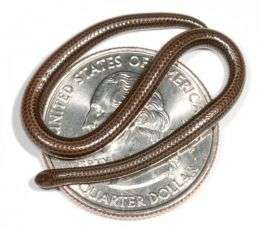
The snake named Leptotyphlops carlae, as thin as a spaghetti noodle, is resting on a US quarter. Blair Hedges, professor of biology at Penn State University, discovered the species and determined that it is the smallest of the more than 3,100 known snake species. Image: Blair Hedges, Penn State

(PhysOrg.com) -- The world's smallest species of snake, with adults averaging just under four inches in length, has been identified on the Caribbean island of Barbados. The species -- which is as thin as a spaghetti noodle and small enough to rest comfortably on a U.S. quarter --was discovered by Blair Hedges, an evolutionary biologist at Penn State. Hedges and his colleagues also are the discoverers of the world's smallest frog and lizard species, which too were found on Caribbean islands. The most recent discovery will be published on 4 August 2008 in the journal Zootaxa.

Hedges found the new snake -- a type of threadsnake -- in a tiny forest fragment on the eastern side of Barbados. He believes the species is rare because most of its potential habitat has been replaced by buildings and farms. "Habitat destruction is a major threat to biodiversity throughout the world," he said. "The Caribbean is particularly vulnerable because it contains an unusually high percentage of endangered species and, because these animals live on islands, they have nowhere to go when they lose their habitat."

Hedges determined that the Barbados species is new to science on the basis of its genetic differences from other snake species and its unique color pattern and scales. He also determined that some old museum specimens that had been misidentified by other scientists actually belong to this new species.

Scientists use adults to compare sizes among animals because the sizes of adults do not vary as much as the sizes of juveniles and because juveniles can be harder to find. In addition, scientists seek to measure both males and females of a species to determine its average size. Using these methods, Hedges determined that this species, which he named Leptotyphlops carlae, is the smallest of the more than 3,100 known snake species.

According to Hedges, the smallest and largest species of animals tend to be found on islands, where species can evolve over time to fill ecological niches in habitats that are unoccupied by other organisms. Those vacant niches exist because some types of organisms, by chance, never make it to the islands. For example, if a species of centipede is missing from an island, a snake might evolve into a very small species to "fill" the missing centipede's ecological niche.

Hedges thinks the Barbados snake may be at or near the minimum possible size for snakes, though he cannot say for sure that no smaller species exists -- several other snake species are nearly as small. While it is possible that a smaller species exists, finding such an animal is unlikely. "Snakes may be prevented by natural selection from becoming too small because, below a certain size, there may be nothing for their young to eat," said Hedges, adding that the Barbados snake, like others to which it is related, likely feeds primarily on the larvae of ants and termites.

In contrast to larger species -- some of which can lay up to 100 eggs in a single clutch -- the smallest snakes, and the smallest of other types of animals, usually lay only one egg or give birth to one offspring. Furthermore, the smallest animals have young that are proportionately enormous relative to the adults. For example, the hatchlings of the smallest snakes are one-half the length of an adult, whereas the hatchlings of the largest snakes are only one-tenth the length of an adult. The Barbados snake is no exception to this pattern. It produces a single slender egg that occupies a significant portion of the mother's body.

"If a tiny snake were to have two offspring, each egg could occupy only half the space that is devoted to reproduction within its body. But then each of the two hatchlings would be half the normal size, perhaps too small to function as a snake or in the environment," said Hedges. "The fact that tiny snakes produce only one massive egg -- relative to the size of the mother -- suggests that natural selection is trying to keep the size of hatchlings above a critical limit in order to survive."

Hedges has discovered and described more than 65 new species of amphibians and reptiles throughout the Caribbean in the course of his genetic and evolutionary studies. In the paper in which he describes the Leptotyphlops carlae snake that he discovered on Barbados, he also describes another new snake that he discovered on the nearby island of St. Lucia, a new threadsnake that is nearly as small as the Barbados snake. Finding new species, collecting them, and naming them is a necessary first step for other types of research. Hedges said this exploration and discovery of new species also is critical for protecting biodiversity. "It is difficult to protect a species if you don't know it exists," he said.

Provided by Penn State

4.6 /5 (32 votes)  

Filter


Move the slider to adjust rank threshold, so that you can hide some of the comments.


Display comments: newest first

Star_Gazer
Aug 03, 2008

Rank: 1 / 5 (1)
Thanks for finding it, I won't loose it again!
xen_uno
Aug 03, 2008

Rank: 4 / 5 (2)
"The Caribbean is particularly vulnerable because it contains an unusually high percentage of endangered species and, because these animals live on islands, they have nowhere to go when they lose their habitat."

... absolutely sickening ... god damn greedy humans will destroy everything that can't be bought, sold, eaten, squatted on, or simply left alone. If we as a species don't start honoring other creatures by allowing them the same life, liberty, and the pursuit of happiness we afford our own, then I welcome our extinction.
earls
Aug 03, 2008

Rank: 1 / 5 (2)
"Survival of the Fittest"
Rank 4.6 /5 (32 votes)
Related Stories
Relevant PhysicsForums posts

More news stories

Big Society could threaten biodiversity conservation

A study of the Moray Firth Seal Management Plan (MFSMP), in north-east Scotland, identified four key conditions for long-term success, three of which pointed to the importance of direct government involvement.

Biology / Ecology

created 1 hour ago | popularity not rated yet | comments 0

New molecule has potential to help treat genetic diseases and HIV

(PhysOrg.com) -- Chemists at The University of Texas at Austin have created a molecule that's so good at tangling itself inside the double helix of a DNA sequence that it can stay there for up to 16 days before ...

Biology / Plants & Animals

created 3 hours ago | popularity 5 / 5 (2) | comments 0 | with audio podcast

Biobased approaches examined in fight against zebra chip

Thanks to investigations by scientists-turned-detectives with the U.S. Department of Agriculture (USDA) and other agencies, potato growers in the western United States and abroad now know the identities of ...

Biology / Ecology

created 1 hour ago | popularity not rated yet | comments 0

Integrated pest management recommendations for the southern pine beetle

The southern pine beetle, Dendroctonus frontalis Zimmermann, is a chronic insect pest within pine forests in the southeastern United States. Under favorable environmental and host conditions, it is an agg ...

Biology / Ecology

created 6 hours ago | popularity not rated yet | comments 0

A mitosis mystery solved: How chromosomes align perfectly in a dividing cell

Although the process of mitotic cell division has been studied intensely for more than 50 years, Whitehead Institute researchers have only now solved the mystery of how cells correctly align their chromosomes during symmetric ...

Biology / Cell & Microbiology

created 21 hours ago | popularity 4.5 / 5 (24) | comments 0 | with audio podcast


Fast photon control brings quantum photonic technologies closer

(PhysOrg.com) -- Using photons instead of electrons to transmit information could lead to faster and more secure ways to communicate, among other advantages. Now a team of physicists has taken another step toward realizing ...

Planck mission steps closer to the cosmic blueprint

(PhysOrg.com) -- ESA's Planck mission has revealed that our Galaxy contains previously undiscovered islands of cold gas and a mysterious haze of microwaves. These results give scientists new treasure to mine ...

New ability to regrow blood vessels holds promise for treatment of heart disease

(Medical Xpress) -- University of Texas at Austin researchers have demonstrated a new and more effective method for regrowing blood vessels in the heart and limbs — a research advancement that could have ...

Slowing ocean current caused Earth to spin faster

(PhysOrg.com) -- Most people probably didn’t notice it, but back in 2009, the Earth spun around on its axis a tiny bit faster than usual, making for some slightly shorter days. It only happened for a ...

Myths and shame keep many from seeking bankruptcy protection

(PhysOrg.com) -- Two interesting facts that may counter modern ideas about bankruptcy: The overwhelming majority of U.S. filings belong to individuals rather than corporations or entities, and most of these ...

Motivation to exercise affects behavior

(Medical Xpress) -- For many people, the motivation to exercise fluctuates from week to week, and these fluctuations predict whether they will be physically active, according to researchers at Penn State. In an effort to ...