Antarctic fossils paint a picture of a much warmer continent
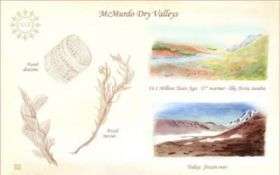
National Science Foundation-funded scientists working in an ice-free region of Antarctica have discovered the last traces of tundra--in the form of fossilized plants and insects--on the interior of the southernmost continent before temperatures began a relentless drop millions of years ago.
An abrupt and dramatic climate cooling of 8 degrees Celsius, over a relatively brief period of geological time roughly 14 million years ago, forced the extinction of tundra plants and insects and tranformed the interior of Antarctica into a perpetual deep-freeze from which it has never emerged.
The international team of scientists headed by David Marchant, an earth scientist at Boston University and Allan Ashworth and Adam Lewis, geoscientists at North Dakota State University, combined evidence from glacial geology, paleoecology, dating of volcanic ashes and computer modeling, to report a major climate change centered on 14 million years ago. The collaboration resulted in a major advance in the understanding of Antarctica's climatic history.
NSF, in its role as the manager of the United States Antarctic Program, supported Ashworth's, Lewis', and Marchant's research as well as U.S. researchers from Lamont-Doherty Earth Observatory, Ohio State University and the University of Montana.
Their findings appear in the Aug. 4 edition of the Proceedings of the National Academy of Sciences.
"To me, the most interesting part of the whole story is that we've documented the timing and the magnitude of a tremendous change in Antarctic climate: the transition marks a shift from warm, temperate glaciers with patches of fringing tundra to today's cold-polar glaciers set within in a barren polar desert," said Marchant. "The contrast couldn't be more striking. It is like comparing Tierra del Fuego today with the surface of Mars--and this transition took place over a geologically short interval of roughly 200,000 years."
The discovery of lake deposits with perfectly preserved fossils of mosses, diatoms and ostracods, a type of small crustacean, is particularly exciting to scientists, noted Lewis. Fossils are extremely rare in Antarctica, especially those of terrestrial and freshwater plants and animals.
"They are the first to be found even though scientific expeditions have been visiting the Dry Valleys since their discovery during the first Scott expedition in 1902-1903," said Lewis. Robert Falcon Scott was a British Antarctic explorer who perished during an attempt to the first to reach the South Pole in 1912.
For Ashworth the fossils are a scientific treasure trove.
He said he was particularly struck that some species of diatoms and mosses are indistinguishable from living creatures. Today, these species occur throughout the world, except in Antarctica.
"To be able to identify living species amongst the fossils is phenomenal. To think that modern counterparts have survived 14 million years on Earth without any significant changes in the details of their appearances is striking. It must mean that these organisms are so well-adapted to their habitats that in spite of repeated climate changes and isolation of populations for millions of years they have not become extinct but have survived" said Ashworth, the principal paleoecologist in the research.
What makes the fossils especially valuable is that their context is known following years of detailed mapping of ancient glacial deposits in the western Olympus and Asgard mountain ranges of Antarctica by Marchant and Lewis. As part of their research, they discovered volcanic ashes which have been dated at Lamont-Doherty geochronology labs by researchers Sidney Hemming and Malka Machlus, coauthors in the study.
Lewis added that the fossils are the best dated so far to come from Antarctica.
The fossil location today high in the mountains is a completely frozen landscape.
Marchant, Lewis and Ashworth, who often spend months living in tents in the Dry Valleys doing their research, all said that the fossil finds stretch their imagination about how the Antarctic continent once looked.
"The fossil finds allow us to examine Antarctica as it existed just prior to climate cooling at 13.9 million years ago. It is a unique window into the past. On land, there are very few places on Earth that contain sediment of this age, and none are as well preserved as those found in the Dry Valleys," Marchant said. "The sediments allow reconstructions of alpine glaciers, tundra and lakes, all in remarkable detail. To study these deposits is akin to strolling across the Dry Valleys 14.1 million years ago."
"What we're basically looking at," Lewis added "is the last hint of vegetation in the Dry Valleys." "The fossil finds and dating of volcanic ash show that roughly 14.1 million years ago, the area was home to tundra, "wet" glaciers typical of those of the mountains of Tierra Del Fuego in the high southern latitudes, and seasonally ice-free lakes. The beds of those long-gone lakes contain layers of sediments where detritus such as dying plants and insects would have settled and been preserved."
"And it's within these ancient lake beds that we found the fossils," said Lewis.
Ashworth's and the other paleoecologists' research shows that the lakes supported mosses and diatoms, and the surrounding margins were 'minimally colonized' by insects and shrubby vegetation."
At 14.1 million years ago, the Dry Valleys were relatively warm. By 13.9 million years ago, everything was different. The transition brought the Dry Valleys from a climate like that of South Georgia to one that has Mars as a close analog.
Tom Wagner, program director for Antarctic Earth Sciences in NSF's Office of Polar Programs, added that "Lewis, Marchant and Ashworth discovered the last bit of life on the Antarctic continent. It was hanging on by its fingernails--just a few simple plants and bugs in a small pond, everything else around them frozen over--and then, wham!, they went too. And it must have happened quickly because these fossils are literally freeze dried. When I visited the scientists in the field, they showed me how the moss was still green and leafy."
"It is one of the most dramatic and long-lasting changes that one can imagine," Marchant said. "I don't know of any other place on Earth where such an enduring change has been documented; the fact that it is associated with the extinction of tundra plants and insects helps provide quantitative estimates for the magnitude of this change."
The mean summertime temperatures would have dropped in that period by as much as 8 degrees Celsius. On average, the summertime temperatures in the Valleys during this temperate period would have been as much as 17 degrees warmer than the present-day average. What caused the change, Marchant said, "Is really a big unknown", though theories abound and include phenomena as different as the levels of carbon dioxide in the atmosphere and tectonic shifts that affected ocean circulation.
According to Lewis, the freshness of the crystals and glass in the volcanic ash and the preservation of cellular detail in the fossils argues that they have been permanently frozen since 13.9 million years ago. The climate changed during those millions of years but the temperatures in the mountains never rose high enough to allow groundwater to flow and microorganisms to become active.
This conclusion suggests that even when global atmospheric temperatures were warmer than they are now, as occurred--approximately 3.5 million years ago during the Pliocene Epoch--and as might occur in the near future as a consequence of global warming, there was no significant melting of the East Antarctic ice sheet inland of the Dry Valleys, nor were there dramatic changes in environmental conditions in the fossil region.
If this conclusion stands the test of time, it suggests a very robust ice sheet in this sector of Antarctica, and stresses the complex and potentially non-uniform response of Antarctica's ice sheets to global change.
Wagner also noted, "Other scientists had been to this area before, but hadn't noticed anything unusual. It took the trained eye of this team to make the discovery."
Source: National Science Foundation


