Scientists discover 'Planet of the Apes'
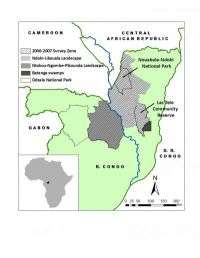
The world's population of critically endangered western lowland gorillas received a huge boost today when the Wildlife Conservation Society released a census showing massive numbers of these secretive great apes alive and well in the Republic of Congo.
The new census tallied more than 125,000 western lowland gorillas in two adjacent areas in the northern part of the country, covering an area of 18,000 square miles (47,000 square kilometers). Previous estimates from the 1980s placed the entire population of western lowland gorillas, which occur in seven Central African nations, at less than 100,000. Since then, however, scientists had believed that this number had at least halved, due to hunting and disease.
The census data were released at a press conference at the International Primatological Society Congress in Edinburgh, Scotland. The WCS scientists who worked on the census include Fiona Maisels, Richard Malonga, Hugo Rainey, Emma Stokes, and Samantha Strindberg.
The new census was the result of intensive field work carried out by the Bronx Zoo-based WCS and the Government of Republic of Congo, where researchers combed rainforests and isolated swamps to count gorilla "nests" to accurately estimate the population. Gorillas construct nests each night from leaves and branches for sleeping. Population densities ranged as high as eight individuals per square kilometer in one particularly rich forest patch, which ranks as among the highest gorilla densities ever recorded.
WCS says a combination of factors led to such high numbers of gorillas including: successful long-term conservation management of the Republic of Congo's protected areas; remoteness and inaccessibility of some of the key locations where the gorillas were found; and a food-rich habitat, particularly in some of the swamp forests and the herb-rich "Marantaceae" forests.
WCS has worked with the Government of Republic of Congo in the northern area of the country for nearly 20 years, helping establish the Nouabalé-Ndoki National Park and manage the Lac Tele Community Reserve while working with logging companies outside of protected areas to reduce illegal hunting.
"These figures show that northern Republic of Congo contains the mother lode of gorillas," said Dr. Steven E. Sanderson, President and CEO of the Wildlife Conservation Society. "It also shows that conservation in the Republic of Congo is working. This discovery should be a rallying cry for the world that we can protect other vulnerable and endangered species, whether they be gorillas in Africa, tigers in India, or lemurs in Madagascar."
In all, the researchers estimated a total of 125,000 gorillas in just this northern Congo area. Seventy three thousand came from the Ntokou-Pikounda region and another 52,000 from the Ndoki-Likouala landscape—including a previously unknown population of nearly 6,000 gorillas living in an isolated Raphia swamp. WCS cautioned that many of the gorillas live outside of existing protected areas, though the Government of Congo has committed to creating a new national park in the Ntokou-Pikounda region.
"We knew from our own observations that there were a lot of gorillas out there, but we had no idea there were so many," said Dr. Emma Stokes, who led the survey efforts in Ndoki-Likouala. "We hope that the results of this survey will allow us to work with the Congolese government to establish and protect the new Ntokou-Pikounda protected area."
Mr. Claude Etienne Massimba of the Government of Republic of Congo's Department of Wildlife and Protected Areas said, "We hope that these results will speed up the classification of the Ntokou-Pikounda zone into a protected area."
Across Central Africa, gorillas face the looming threats of hunting for bushmeat and the spread of the Ebola virus, which is lethal to gorillas as well as humans. WCS is working with partners to combat Ebola, eliminate commercial hunting, and secure this last stronghold for Africa's apes.
Many gorilla conservation projects are funded through two primary programs of the federal government—the Congo Basin Forest Partnership at the U.S. Agency for International Development and the Great Apes Conservation Fund at the U.S. Fish and Wildlife Service. Both of these programs are at risk of being cut in the Fiscal Year 2009 federal budget. Although the budget process in Washington has stalled, WCS is calling for Congress to restore and grow these programs by completing work on the Fiscal Year 2009 budget before the end of September.
Source: Wildlife Conservation Society


