NASA data show some African drought linked to warmer Indian Ocean
August 5, 2008 NASA data show some African drought linked to warmer Indian Ocean

Enlarge

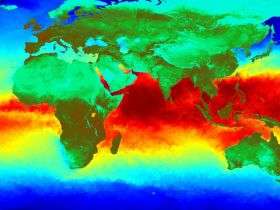
Sea surface temperatures and land vegetation over the Indian Ocean are seen below in a visualization created with data from 1994 to 2005 from the Pathfinder satellite dataset. Credit: NASA

A new study, co-funded by NASA, has identified a link between a warming Indian Ocean and less rainfall in eastern and southern Africa. Computer models and observations show a decline in rainfall, with implications for the region's food security.

Rainfall in eastern Africa during the rainy season, which runs from March through May, has declined about 15 percent since the 1980s, according to records from ground stations and satellites. Statistical analyses show that this decline is due to irregularities in the transport of moisture between the ocean and land, brought about by rising Indian Ocean temperatures, according to research published today in Proceedings of the National Academy of Sciences. This interdisciplinary study was organized to support U.S. Agency for International Development's Famine Early Warning Systems Network.

"The last 10 to 15 years have seen particularly dangerous declines in rainfall in sensitive ecosystems in East Africa, such as Somalia and eastern Ethiopia," said Molly Brown of NASA's Goddard Space Flight Center, Greenbelt, Md., a co-author of the study. "We wanted to know if the trend would continue or if it would start getting wetter."

To find out, the team analyzed historical seasonal rainfall data over the Indian Ocean and the eastern seaboard of Africa from 1950 to 2005. The NASA Global Precipitation Climatology Project's rainfall dataset provided a series of data covering both the land and the oceans. They found that declines in rainfall in Ethiopia, Kenya, Tanzania, Zambia, Malawi and Zimbabwe were linked to increases in rainfall over the ocean.

The team used computer models that describe the atmosphere and historical climate data to identify and validate the source of this link. Lead author Chris Funk of the University of California, Santa Barbara, and colleagues showed that the movement of moisture onshore was disrupted by increased rainfall over the ocean.

Funk and colleagues used a computer model from the National Center for Atmospheric Research to confirm their findings. The combination of evidence from models and historical data strongly suggest that human-caused warming of the Indian Ocean leads to an increase of rainfall over the ocean, which in turn adds energy to the atmosphere. Models showed that indeed, the added energy could create a weather pattern that reduces the flow of moisture onshore and bring dry air down over the African continent, reducing rainfall.

Next, the team investigated whether or not the decline in rainfall over eastern Africa would continue. Under guidance from researchers at USGS, which co-funded the study, the team looked at 11 climate models to simulate rainfall changes in the future. Ten of the 11 models agreed that though 2050, rainfall over the Indian Ocean would continue to increase – depriving Africa's eastern seaboard of rainfall.

"We can be quite certain that the decline in rainfall has been substantial and will continue to be," Funk said. "This 15 percent decrease every 20-25 years is likely to continue."

The trend toward dryer rainy seasons in eastern and southern Africa directly impacts agricultural productivity. To evaluate how potential future rainfall scenarios and shifts in agriculture could affect undernourishment, the team came up with a "food-balance indicator" model. The model considers factors such as growing-season rainfall, fertilizer, seed use, crop area and population to estimate the number of undernourished people a region can anticipate.

Continuing along a "business as usual" scenario – with current trends in declining rainfall and agricultural capacity continuing as it is currently to 2030, the team found that the number of undernourished people will increase by more than 50 percent in eastern Africa.

Still, the food-balance indicator also showed that in the face of a continuation of the current downward trend in rainfall, even modest increases in agricultural capacity could reduce the number of undernourished people by 40 percent.

"A strong commitment to agricultural development by both African nations and the international community could lead fairly quickly to a more food-secure Africa," Funk said.

Source: Goddard Space Flight Center, by Kathryn Hansen


print this article email this article download pdf blog this article bookmark this article     Stumble it Digg this share on Facebook retweet share on Reddit add to delicious
Rate this story - 2.6 /5 (15 votes)

Rank Filter

Move the slider to adjust rank threshold, so that you can hide some of the comments.


Display comments: newest first

  • marjon - Aug 05, 2008
    • Rank: 3.9 / 5 (7)
    "The combination of evidence from models and historical data strongly suggest that human-caused warming of the Indian Ocean leads to an increase of rainfall over the ocean, which in turn adds energy to the atmosphere."

    Of course, it must be AGW. Where is the evidence for this?
  • gmurphy - Aug 05, 2008
    • Rank: 2.3 / 5 (6)
  • Velanarris - Aug 05, 2008
    • Rank: 3 / 5 (8)
    Or it could be that solar energy is at an all time high over that period of 50 someodd years resulting in less rainfall, more atmospheric water vapor, and drought conditions.

    Funny how you'd think that rain over Rhode Island could end up in Massachusetts due to the northern hemisphere's jet stream but you'd never think the southern hemisphere's jet stream would be capable at all of blowing rains over Western Africa from the Indian ocean.........

    This global warming human impact foolishness is completely out of hand. Human beings contribute less than 1% to the total carbon mass in our atmosphere. We're so much smaller than we realize and so we make ourselves pay for natural processes rather than just set up irrigation in the area so the native people can grow food, drink clean water, and bring themselves into the first world.
  • drel - Aug 05, 2008
    • Rank: 3.5 / 5 (8)
    Careful Velanarris or the "Carbonuts" will be after you!

    I did not know we (humans) had specifically targeted the Indian Ocean for heating. It must be a secret plot of all the evil big oil corporations.
    Step 1 = Heat Indian Ocean...
    Step 2 =
    Step 3 = Profit

    (Sorry for the lack of Science in this post, I'm just following AGW's lead)
  • Velanarris - Aug 05, 2008
    • Rank: 3 / 5 (6)
    Careful Velanarris or the "Carbonuts" will be after you!


    Well true, I must be careful. What they say about arguing with idiots is true. Don't do it, they'll bring you down to their level and beat you with experience.
  • NotParker - Aug 05, 2008
    • Rank: 3.7 / 5 (6)
    The Aquos satellite showed ocean cooling over the last 5 years.

    http://www.scienc...3321.htm
  • GrayMouser - Aug 06, 2008
    • Rank: 2 / 5 (4)
    They aren't "Carbonuts".

    They are Eco-Nazis!
  • Bazz - Sep 27, 2008
    • Rank: not rated yet
    No no no! they are clearly Eco-Communists their main foor is carbonuts.

    The Nazi-climate is their nemesis, its bad because its facist.

    Rational thinking people are seen by them as facist appeasers wich should be executed for treason of the Scientist-belief, they refuse to bow for them and are evildoers.

    There is no reasoning with them they are clearly delusional, they are so indoctorated in thinking the way The Man wants them to that they come up with all sorts of facts Science-belief clearly made up.

    Its not a conspiracy ,the corrupt government,enviromorontalists, Scientific-bullievers, mainstream media and communist/socialist liberals are working openly together to create this nonsense.

    Dont believe the hype, think rationally what we think.

August 5, 2008 all stories

Comments: 8

2.6 /5 (15 votes)
  • Stumble this up

  • Digg this

  • share this

  • hide
  • Related Stories


  • hide
  • Relevant PhysicsForums posts

  • Is there any scientific explanation for increasingly violent natural disasters?
    created 7 hours ago
  • Rocks
    created Nov 11, 2009
  • Himalayan glaciers
    created Nov 11, 2009
  • upcoming GRL paper shows CO2 fraction is constant
    created Nov 11, 2009
  • Is there a point to buying organic?
    created Nov 11, 2009
  • cycles
    created Nov 08, 2009
  • More from Physics Forums - Earth

Other News

NASA on track for Monday space shuttle launch (AP)

NASA on track for Monday space shuttle launch

Space & Earth / Space Exploration

created 14 hours ago | popularity 3 / 5 (1) | comments 0

(AP) -- NASA has cleared space shuttle Atlantis for liftoff Monday on a trip to stock up the International Space Station with several years' worth of spare parts.


LCROSS Impact Data Indicates Water on Moon

LCROSS Impact Finds Water on the Moon

Space & Earth / Space Exploration

created Nov 13, 2009 | popularity 4.9 / 5 (27) | comments 10

(PhysOrg.com) -- The argument that the moon is a dry, desolate place no longer holds water. Secrets the moon has been holding, for perhaps billions of years, are now being revealed to the delight of scientists ...


Controversial new climate change results

Controversial new climate change results

Space & Earth / Environment

created Nov 10, 2009 | popularity 4.1 / 5 (37) | comments 81

(PhysOrg.com) -- New data show that the balance between the airborne and the absorbed fraction of CO2 has stayed approximately constant since 1850, despite emissions of CO2 having risen from about 2 billion ...


Greenland ice cap melting faster than ever

Greenland ice cap melting faster than ever

Space & Earth / Earth Sciences

created Nov 12, 2009 | popularity 3.5 / 5 (30) | comments 23

Satellite observations and a state-of-the art regional atmospheric model have independently confirmed that the Greenland ice sheet is loosing mass at an accelerating rate, reports a new study in Science.


Exoplanets Clue to Sun's Curious Chemistry

Exoplanets Clue to Sun's Curious Chemistry

Space & Earth / Astronomy

created Nov 11, 2009 | popularity 4.7 / 5 (18) | comments 13

(PhysOrg.com) -- A ground-breaking census of 500 stars, 70 of which are known to host planets, has successfully linked the long-standing "lithium mystery" observed in the Sun to the presence of planetary systems. ...