Remedial instruction rewires dyslexic brains, provides lasting results, study shows
August 5, 2008
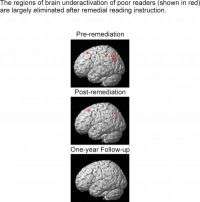
The regions of brain underactivation in poor readers (shown in red) are largely eliminated after remedial reading instruction. Credit: Tim Keller, Ph.D.
A new Carnegie Mellon University brain imaging study of dyslexic students and other poor readers shows that the brain can permanently rewire itself and overcome reading deficits, if students are given 100 hours of intensive remedial instruction.
The study, published in the August issue of the journal Neuropsychologia, shows that the remedial instruction resulted in an increase in brain activity in several cortical regions associated with reading, and that neural gains became further solidified during the year following instruction.
"This study demonstrates how remedial instruction can use the plasticity of the human brain to gain an educational improvement," said neuroscientist Marcel Just, director of Carnegie Mellon's Center for Cognitive Brain Imaging (CCBI) and senior author of the study. "Focused instruction can help underperforming brain areas to increase their proficiency."
Using functional magnetic resonance imaging (fMRI), scientists investigated the changes in a number of cortical regions located in the parietotemporal area, which is responsible for decoding the sounds of written language and assembling them into words and phrases that make up a sentence.
CCBI research fellows Ann Meyler and Tim Keller measured brain activity patterns by examining blood flow to all of the different parts of the brain while children were reading. Those measurements showed that prior to the remediation, the parietotemporal areas were significantly less activated among the poor readers than in the control group.
The new findings showed that many of the poor readers' brain areas activated at near-normal levels immediately after remediation, with only a few areas still underactive. However, at the one year follow-up scan, the activation differences between good and poor readers had nearly vanished, suggesting that the neural gains were strengthened over time, probably just due to engagement in reading activities.
These findings that point to the parietotemporal region's role in reading contradict a common perception that dyslexia is primarily caused by difficulties in the visual perception of letters, leading to confusions between letters like "p" and "d."
Visual difficulties are only at fault in about 10 percent of dyslexia cases. The most common cause, accounting for more than 70 percent of dyslexia, is a difficulty in relating the visual form of a letter to its sound, which is not a straightforward process in the English language. The same parietotemporal areas of the brain that showed increased activity following instruction are centrally involved in this sound-based processing.
The poor readers, 25 fifth-graders from Pittsburgh and its surrounding communities, worked in groups of three for an hour a day with a teacher specialized in administering a remedial reading program. The training included both word decoding exercises in which students were asked to recognize the word in its written form and tasks in using reading comprehension strategies.
This brain imaging study was also the first in which children were tested on their understanding of sentences, not just on their recognition of single words. The sentences were relatively straightforward ones, which the children judged as being sensible or nonsense, such as "The girl closed the gate" and "The man fed the dress." The children's accurate sensibility judgments ensured that they were actually processing the meaning of the sentences, and not just recognizing the individual words.
The research's implications may reach far beyond improving literacy skills. Just noted that the brain's capacity to adapt as the result of targeted instruction has the potential to influence the remedial learning process in other subject areas, as well.
"Any kind of education is a matter of training the brain. When poor readers are learning to read, a particular brain area is not performing as well as it might, and remedial instruction helps to shape that area up," he said. "This finding shows that poor readers can be helped to develop buff brains. A similar approach should apply to other skills."
Additionally, the concrete evidence of improvement demonstrated in this study may be valuable in evaluating the effectiveness of a teaching approach or curriculum, or could even be used to shape education policy. "We are at the beginning of a new era of neuro-education," Just said.
Source: Carnegie Mellon University
-
New CMU brain imaging research reveals why autistic individuals confuse pronouns
Aug 01, 2011 |
5 / 5 (1) |
0
-
Learning to read is good for the brain
Nov 12, 2010 |
4.8 / 5 (11) |
3
-
Scientists discover first evidence of brain rewiring in children
Dec 09, 2009 |
5 / 5 (8) |
0
-
Brain imaging study illustrates how remedial instruction helps poor readers
Jun 11, 2008 |
4.6 / 5 (8) |
0
-
Making the worms turn
Feb 03, 2012 |
not rated yet |
0
-
Engineers build first sub-10-nm carbon nanotube transistor
Feb 01, 2012 |
4.9 / 5 (33) |
30
-
Something old, something new: Evolution and the structural divergence of duplicate genes
Jan 31, 2012 |
4.6 / 5 (7) |
1
-
The hidden nanoworld of ice crystals: Revealing the dynamic behavior of quasi-liquid layers
Jan 30, 2012 |
5 / 5 (4) |
1
-
Stock market network reveals investor clustering
Jan 27, 2012 |
3.9 / 5 (23) |
8
-
Of microchemistry and molecules: Electronic microfluidic device synthesizes biocompatible probes
Jan 26, 2012 |
5 / 5 (2) |
0
-
Is Everyday Technology Killing Us?
Feb 08, 2012
-
Exercise and weight loss
Feb 08, 2012
-
Why do we have head aches? Our brains can't feel anything.
Feb 07, 2012
-
"The end of diseases" by David Agus, interview from Daily Show with Jon Stewart
Feb 04, 2012
-
Oncolytic adenovirus
Feb 04, 2012
-
Nutrition label stuffs and diets
Feb 02, 2012
- More from Physics Forums - Medical Sciences
More news stories
Overeating may double risk of memory loss
New research suggests that consuming between 2,100 and 6,000 calories per day may double the risk of memory loss, or mild cognitive impairment (MCI), among people age 70 and older. The study was released today and will be ...
Medicine & Health / Neuroscience
35 minutes ago |
not rated yet |
0
|
Injured boomers beware: Know when to see doctor
(AP) -- It happened to nurse Jane Byron years after an in-line skating fall, business owner Haralee Weintraub while doing "men's" push-ups, and avid cyclist Gene Wilberg while lifting a heavy box.
5 hours ago |
5 / 5 (1) |
0
Starve a virus, feed a cure? Findings show how some cells protect themselves against HIV
A protein that protects some of our immune cells from the most common and virulent form of HIV works by starving the virus of the molecular building blocks that it needs to replicate, according to research published online ...
4 hours ago |
5 / 5 (1) |
0
|
FDA-approved drug rapidly clears amyloid from the brain, reverses Alzheimer's symptoms in mice
Neuroscientists at Case Western Reserve University School of Medicine have made a dramatic breakthrough in their efforts to find a cure for Alzheimer's disease. The researchers' findings, published in the journal Science, show t ...
Medicine & Health / Neuroscience
Feb 09, 2012 |
4.9 / 5 (57) |
15
|
Green tea found to reduce disability in the elderly
(Medical Xpress) -- A lot of research has been done over the past several years looking into the health benefits of green tea. As a result, scientists have found that regular consumption of the beverage leads ...
Google might launch Drive for cloud storage soon
(PhysOrg.com) -- Google's next big move, according to the Wall Street Journal, is a cloud storage service called Drive. Hardly first to the plate, Google is simply catching up to introducing its cloud reposi ...
Scientists discover molecular secrets of 2,000-year-old Chinese herbal remedy
For roughly two thousand years, Chinese herbalists have treated Malaria using a root extract, commonly known as Chang Shan, from a type of hydrangea that grows in Tibet and Nepal. More recent studies suggest that halofuginone, ...
New method to examine batteries -- MRI from the inside
There is an ever-increasing need for advanced batteries for portable electronics, such as phones, cameras, and music players, but also to power electric vehicles and to facilitate the distribution and storage of energy derived ...
Lab study raises questions over nano-particle impact
Tests involving chickens have raised questions about the impact on health from engineered nano-particles, the ultra-fine grains commonly used in drugs and processed foods, scientists said on Sunday.
A mitosis mystery solved: How chromosomes align perfectly in a dividing cell
Although the process of mitotic cell division has been studied intensely for more than 50 years, Whitehead Institute researchers have only now solved the mystery of how cells correctly align their chromosomes during symmetric ...
Researchers find extensive RNA editing in human transcriptome
In a new study published online in Nature Biotechnology, researchers from BGI, the world's largest genomics organization, reported the evidence of extensive RNA editing in a human cell line by analysis of RNA-seq data, demons ...