'Cosmic ghost' discovered by volunteer astronomer
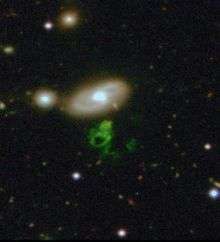
When Yale astrophysicist Kevin Schawinski and his colleagues at Oxford University enlisted public support in cataloguing galaxies, they never envisioned the strange object Hanny van Arkel found in archived images of the night sky.
The Dutch school teacher, a volunteer in the Galaxy Zoo project that allows members of the public to take part in astronomy research online, discovered a mysterious and unique object some observers are calling a "cosmic ghost."
van Arkel came across the image of a strange, gaseous object with a hole in the center while using the www.galaxyzoo.org website to classify images of galaxies.
When she posted about the image that quickly became known as "Hanny's Voorwerp" (Dutch for "object") on the Galaxy Zoo forum, astronomers who run the site began to investigate and soon realized van Arkel might have found a new class of astronomical object.
"At first, we had no idea what it was. It could have been in our solar system, or at the edge of the universe," said Schawinski, a member and co-founder of the Galaxy Zoo team.
Scientists working at telescopes around the world and with satellites in space were asked to take a look at the mysterious Voorwerp. "What we saw was really a mystery," said Schawinski. "The Voorwerp didn't contain any stars." Rather, it was made entirely of gas so hot — about 10,000 Celsius — that the astronomers felt it had to be illuminated by something powerful. They will soon use the Hubble Space Telescope to get a closer look.
Since there was no obvious source at hand in the Voorwerp itself, the team looked to find the source of illumination around the Voorwerp, and soon turned to the nearby galaxy IC 2497.
"We think that in the recent past the galaxy IC 2497 hosted an enormously bright quasar," Schawinski explains. "Because of the vast scale of the galaxy and the Voorwerp, light from that past still lights up the nearby Voorwerp even though the quasar shut down sometime in the past 100,000 years, and the galaxy's black hole itself has gone quiet."
"From the point of view of the Voorwerp, the galaxy looks as bright as it would have before the black hole turned off – it's this light echo that has been frozen in time for us to observe," said Chris Lintott, a co-organizer of Galaxy Zoo at Oxford University, UK. "It's rather like examining the scene of a crime where, although we can't see them, we know the culprit must be lurking somewhere nearby in the shadows." Similar light echoes have been seen around supernovae that exploded decades or centuries ago.
Quasars are very unusual, highly luminous objects, powered by supermassive black holes, and most are extremely distant. "The strange 'Hanny's Voorwerp' looks like it could be the nearest example of a luminous quasar," said C. Megan Urry, Israel Munson Professor of Physics & Astronomy and Chair of the Physics Department at Yale, who was not involved in the research.
"IC 2497 is so close that if the quasar was still shining today, on a good night you could probably see it with a small telescope," Schawinski added. "The nearest active quasar, called 3C 273, is 1.7 billion light years further away."
"This discovery really shows how citizen science has come of age in the Internet world," commented Professor Bill Keel of the University of Alabama, a galaxyzoo.org team member. "Hanny's attentiveness alerted us not only to a peculiar object, but to a window into the cosmic past which might have eluded us for a long time otherwise. Trying to understand the processes operating here has proven to be a fascinating challenge, involving a whole range of astrophysical techniques and instruments around the world and beyond. This has also been some of the most rewarding astronomy I've done in years!"
The Galaxy Zoo project was imagined and begun by Schawinski and his colleague Chris Lintott at Oxford. While working on his PhD thesis, Schawinski classified and catalogued nearly 50,000 galaxies. Knowing that the human eye is sometimes more sensitive than a computer at picking out unusual patterns, he mused that it would be wonderful if there were amateur astronomers who were interested in doing some of the "scanning."
"When we launched Galaxy Zoo we were overwhelmed — as was the internet portal, initially — with the outpouring of public interest and volunteer input," said Schawinski. During the last year, over 150,000 armchair astronomers from all over the world volunteered their time and submitted over 50 million classifications for a set of one million images online. They then could follow the progress of the science they made possible at www.galaxyzooblog.org .
"It's amazing to think that this object has been sitting in the archives for decades and that amateur volunteers can help by spotting things like this online," said Hanny van Arkel. "It was a fantastic present to find out on my 25th birthday that we will get observational time on the Hubble Space Telescope to follow-up this discovery."
The next stage of Galaxy Zoo will ask volunteers to search for more unusual astronomical objects. But, “Hanny's Voorwerp” remains a mystery. It’s huge central hole is over 16,000 light years across and Galaxy Zoo astronomers are still puzzling over what caused it.
Source: Yale University


