Researchers make milestone discovery in quantum mechanics
August 5, 2008
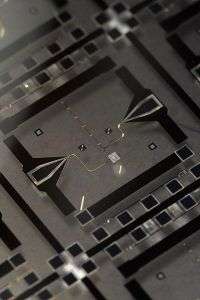
A close-up of one of the circuits used in the quantum mechanics experiment. Credit: UCSB photo
Researchers at UC Santa Barbara have recently reached what they are calling a milestone in experimental quantum mechanics.
In a paper published in the July 17 issue of the journal Nature, UCSB physicists Max Hofheinz, John Martinis, and Andrew Cleland documented how they used a superconducting electronic circuit known as a Josephson phase qubit, developed in Martinis's lab, to controllably pump microwave photons, one at a time, into a superconducting microwave resonator.
Up to six photons were pumped into and stored in the resonator, and their presence was then detected using the qubit, which acts like an electronic atom, as an analyzer. The photon number states, known as Fock states, have never before been controllably created, said Cleland.
"These states are ones you learn about in introductory quantum mechanics classes, but no one has been able to controllably create them before," Cleland said.
Using the same technique, the researchers also created another type of special state, known as a coherent state, in the superconducting resonator. These states are relatively easily generated, and appear to behave in a completely non-quantum mechanical fashion, but by using the same analysis technique, the UCSB researchers were able to demonstrate the expected underlying quantum behavior.
Hofheinz, a postdoctoral researcher from Germany who's been at UCSB for the past year working on this project, explained how the resonator works.
"The resonator is the electrical equivalent of a pendulum," Hofheinz said. "In quantum mechanics the energy, or amplitude of motion of this pendulum, only comes in finite steps, in quanta. We first carefully prepared the resonator in these quantum states, and showed we could do this controllably and then measure the states. Then we 'kicked' the pendulum directly, a method where the amplitude can take on any value, and appears to not be limited to these quanta. But when we look at the resonator with our qubit, we see that the amplitude does come in steps,
but that the resonator is actually in several such states at the same time, so that on average it looks like it is not limited to the quantum states."
Hofheinz spent several months in the UCSB Nanofabrication cleanroom fabricating the device used for the experiment. "This resonator, once you excite it, has to 'swing' for a very long time," he explained. "The first samples I fabricated stopped oscillating very quickly. We had to work to rearrange the fabrication method to get the resonator to oscillate longer."
He then fine-tuned the microwave electronics built by Martinis's group to emit the precisely shaped signals necessary to produce these exciting results.
Martinis, Cleland, and Hofheinz say that their research could help in the quest to build a possible quantum computer, which both the government and industry have been seeking for a long time. A quantum computer could be used to break – or make – the encryption codes most heavily used for secure communication.
"Harmonic oscillators might allow us to get a quantum computer built more quickly," Cleland said.
"I think if they really build one of these quantum computers, there will definitely be resonators in them," Hofheinz said.
Source: University of California - Santa Barbara
-
Physicists challenge classical world with quantum-mechanical implementation of 'shell game'
Jan 31, 2011 |
3.7 / 5 (9) |
8
-
Physicists Show Theory of Quantum Mechanics Applies to the Motion of Large Objects
Mar 17, 2010 |
4.8 / 5 (42) |
6
-
Fock states could hold clues to quantum memory components
Dec 23, 2008 |
4.5 / 5 (13) |
10
-
Physicists cool semiconductor by laser light
Jan 22, 2012 |
4.5 / 5 (11) |
2
-
Finnish team devise nanomechanical microwave amplifier with near least possible noise generation
Dec 15, 2011 |
4.8 / 5 (6) |
4
-
Engineers build first sub-10-nm carbon nanotube transistor
Feb 01, 2012 |
4.9 / 5 (31) |
30
-
Something old, something new: Evolution and the structural divergence of duplicate genes
Jan 31, 2012 |
4.6 / 5 (7) |
1
-
The hidden nanoworld of ice crystals: Revealing the dynamic behavior of quasi-liquid layers
Jan 30, 2012 |
5 / 5 (3) |
1
-
Stock market network reveals investor clustering
Jan 27, 2012 |
3.9 / 5 (23) |
8
-
Of microchemistry and molecules: Electronic microfluidic device synthesizes biocompatible probes
Jan 26, 2012 |
5 / 5 (1) |
0
-
Strength of induced magnetic field inside an inductor
2 hours ago
-
Physical laws .... are they material?!!
3 hours ago
-
increasing time of daylight
3 hours ago
-
Light & Sight
4 hours ago
-
Wind Turbine Power
7 hours ago
-
Steam Table issues
9 hours ago
- More from Physics Forums - General Physics
More news stories
Putting the squeeze on planets outside our solar system
(PhysOrg.com) -- Using high-powered lasers, scientists at Lawrence Livermore National Laboratory and collaborators discovered that molten magnesium silicate undergoes a phase change in the liquid state, abruptly ...
3 hours ago |
5 / 5 (1) |
0
|
Hovering not hard if you're top-heavy, researchers find
Top-heavy structures are more likely to maintain their balance while hovering in the air than are those that bear a lower center of gravity, researchers at New York University's Courant Institute of Mathematical Sciences ...
4 hours ago |
5 / 5 (1) |
1
|
SLAC, Stanford team focuses on high-energy electrons to treat cancer
Accelerator physicists at SLAC and cancer specialists from Stanford are working on a new technology that could dramatically reduce the time needed for cancer radiation treatments. The team ran an initial experiment ...
7 hours ago |
5 / 5 (1) |
0
Measurements from high-energy collisions lead to better understanding of why meson particles disappear
For several years, physicists at the Relativistic Heavy Ion Collider (RHIC) at Brookhaven National Laboratory (BNL), USA, have studied an unusual state of matter called the quarkgluon plasma, which they ...
7 hours ago |
5 / 5 (1) |
0
Quantum physicist explains $100K offer for proof scaled-up quantum computing is impossible
(PhysOrg.com) -- MIT researcher Scott Aaronson has certainly riled the physics community with his offer this past Friday, of $100,000 to anyone who can prove that scaled-up quantum computing is impossible. ...
Complex wiring of the nervous system may rely on a just a handful of genes and proteins
Researchers at the Salk Institute have discovered a startling feature of early brain development that helps to explain how complex neuron wiring patterns are programmed using just a handful of critical genes. ...
CIA website offline, Anonymous takes credit
The website of the Central Intelligence Agency was unresponsive on Friday after the hacker group Anonymous claimed to have knocked it offline.
Q&A: Obama and the birth control controversy
(AP) -- What birth control debate? A half-century after the introduction of the pill, acceptance of birth control by American women is virtually universal.
The power of estrogen -- male snakes attract other males
A new study has shown that boosting the estrogen levels of male garter snakes causes them to secrete the same pheromones that females use to attract suitors, and turned the males into just about the sexiest ...
New error-correcting codes guarantee the fastest possible rate of data transmission
Error-correcting codes are one of the triumphs of the digital age. Theyre a way of encoding information so that it can be transmitted across a communication channel such as an optical fiber o ...
Humans may have helped the decline of African rainforests 3000 years ago
(PhysOrg.com) -- Large areas of rainforests in Central Africa mysteriously disappeared over three thousand years ago, to be replaced by savannas. The prevailing theory has been that the cause was a change ...
Aug 05, 2008
Rank: 3.3 / 5 (3)
Is this a manifestation of interference?
For example, you have the underlying quantum of energies that interact (constructively/destructively interfere) producing a smooth gradient of energies?
Aug 05, 2008
Rank: 3.8 / 5 (4)
Similar harmonic current is a byproduct of plugging electronic equipment, switching DC power supplies, into 50/60Hz AC power outlets.
Some of the most menacing are the 3rd & 5th harmonics. These harmonic currents can add onto the unfused neutral conductors, turning them black with heat and sometimes causing fires.
The mechanics of this noise is less studied than the predictable harmonic spectrum that follows the confines of the conductor. The end result is a product of interference. Some particularly menacing equipment has a published harmonic signature, which can be located by measurement and followed upstream to its source.
Aug 05, 2008
Rank: 2.5 / 5 (2)
Aug 06, 2008
Rank: 2.5 / 5 (2)
Aug 06, 2008
Rank: 3.5 / 5 (2)
It's funny, any news related to QM always "might" allow to build quantum computers.
Aug 13, 2008
Rank: not rated yet
...it's not always practical to build quantum based technology. You can build a quantum computer, it's just going to cost way too much and it won't do much...quantum level things are not easy to control so the "might" generally means "this could be an easy way to build a chip" so it's all a big work in progress.