Multi-tasking maggots in superbug showdown
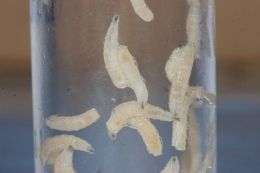
August 5, 2008 Blowfly larvae

Enlarge

Blowfly larvae

Scientists at Swansea University (Wales, UK) have discovered a new type of antibiotic in maggot secretions that can tackle up to 12 different strains of MRSA, as well as E. coli and C. difficile. The research was funded by leading charity Action Medical Research, with support from the Rosetrees Trust.

The antibiotic, named Seraticin™, is derived from the maggot secretions of the common green bottle fly (Lucilia sericata) and scientists hope to develop it into an injection, pill or ointment.

So far, they have purified Seraticin™ and undertaken the study of its structure and the mechanism by which it prevents infection. The next steps will be to complete the identification of the compound and develop a way to synthesise it. It can then be tested on human cells and eventually in clinical trials in order to determine its medical effectiveness and properties as a novel antibiotic.

MRSA infections cause suffering, amputations and death, not to mention the estimated £1 billion cost to the NHS. Between 2002 and 2006, 6,201 deaths in England and Wales involved MRSA and 15,683 deaths in England and Wales involved C. difficile. The rapid rise in antibiotic-resistant bacteria means that scientists urgently need to find a solution.

Using live maggots on infected wounds is an age-old method of tackling infection and they work with amazing speed. It’s not uncommon for someone to suffer from chronic infected wounds for 18 months, despite all sorts of conventional treatment, but when maggots are applied to the same wound they can often begin to clear infection in just a few days. They have even been known to save people from having limbs amputated.

Dr Yolande Harley of Action Medical Research said: “The discovery of a potential new antibiotic is an exciting advance. It could mean a possible novel treatment for people with chronic wounds that are infected with MRSA or other bugs. By developing the pure antibiotic into a formula, such as a cream, it could reduce the contact patients need to have with live maggots to heal wounds. It could also offer a potential treatment, such as an injection or pill, for internal infections like C. difficile.”

Professor Norman Ratcliffe, a principal researcher on the project at Swansea University, said: “It has been a huge team effort to get to this level and I am delighted with our progress; however there is more to do if we are to realise the maximum benefits from this discovery. It takes approximately 20 mugs of maggots to yield just one drop of purified Seraticin™ at present. Thus, the next stage will be to confirm its exact identity using mass spectrometry and nuclear magnetic resonance analyses in order for us to produce this chemically on a larger scale. “

Dr Alun Morgan of ZooBiotic Ltd, based in Wales, that supplied the maggots for the project, said: “Maggots are great little multi-taskers. They produce enzymes that clean wounds, they make a wound more alkaline which may slow bacterial growth and finally they produce a range of antibacterial chemicals that stop the bacteria growing.”

Source: Swansea University


print this article email this article download pdf blog this article bookmark this article     Stumble it Digg this share on Facebook retweet share on Reddit add to delicious
Rate this story - 4.8 /5 (13 votes)

Rank Filter

Move the slider to adjust rank threshold, so that you can hide some of the comments.


Display comments: newest first

  • xen_uno - Aug 05, 2008
    • Rank: not rated yet
    That image is WAY too big as is, why would I want to enlarge it?
  • Eco_R1 - Aug 06, 2008
    • Rank: not rated yet
    such a contrast in the maggots life cycle, first its a antibacterial,white,crawling, wound cleaning maggot, then its turns into a green, disease carrying, flying insect.
  • russellharper - Aug 06, 2008
    • Rank: not rated yet
    This is great news. I hope Seraticin(TM) works wonders and doesn't get abused to the point of ineffectiveness like other antibiotics. Conventionally the next step would be to breed for flies with increased Seraticin(TM) production. Instead now we determine the underlying genetic sequence, include it in the genome of a more compatible organism, and get it to produce the antibiotic.
  • KB6 - Aug 06, 2008
    • Rank: not rated yet
    It should be harder for bacteria to develop resistance to it, given that the stuff has been around about as long as the maggots have and apparently it still works.
  • Doughboy - Aug 06, 2008
    • Rank: not rated yet
    Bacteria will find a way, if Seraticin(TM)is abused like another antibiotics.
  • KB6 - Aug 07, 2008
    • Rank: not rated yet
    ^^That's true. And come to think of it, penicillin is really as ancient as the Penicillium mold yet in drug form it only took decades for bacteria to become resistant.

August 5, 2008 all stories

Comments: 6

4.8 /5 (13 votes)
  • Stumble this up

  • Digg this

  • share this

  • hide
  • Related Stories

  • Maggots make a comeback in Mexico
    created Mar 26, 2007 | popularity not rated yet | comments 0
  • Fruit fly pest identified in wine grapes
    created Oct 15, 2009 | popularity not rated yet | comments 0
  • Tribal effort to fix broken world hinges on condor
    created Aug 16, 2009 | popularity not rated yet | comments 0
  • Smell is 'noisy' and 'in shades of grey': Scientists debunk ancient lock-and-key theory
    created Oct 13, 2008 | popularity not rated yet | comments 0
  • Left, Right; Obama, McCain: It may not be what you think
    created Sep 18, 2008 | popularity not rated yet | comments 0


Other News

Fish food fight: Fish don't eat trees after all, says new study

Fish food fight: Fish don't eat trees after all, says new study

Biology / Ecology

created 3 hours ago | popularity 4.5 / 5 (2) | comments 0

(PhysOrg.com) -- What constitutes fish food is a matter of debate. A high-profile study a few years ago suggested that fish get almost 50 percent of their carbon from trees and leaves, evidence for a very ...


A coating for life: Biodegradable fibers advance stent technology and brain surgery, then disappear

A coating for life: Biodegradable fibers advance stent technology and brain surgery, then disappear

Biology / Biotechnology

created 2 hours ago | popularity 5 / 5 (2) | comments 0

Stents that keep weakened and flabby arteries from collapsing have been true life-savers. But after six months, those stents are no longer needed -- once the arteries are strengthened, they become unnecessary. ...


Computational microscope peers into the working ribosome

Computational microscope peers into the working ribosome (w/ Video)

Biology / Cell & Microbiology

created 23 hours ago | popularity 4.9 / 5 (8) | comments 1

Two new studies reveal in unprecedented detail how the ribosome interacts with other molecules to assemble new proteins and guide them toward their destination in biological cells. The studies used molecular ...


Spider secrets decoded in world-first database

Biology / Plants & Animals

created 18 hours ago | popularity not rated yet | comments 0

(PhysOrg.com) -- Queensland scientists have developed a world-first database that catalogues the venom components from hundreds of spiders.


A year after discovery, Congo's 'mother lode' of gorillas remains vulnerable

A year after discovery, Congo's 'mother lode' of gorillas remains vulnerable

Biology / Plants & Animals

created 21 hours ago | popularity 5 / 5 (1) | comments 0

A new study by the Wildlife Conservation Society says that western lowland gorillas living in a large swamp in the Republic of Congo—part of the "mother lode" of more than 125,000 gorillas discovered last ...