Duck-billed dinosaurs outgrew predators to survive
August 6, 2008
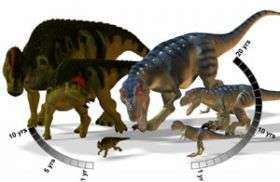
Hypocrasaurus grew three to five times faster than predators such as tyrannosaurs. Art by: Drew Lee/Ohio University
With long limbs and a soft body, the duck-billed hadrosaur had few defenses against predators such as tyrannosaurs. But new research on the bones of this plant-eating dinosaur suggests that it had at least one advantage: It grew to adulthood much faster than its predators, giving it superiority in size.
In a study published online today in the Proceedings of the Royal Society of London B: Biological Sciences, scientists compared growth rate data from the hadrosaur, Hypacrosaurus, to three predators: the tyrannosaurs Albertosaurus and its gigantic relative Tyrannosaurus rex, as well as the small Velociraptor-like Troodon.
The research suggests that it took 10 to 12 years for Hypacrosaurus to become fully grown. Tyrannosaurs, however, reached adulthood after 20 to 30 years, said Drew Lee, a postdoctoral fellow in Ohio University's College of Osteopathic Medicine who co-authored the paper with Lisa Noelle Cooper, a doctoral student at Kent State University and a researcher with the Northeastern Ohio Universities College of Medicine.
"Our duck-billed dinosaur grew three to five times faster than any potential predators that lived alongside it," Lee said. "By the time the duck-billed dinosaur was fully grown, the tyrannosaurs were only half grown – it was a huge size difference."
Hypacrosaurus also reached sexual maturity early, at only two or three years of age, Cooper said.
"That's another added bonus when facing predators – if you can keep reproducing, you're set," she said. "It's the stuff of evolution."
Cooper conducted the original analysis of the hadrosaur while an undergraduate student at Montana State University. Working with scientists Jack Horner and Mark Taper, Cooper looked at thin sections of the long leg bones of a specimen of Hypacrosaurus and counted and measured the growth rings, which each represent one year of life.
"We were shocked at how fast they grew. If you look at a cross section of the bone of a nestling or even from within the egg, there are huge spaces in which blood supply was going through the bone, which means they were growing like crazy," she said.
Hypacrosaurus was one of three common prey for the meat-eating tyrannosaurs, but was the most vulnerable, Lee said. He described the animal, which lived 67 million to 80 million years ago, as the "Thomson's gazelle of the Late Cretaceous." The other two had horns or had stout, tank-like bodies that would have provided some physical protection from their enemies. But even those creatures show faster growth rates than the predators, Lee noted, with the hadrosaur boasting the quickest growth spurt.
At least one study suggests that living animals employ this survival strategy as well, Lee said. Scientists have found that killifish, a tiny freshwater fish found mainly in the Americas, mature faster when predators lurk. Anecdotal evidence suggests that creatures such as African ungulates grow big to create an advantage over lions, cheetahs and hyenas, he said. And researchers also see signs of this phenomenon in butterflies, toads, salamanders, guppies and some birds, Cooper added.
"Over evolutionary history, this pattern seems to be prevalent," she said.
Though scientists are careful to preserve dinosaur fossils, they've also learned much more about growth rates, life spans, behavior and sexual reproduction of dinosaurs in the past decade by cutting up the bones and taking a closer look at the clues they contain, Lee and Cooper noted. Such research has offered a much more detailed picture of the relationships between different dinosaur species, including predator and prey. Cooper also has used the same bone analysis techniques to confirm the ancestor of whales, a study she co-authored last year in Nature.
Lee, who recently published a study in the Proceedings of the National Academy of Sciences on the sexual maturity rates of dinosaurs, hopes to conduct more research on communities of dinosaurs, such as those of Allosaurus, Stegosaurus and Apatosaurus, to draw further conclusions on the fast growth survival strategy.
"This study is a stepping stone to a larger comparative study on community changes that impacted dinosaur evolution," Lee said.
Source: Ohio University
-
Early growth trajectories have long-term effects on fitness, study finds
Oct 28, 2011 |
5 / 5 (2) |
0
-
Regaining trust after a transgression
Oct 13, 2011 |
1 / 5 (1) |
3
-
New fossils demonstrate that powerful eyes evolved in a twinkling (w/ video)
Jun 29, 2011 |
4.6 / 5 (10) |
140
-
Black members of Adventist church defy health disparities, study shows
Jun 27, 2011 |
not rated yet |
0
-
Immature skull led young Tyrannosaurs to rely on speed, agility to catch prey
May 09, 2011 |
5 / 5 (4) |
0
-
Engineers build first sub-10-nm carbon nanotube transistor
Feb 01, 2012 |
4.9 / 5 (32) |
30
-
Something old, something new: Evolution and the structural divergence of duplicate genes
Jan 31, 2012 |
4.6 / 5 (7) |
1
-
The hidden nanoworld of ice crystals: Revealing the dynamic behavior of quasi-liquid layers
Jan 30, 2012 |
5 / 5 (4) |
1
-
Stock market network reveals investor clustering
Jan 27, 2012 |
3.9 / 5 (23) |
8
-
Of microchemistry and molecules: Electronic microfluidic device synthesizes biocompatible probes
Jan 26, 2012 |
5 / 5 (2) |
0
-
Factors affecting beet root cell membrane
6 hours ago
-
Stem cell question.
Feb 10, 2012
-
Protease cleavage
Feb 10, 2012
-
Pertubance in a model
Feb 10, 2012
-
Cancer drugs and Alzheimer's, Oh my!
Feb 09, 2012
-
Squishing cells
Feb 09, 2012
- More from Physics Forums - Biology
More news stories
Employers feel no love for unscrupulous practice of 'service sweethearting'
A new study led by two Florida State University marketing professors finds that some frontline service employees who are rewarded for hikes in customer loyalty and satisfaction also may engage in "service ...
Other Sciences / Economics & Business
Feb 10, 2012 |
3.3 / 5 (3) |
11
A frank discussion of the power law and linking correlation to causation
(PhysOrg.com) -- Michael Stumpf a mathematics professor at Imperial College in London, and Mason Porter a lecturer at Oxford have teamed together to write and publish a perspective piece in Science regarding the in ...
US workers are 'giving away the store,' costing firms billions
Nearly 70 percent of the nation's service employees give away free goods and services from hamburgers to cable TV costing companies billions of dollars a year, according to a groundbreaking study.
Other Sciences / Economics & Business
Feb 09, 2012 |
3.5 / 5 (4) |
10
New insights into how to correct false knowledge
The abundance of false information available on the Internet, in movies and on TV has created a big challenge for educators.
Other Sciences / Social Sciences
Feb 07, 2012 |
4.9 / 5 (7) |
9
|
Neanderthal demise due to many influences, including cultural changes: study
As an ice age crept upon them thousands of years ago, Neanderthals and modern human ancestors expanded their territory ranges across Asia and Europe to adapt to the changing environment.
Other Sciences / Archaeology & Fossils
Feb 07, 2012 |
4.4 / 5 (5) |
8
|
Scientists discover molecular secrets of 2,000-year-old Chinese herbal remedy
For roughly two thousand years, Chinese herbalists have treated Malaria using a root extract, commonly known as Chang Shan, from a type of hydrangea that grows in Tibet and Nepal. More recent studies suggest that halofuginone, ...
New method to examine batteries -- MRI from the inside
There is an ever-increasing need for advanced batteries for portable electronics, such as phones, cameras, and music players, but also to power electric vehicles and to facilitate the distribution and storage of energy derived ...
Google might launch Drive for cloud storage soon
(PhysOrg.com) -- Google's next big move, according to the Wall Street Journal, is a cloud storage service called Drive. Hardly first to the plate, Google is simply catching up to introducing its cloud reposi ...
Lab study raises questions over nano-particle impact
Tests involving chickens have raised questions about the impact on health from engineered nano-particles, the ultra-fine grains commonly used in drugs and processed foods, scientists said on Sunday.
A mitosis mystery solved: How chromosomes align perfectly in a dividing cell
Although the process of mitotic cell division has been studied intensely for more than 50 years, Whitehead Institute researchers have only now solved the mystery of how cells correctly align their chromosomes during symmetric ...
Starve a virus, feed a cure? Findings show how some cells protect themselves against HIV
A protein that protects some of our immune cells from the most common and virulent form of HIV works by starving the virus of the molecular building blocks that it needs to replicate, according to research published online ...
Aug 06, 2008
Rank: 2.7 / 5 (7)
Creatures don't evolve to have a result.
Some genetic variation combined with environment factors over many generations causes a measurable difference or the birth of a new species, reproductive success of the larger ones contributed to this process. Duck-billed dinosaurs weren't consciously thinking "hey let's get bigger".
Aug 06, 2008
Rank: 1.8 / 5 (5)
Hmmm... so if you want to survive as a species you have to reproduce in order to reproduce (barring a few odd examples) you need a male and a female...
Aug 06, 2008
Rank: 3.9 / 5 (7)
This is silly logic. This wasn't a race. We're looking at equilibrium populations here, so the time to size maturity for the prey and predator are not directly related to each other.
What was necessary for the prey was to grow at a sufficient rate to reach sexual maturity quickly enough to allow replacement of those who died. That's all.
Aug 07, 2008
Rank: 2 / 5 (4)
Evolution does not occur to achieve specific goals. What is more likely is that high levels of predation favoured survival of prey with faster growth, bigger size and higher birthrates.
Aug 11, 2008
Rank: 3.3 / 5 (3)
The result of the "arms race" between predator and prey, in this and other examples mentioned, is that the survivors of the prey species were those which, amongst other traits to ensure survival, tended to grow faster than their predator species.
For all intents and purposes, they "outgrew their predators to survive".
Not as a goal in itself, but as a result of the "arms race" - as has been indicated in the above comments.
@deatopmg
With all due respect, I'm not certain that the accelerated sexual maturity was the only advantage afforded by the prey species' rate of growth exceeding that of the predator species ("time to size maturity").
Attacking a large(r) animal puts the predator at greater risk.
There would, thus, be a smaller "window" for the predator to attack its prey before the latter reaches a size which would cause the former pause for thought.
The predator would tend to favour attacking younger (smaller) members of the prey species rather than risk injury (or even death) attacking older (larger) animals.
Once the individual member of the prey species reached a certain size, it would be relatively "safe" from predation.
One could think of it in terms of a bully and his victim. Generally, the bully tends to pick on those smaller than him/herself. What if the victim experiences a spurt of growth? This year, he's smaller - next year, he's as big - the year after that, he's bigger than the bully. The bully would be less likely to attack the "victim" from next year (same size) onward.
Thus there are two advantages inherent in this reported evolved survival-strategy - accelerated sexual maturity (faster rate of reproduction) and physical size (less likely to be attacked, thus better ensuring a continued faster rate of reproduction).