Vine invasion? Ecologist looks at coexistence of trees and lianas
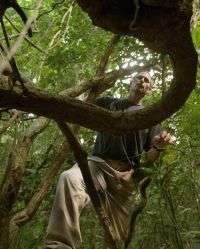
Among the hundreds of species of woody vines that University of Wisconsin–Milwaukee ecologist Stefan Schnitzer has encountered in the tropical forests of Panama, the largest has a stalk nearly 20 inches in circumference.
"That's like a large tree," says Schnitzer. "And because it winds itself up to the forest canopy and spreads, it can cover as much canopy area as a community of trees."
Such vines, called lianas, concentrate their energy on extending high and wide, and plunging their roots deep into the earth, rather than on building a thick trunk, says Schnitzer, an assistant professor of biological sciences at UWM who specializes in the vines and forest diversity.
They are essentially structural parasites, he says. But tropical lianas, even more so than their temperate counterparts (like kudzu, grapevine and poison ivy), are important players in tropical forest dynamics.
Growing evidence suggests that lianas are becoming more abundant with rising levels of carbon dioxide (C02) in the atmosphere, choking out trees. While all plants remove C02 from the atmosphere and store it, vines do not sequester as much as trees do – so vines may cause a net forest-wide loss in carbon.
Scientists would like to know if lianas really are becoming more numerous in tropical forests and what – if any –effects that would have on C02 and climate change.
One problem in testing the theory of lianas on climate change, says Schnitzer, is that scientists aren't sure whether C02 is acting on lianas or the other way around. To find out more, he is involved in one of the most comprehensive community-level studies on liana-tree interactions ever conducted.
Lianas vs. trees
Schnitzer's study in central Panama aims to better understand the impact of lianas on forest regeneration by first looking at the abundance and distribution of the vines.
The project is backed by the Smithsonian Tropical Research Institute and its Center for Tropical Forest Science. It has three years of financial support from the National Science Foundation (NSF) and two rounds of UWM Research Growth Initiative grants.
With collaborator Stephen Hubbell and graduate students Suzanne Rutishauser and Sasha Wright, Schnitzer is conducting a census of all lianas 1 centimeter in diameter or larger on a 50 hectare plot on Barro Colorado Island – nearly 50,000 individuals have been tagged, mapped, measured and identified to species.
The researchers will match a map of liana abundance on their Panamanian plot with an existing dataset on 25 years of tree growth and mortality for nearly a quarter million trees and saplings. They will also conduct a separate study of liana removal in an adjacent forest. In that study, they will quantify how lianas contribute to forest-level CO2 sequestration.
Thriving in drought
"It appears to be true that lianas grow more rapidly at higher levels of C02," Schnitzer says. "But there could be other explanations for the increase in lianas, too. Weather could be a factor."
His hypothesis is that tropical lianas thrive during seasonal droughts, when trees suspend their growth and lose their leaves, giving the lianas a competitive advantage in those locations. In fact, he found the growth rate of lianas is seven times that of trees in dry conditions, compared to only twice that of trees in the rainy season.
One reason may be that lianas have a more efficient root system than trees, but Schnitzer says more information is needed. He and his collaborators are using probes inserted into lianas to collect data on the flow of the water inside the vines' vascular system throughout the year in order to determine how lianas respond to drought.
"If lianas can grow far more than trees during seasonal droughts, then global increases in drought from such events as El Niño or La Niña may be responsible for the documented increases in liana abundance," Schnitzer says. He hopes to test this hunch when funding is secured, by monitoring liana growth rates and internal water flow in a number of wet and dry forests. Panama, where one side of the isthmus is far wetter than the other, provides a perfect natural location for such a study.
By studying lianas, Schnitzer hopes to answer the larger question of what mechanisms determine the distribution and abundance of lianas, and maintenance of plant diversity, in tropical forests.
With so many variables clouding issues of diversity and abundance, Schnitzer's investigative approach is to test his theories on the organism that is most different from the others – like lianas.
"If you can't figure out what's going on in the ecological system, then look at the oddball, the deviant– something that doesn't fit the model," he says.
Source: University of Wisconsin - Milwaukee


