New Technique Reveals Hidden Properties of Ultracold Atomic Gases
(PhysOrg.com) -- Physicists at JILA, a joint institute of the National Institute of Standards and Technology and the University of Colorado at Boulder, have demonstrated a powerful new technique that reveals hidden properties of ultracold atomic gases.
To develop the new technique, the scientists borrowed an idea used for nearly a century in the study of materials: photoemission spectroscopy. Traditional photoemission spectroscopy probes the energy of electrons in a material. The new photoemission spectroscopy technique, described in the Aug. 7 issue of Nature, adapts this technique to study potassium atoms in an ultracold gas.
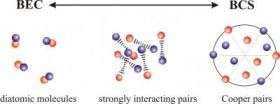
Photoemission spectroscopy is particularly powerful in revealing details of the pairing of electrons in high-temperature superconductors, which are solids that have zero resistance to electrical current at relatively high temperatures (but still below room temperature). The scientists at JILA study a very similar phenomenon: superfluidity (fluids that can flow with zero friction). Specifically, they study how atoms in a Fermi gas behave as they "cross over" from acting like a Bose Einstein Condensate (in which fermions pair up to form tightly bound molecules) to behaving like pairs of separated electrons in a superconductor.
In the crossover region, atoms in an ultracold gas exert very strong forces on each other, which masks their individual properties. To see the hidden behavior, JILA scientists apply a radio frequency field to a cloud of trapped, paired potassium atoms, ejecting a few atoms from the strongly interacting cloud. Then the laser trap is turned off so the gas can expand. Scientists make images and count the numbers of escaping atoms at different velocities.
With this information, scientists can calculate the atoms' original energy states and momentum values back when they were inside the gas. Scientists then map the energy levels for all the original states of the atoms and can identify a particular pattern that shows the appearance of a large "energy gap," which represents the amount of energy needed to break apart a pair of atoms.
The new photoemission technique represents a huge jump in the information available to physicists who study ultracold gases. Traditionally, scientists could probe either the energy or momentum of these gases, not both. The new technique simultaneously probes the energy and
momentum, allowing the scientists to study the microscopics involved in the pairing of two atoms.
"This technique is a clean probe of the microscopics in this system, and it allows us to see interesting things like a very large energy gap that seems to appear before the superfluid state," says group leader Deborah Jin, a JILA/NIST fellow. Another research group previously identified what seemed to be an energy gap; however, the results of the JILA technique are much clearer to interpret, Jin says.
Ultimately, the JILA work studying superfluidity in atomic gases may one day help in understanding the energy gap that appears in high-temperature superconductors, which may have applications such as more efficient transmission of electricity across power grids. In addition, the new technique can be extended beyond the study of pairing to include, for example, the study of atoms trapped in crisscrossed "lattices" of laser light, a building block for some atomic clock and quantum computer designs.
Citation: J.T. Stewart, J.P. Gaebler and D.S. Jin. Using photoemission spectroscopy to probe a strongly interacting Fermi gas. Nature. Aug. 7, 2008.
Provided by National Institute of Standards and Technology


