Hunting the elusive L-function
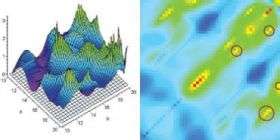
(PhysOrg.com) -- There was a lot of excitement last month about ‘L-functions’. A PhD student in the Department of Mathematics, University of Bristol, Ce Bian, in collaboration with his supervisor, Dr Andrew Booker, had discovered some new ones.
Ce Bian revealed his discovery at a workshop organised by the American Institute of Mathematics where teams of researchers from Europe and America, all competing for the same result, planned to announce their findings. Despite ‘only’ being a postgraduate student (the others were more senior), Bian was the only one to succeed before the workshop. After months of preliminary work and testing, he finally got everything working just before flying out to California – the computers were still crunching while he was in the air.
Bian’s discovery caused considerable excitement among the world’s leading mathematicians who were attending the workshop. Dorian Goldfeld, Professor of Mathematics at Columbia University, USA, likened it to finding new planets in remote solar systems: “We know they are out there, but the problem is how to detect them and determine what they look like. It gives us a glimpse of new worlds,” he said. Clearly something important had been discovered, but what was it? “Unfortunately, L-functions are rather like fundamental particles in physics, in the sense that they are very important to the universe in which they exist, but hard to relate directly to everyday experience,” explained Booker.
L-functions are rather like particles in physics, they are very important to the universe in which they exist, but hard to relate to everyday experience
There are two types of L-functions – algebraic and transcendental – but in the same way that there are billions of electrons in the universe, there are billions of each type of L-function, which are classified according to their degree. For example, the Riemann zeta-function – the granddaddy of all L-functions – is a first-degree algebraic L-function which holds the secret to how the prime numbers are distributed. What Bian has found is a new class of L-function – a ‘third degree transcendental L-function’ – and he has demonstrated four examples of that class. The last L-function to be discovered was more than 30 years ago when the second degree transcendental L-function was found by Harold Stark from the University of California, San Diego.
Prime numbers – numbers that are only divisible by themselves or one – have been the subject of intense research, probably since the Egyptians, and certainly since the Ancient Greeks. The problem of modelling their distribution is a tantalising one for mathematicians working on number theory because when one looks at individual numbers, the primes seem to be randomly distributed, but the ‘global’ distribution of primes follows well-defined laws. It’s rather like the way that physics follows well-defined laws at the macro scale, which then completely change at the quantum scale. So some fundamental questions about prime numbers, such as the Riemann Hypothesis, have remained unresolved for more than a century.
Prime numbers - numbers that are only divisible by themselves or one - have been the subject of intense research since the Ancient Greeks
The Riemann Hypothesis, announced in 1859 and today the most important of all unsolved mathematical problems, seeks to understand the connection between addition and multiplication. There is an unclaimed million-dollar prize for a valid proof of the hypothesis. But despite not being able to prove it, most mathematicians believe it to be true; if it isn’t true, the world is a very different place from what we imagine. Bian’s discovery of his new L-functions is a small step toward a greater under-standing of these elusive objects, and many mathematicians believe that the route to a proof of the Riemann Hypothesis will go through families of L-functions.
In order to check that Bian really had found something new, and that his discovery had all the properties it was expected to have, Michael Rubinstein from the University of Waterloo in Canada, who was attending the workshop, immediately tested the Riemann Hypothesis for this newly-minted L-function. Rubenstein enthused: “Being able to explore this new L-function gives me the excitement that a biologist must feel when discovering a new mammal. The techniques developed by Bian and Booker open up whole new possibilities for experimenting with these powerful and mysterious functions.”
To achieve his results, Bian’s computer programme needed to solve systems of equations in roughly 10,000 unknowns, which took nearly 10,000 hours of computer time. Ten years ago this work would have required a supercomputer; today it’s feasible using a PC on your desk. One day, with sufficient advances in number theory and computing power, someone will succeed in proving the Riemann Hypothesis and win that million-dollar prize, but Bian freely admits that their results are just a small step along the way.
Prize for work on Riemann Hypothesis
The University’s Maths Department is one of the leading research centres in the world for the study of random matrix theory and its applications to number theory, including the modelling of L-functions and the Riemann Hypothesis. Earlier this year, Professor Brian Conrey, also from the department, was awarded the 2008 Conant Prize by the American Mathematical Society for his article entitled The Riemann Hypothesis. Conrey is also Executive Director of the American Institute of Mathematics and was present at the AIM workshop when Bian and Booker presented their findings. He too was impressed: “It’s a big step towards our understanding the ‘world of L’, which is where most of the secrets of number theory are kept”.
Provided by University of Bristol


