A potted history of milk
August 6th, 2008 A potted history of milk

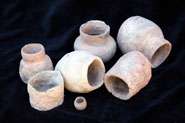
Examples of early Neolithic cooking vessels providing the earliest organic residue evidence for milk use and processing. Photo by Olivier Nieuwenhuijse, University of Leiden

(PhysOrg.com) -- Humans were processing cattle milk in pottery vessels more than two thousand years earlier than previously thought, according to new research from the University of Bristol.

In work published online in Nature this week, Professor Richard Evershed and colleagues describe how the analysis of more than 2,200 pottery vessels from southeastern Europe, Anatolia and the Levant extends the early history of milk by two millennia to the seventh millennium BC.

Vessels most likely to have been used for food preparation were selected to test where milk use started, and whether the use of milk products first began in the region where farming was pioneered – the Fertile Crescent – or whether it was an innovation of other regions.

Organic residues preserved in the pottery suggest that even before 6,500 BC milk was processed and stored, although this varied regionally depending on the farming techniques used.

Cattle, sheep and goats were familiar domesticated animals by the eighth millennium BC but until now, the first clear evidence for milk use was the late fifth millennium.

This research not only extends the history, but shows that milking was particularly important in areas that were more favourable to cattle compared to other regions where sheep and goats were more common.

Professor Evershed said: “Our results provide new insights into the emergence of dairying as a component of the domestication of animals. They take the early history of milk use back to the seventh millennium BC, early in the evolution of animal domestication and pottery production and use.

“Processing milk would have had two important advantages, providing a means of storing surplus milk as products, that is cheese, ghee, and so on, making them available throughout the year, and providing a solution for any problems of lactose intolerance; most lactose intolerant people have fewer problems with consuming processed milk products.

“The regional differences we found are also significant, suggesting that early farming was not a fixed package but developed in different ways in different areas, probably in response to different environmental conditions and to the different cultural choices of early farmers.”

Provided by University of Bristol


print this article email this article download pdf blog this article bookmark this article     Digg this Stumble it share on Facebook share on Reddit add to delicious save to Yahoo! bookmarks
4.5/5 after 11 votes


August 6th, 2008 all stories
Other Sciences / Archaeology & Fossils

Comments: 0
Rank: 4.5/5 after 11 votes

  • Stumble this up

  • Digg this

  • Share it:
  • share on Facebook
  • share on MySpace
  • share on Slashdot
  • rss-newsfeed
  • share on Google
  • share on Reddit
  • add to delicious
  • save to Yahoo! bookmarks
  • share on Windows Live
  • Add to Mixx!
Rating: 4.5/5 after 11 votes

  • Related Stories

  • How chemistry can reveal the secrets of ancient worlds
    created Jun 30, 2009 | popularity not rated yet | comments 0
  • Your arteries on Wonder bread
    created Jun 25, 2009 | popularity not rated yet | comments 0
  • Big US study will test vitamin D, fish oil
    created Jun 22, 2009 | popularity not rated yet | comments 0
  • Wildlife Conservation Society supports world's first study of egg-laying mammal
    created Jun 09, 2009 | popularity not rated yet | comments 0
  • Breastfeeding associated with a reduced risk of relapse in women with multiple sclerosis
    created Jun 08, 2009 | popularity not rated yet | comments 0

Tags

milk, early

  • Physicists Demonstrate Quantum Memory with Matter Qubits
    Physicists Demonstrate Quantum Memory with Matter Qubits
    Physics / General Physics
    created Jul 03, 2009 | popularity 4.4 / 5 (17) | comments 1
  • 'Holey' Nanosheets for Wastewater Dye Removal
    Nanotechnology / Nanomaterials
    created Jul 01, 2009 | popularity 5 / 5 (5) | comments 1
  • Jellyfish Robot Swims Like its Biological Counterpart
    Jellyfish Robot Swims Like its Biological Counterpart
    Electronics / Robotics
    created Jun 26, 2009 | popularity 4.4 / 5 (8) | comments 1
  • Could Maxwell's Demon Exist in Nanoscale Systems?
    Could Maxwell's Demon Exist in Nanoscale Systems?
    Physics / General Physics
    created Jun 24, 2009 | popularity 4.4 / 5 (18) | comments 29
  • Living Safely with Robots, Beyond Asimov's Laws
    Living Safely with Robots, Beyond Asimov's Laws
    Electronics / Robotics
    created Jun 22, 2009 | popularity 4.6 / 5 (52) | comments 40
  • Other News

    Creation Museum president Ken A. Ham

    Paleontologists brought to tears, laughter by Creation Museum

    Other Sciences / Other

    created Jun 30, 2009 | popularity 4.3 / 5 (44) | comments 125

    For a group of paleontologists, a tour of the Creation Museum seemed like a great tongue-in-cheek way to cap off a serious conference.


    Mummified dinosaur skin yields up new secrets

    Mummified dinosaur skin yields up new secrets

    Other Sciences / Archaeology & Fossils

    created Jul 01, 2009 | popularity 4.7 / 5 (15) | comments 10

    (PhysOrg.com) -- Scientists from The University of Manchester have identified preserved organic molecules in the skin of a dinosaur that died around 66-million years ago.


    Liberal? Conservative? Stanford study says mental nudge can make voters flip-flop

    Liberal? Conservative? Stanford study says mental nudge can make voters flip-flop

    Other Sciences / Social Sciences

    created Jul 02, 2009 | popularity 3.8 / 5 (6) | comments 4

    (PhysOrg.com) -- No doubt you’ve worked hard for your success. But chances are you’ve also had some help and lucky breaks along the way.


    Probing Question: How do Ponzi Schemes work?

    Other Sciences / Economics

    created Jul 02, 2009 | popularity 5 / 5 (2) | comments 2

    Imagine the shock, the horror, and the sheer panic that would come with learning that the financial plan you’d sunk your life savings into was a sham, the financial experts you trusted were crooks, and all your money was ...


    Tourists enjoy a "Pineapple Tour" in Costa Rica

    Costa Rica tops happiness, 'green living' poll

    Other Sciences / Social Sciences

    created Jul 04, 2009 | popularity 3.5 / 5 (4) | comments 0

    Costa Rica is the happiest place on earth, and one of the most environmentally friendly, according to a new survey by a British non-governmental group.