Protecting natural forests crucial for climate change
August 6, 2008 Protecting natural forests crucial for climate change

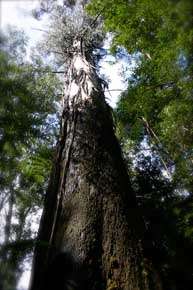
Photo: Sarah Rees

(PhysOrg.com) -- South-east Australia’s natural forests are among the most carbon dense in the world and store three times more carbon than Australian and international climate change experts realise, a world-first study released today at The Australian National University revealed.

The largest stocks of carbon are found in the tall wet eucalypt forests of Victoria and Tasmania. These forests support trees up to 80 metres tall and can contain more than 1200 tonnes of carbon per hectare, which is up to 10 times more carbon per hectare than previously realised.

ANU scientists have calculated that the average amount of carbon stored in unlogged natural eucalypt forests is about 640 tonnes per hectare. According to the leading worldwide climate change scientific body, the Intergovernmental Panel on Climate Change, the average carbon stock in temperate forests is only 217 tonnes of carbon per hectare.

The findings represent a breakthrough in understanding the role of forests in long term carbon storage and in helping solve the climate change problem. The authors – Professor Brendan Mackey, Dr Heather Keith, Dr Sandra Berry and Professor David Lindenmayer – found that a new approach is needed to account for carbon stored in natural forests.

“Reducing emissions from deforestation and forest degradation in developing countries has been the focus for the international community since the United Nations climate change conference in Bali last December, but this is also an issue for Australia,” Professor Mackey said.

About half of Australia’s forests have been cleared in the last 220 years and the carbon stocks in more than 50 per cent of the remaining unprotected forests have been degraded by land use activities such as logging. Professor Mackey said the research should alert Australian governments and international agencies of the urgent need to protect the carbon stored in natural forests as part of the suite of measures needed to solve the climate change problem.

“Protecting the carbon in Australia’s and the world’s natural forests is no longer an option – it is a necessity,” Professor Mackey said. “If natural forests continue to be cleared and degraded then the C02 released will significantly increase concentrations of greenhouse gases in the atmosphere. The carbon stored in natural forests is a larger and more reliable stock than the carbon stored in commercially logged forests and plantations.”

The research from the Fenner School of Environment and Society at ANU found that around 9.3 billion tonnes of carbon can be stored in the 14.5 million hectares of natural eucalypt forests in south-east Australia if they are left undisturbed. The carbon currently stored in these forests is equivalent to “avoided emissions” of 460 million tonnes of CO2 per year for the next 100 years.

Provided by Australian National University


print this article email this article download pdf blog this article bookmark this article     Stumble it Digg this share on Facebook retweet share on Reddit add to delicious
Rate this story - 3.2 /5 (12 votes)

Rank Filter

Move the slider to adjust rank threshold, so that you can hide some of the comments.


Display comments: newest first

  • GrayMouser - Aug 06, 2008
    • Rank: 2 / 5 (4)
    Beating a dead issue.
  • MikeB - Aug 10, 2008
    • Rank: 5 / 5 (1)
    Why do you have to put "climate change" in the title?? No one wants to destroy these forests. We don't need a boogey man.

August 6, 2008 all stories

Comments: 2

3.2 /5 (12 votes)
  • Stumble this up

  • Digg this

  • share this

  • hide
  • Related Stories

  • Scientists map speed of climate change
    created 39 minutes ago | popularity not rated yet | comments 0
  • NASA Calculates a Carbon Budget for California
    created Dec 16, 2009 | popularity not rated yet | comments 0
  • Developing countries end boycott at climate talks
    created Dec 14, 2009 | popularity not rated yet | comments 0
  • New science estimates carbon storage potential of US lands
    created Dec 10, 2009 | popularity not rated yet | comments 0
  • Oceans' Uptake of Manmade Carbon May Be Slowing
    created Dec 09, 2009 | popularity not rated yet | comments 0


  • hide
  • Relevant PhysicsForums posts

  • Fusion or fission within the Earth?
    created 23 hours ago
  • West Mata - Explosive Deep-Ocean Volcano
    created Dec 20, 2009
  • did al gore really say that
    created Dec 20, 2009
  • AIRS and Atmospheric Carbon Dioxide
    created Dec 16, 2009
  • More from Physics Forums - Earth

Other News

The Formation of Blue Stragglers

Vampires and collisions rejuvenate stars

Space & Earth / Astronomy

created 39 minutes ago | popularity not rated yet | comments 0

Stars in globular clusters are generally extremely old, with ages of 12-13 billion years. However, a small fraction of them appear to be significantly younger than the average population and, because they ...


Scientists map speed of climate change

Space & Earth / Environment

created 39 minutes ago | popularity not rated yet | comments 2

New study finds that the average ecosystem will need to shift about a quarter mile per year to keep pace with global climate change.


Sun and moon trigger deep tremors on San Andreas Fault

Space & Earth / Earth Sciences

created 9 minutes ago | popularity not rated yet | comments 0

The faint tug of the sun and moon on the San Andreas Fault stimulates tremors deep underground, suggesting that the rock 15 miles below is lubricated with highly pressurized water that allows the rock to slip with little ...


UN climate official warns of Indian energy 'crisis'

Space & Earth / Environment

created 2 hours ago | popularity 5 / 5 (1) | comments 2

India's reliance on coal means the country is heading for an energy crisis unless it diversifies its sources of power, the chairman of the UN's top climate change panel predicted on Wednesday.


Disproportionate effects of global warming and pollution on disadvantaged communities

Space & Earth / Environment

created 15 hours ago | popularity 2.7 / 5 (7) | comments 10

Global warming, pollution, and the environmental consequences of energy production impose a greater burden on low-income, disadvantaged communities, and strategies to prevent these inequities are urgently needed. A provocative ...