Skipping Atomic-scale Stones to Study Some Chemistry Basics
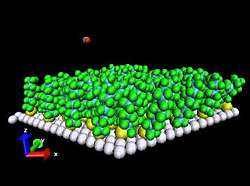
Thought experiment: a carbon dioxide molecule—think of a cheerleader’s baton—comes slanting in at high speed over a dense liquid, strikes the surface and ricochets. How does it tumble? Fast or slow? Forward, backward or sideways? These are not idle questions because simple events like the tumbling molecule go to the heart of the chemistry and physics of gas-liquid interactions. These cover a broad swath of important chemical processes—including breathing—for which details of the encounter are just coming into view.
New experiments reported this week from JILA in Boulder, Colo., are giving a uniquely detailed look at what happens when gas molecule meets fluid.
Historically, chemistry has been confined to observing the mass behavior of huge numbers of molecules—mix things together, look at the reaction products, infer what happened. Only in the past couple of decades have powerful lasers made it possible to “watch” specific events involving only a few molecules. Today, they can even observe the role played by a molecule’s shape, a critical influence in many interactions.
Now, Bradford Perkins, Jr., of the University of Colorado and David Nesbitt of the National Institute of Standards and Technology report the first direct observation of the rotational dynamics of a molecule bouncing off a liquid surface.
Perkins and Nesbitt directed a beam of carbon dioxide molecules at a pool of synthetic fluorinated fluid in a vacuum. The molecules that bounced off passed through an infrared laser beam, which switched rapidly between alternate orientations, or polarization states. A sensitive detector measured how much light was absorbed by the passing molecules.
A rod-like carbon dioxide molecule will absorb with slightly different efficiencies depending on how it rotates relative to the light’s polarization. Analyzing the oscillating signal allowed the team to observe just how fast and in what direction the molecules were tumbling after hitting the fluid. They found the molecules had a pronounced tendency for a forward, end-over-end “top spin,” as if hit by a star Wimbledon tennis player, with the rate of tumbling strongly correlated with how its molecular rotation is aligned relative to the light path.
“To know how this happens at the molecular level—how things bounce, skip, spin, tumble, push and pull—represents a big leap in our understanding,” says Nesbitt. “Experiments of this sort help build that understanding.”
In addition, Nesbitt says, observing how gas molecules of different shapes twist and rotate after striking a liquid reveals a lot about the nature of the fluid surface—how “rough” it is from the disturbance of microscopic waves and how that roughness affects interactions with gases.
JILA is a research institution operated jointly by NIST and the University of Colorado. The research was supported by the Air Force Office of Scientific Research and the National Science Foundation.
Citation: B.G. Perkins, Jr., and D.J. Nesbitt. Stereodynamics in state-resolve scattering at the gas-liquid interface. Proceedings of the National Academy of Science, Early Edition.
MOVIE CLIP Computer simulation of the JILA gas-liquid scattering experiments uses long molecules tethered to a surface as a useful stand-in for liquids, which are too complex for computer modeling. The speed of rotation of the carbon dioxide molecule after striking the surface is strongly dependant on its orientation, an effect caused by atomic-scale “waves” on the fluid surface. This movie clip requires Windows Media Player (or equivalent), a free download – click here. Credit: Perkins, JILA
Provided by NIST


