Jupiter and Saturn full of liquid metal helium
August 6, 2008
Saturn

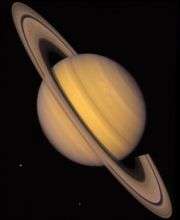
Saturn. Photo by: NASA

(PhysOrg.com) -- A strange, metal brew lies buried deep within Jupiter and Saturn, according to a new study by researchers at the University of California, Berkeley, and in London.

The study, published in this week's online edition of the journal Proceedings of the National Academy of Sciences, demonstrates that metallic helium is less rare than was previously thought and is produced under the kinds of conditions present at the centers of giant, gaseous planets, mixing with metal hydrogen and forming a liquid metal alloy.

"This is a breakthrough in terms of our understanding of materials, and that's important because in order to understand the long-term evolution of planets, we need to know more about their properties deep down," said Raymond Jeanloz, professor of astronomy and of earth and planetary science at UC Berkeley and one of the authors of the study. "The finding is also interesting from the point of view of understanding why materials are the way they are, and what determines their stability and their physical and chemical properties."

Jeanloz studies pressures tens of millions of times greater than Earth's atmospheric pressure - the kinds of forces felt inside Jupiter and Saturn, so called "gas giants" that lack a solid surface. The core of the Earth, which is small and dense compared to the cores of these gas giants, contains pressures of about 3.5 million times atmospheric pressure. Pressures at Jupiter's core, for example, reach 70 million times Earth's atmospheric pressure, the planet's massive size more than offsetting its low density. The cores of Jupiter and Saturn are a balmy 10,000 to 20,000 degrees Celsius, two to four times hotter than the surface of the sun.

In this study, Jeanloz and Lars Stixrude, earth sciences professor at University College London, took a closer look at what happens to helium under such extreme conditions.

Most studies of materials in gaseous planets have focused on hydrogen, Jeanloz said, because it is the predominant element of both these planets and the universe. But even though hydrogen is the lightest element, its behavior is fairly complicated due to its tendency to form molecules of two bonded hydrogen atoms, Jeanloz said. Jeanloz and Stixrude wanted to study a simpler element, to more easily understand the effects of extreme temperatures and pressure.

So, they picked helium, the second most abundant element, which comprises five to 10 percent of the universe. They used theories based on quantum mechanics to calculate the behavior of helium under different pressures and temperatures. Although these equations are only approximations, Stixrude said, the researchers' predictions closely matched experimental results for lower pressures.

Under Earthly conditions, helium is a colorless, see-through, electrically insulating gas. But under the kinds of pressure and temperature found at the centers of Jupiter and Saturn, the researchers found that helium turns into a liquid metal, like mercury.

"You can imagine this liquid looking like mercury, only less reflective," Jeanloz said.

The finding was a surprise, as scientists had assumed that high pressures and high temperatures would make metallization of elements such as helium more difficult, not easier, Jeanloz said. He and his colleagues had previously found that helium starts to have some metal-like qualities in experiments at extremely high pressure, but they have not yet been able to experiment with helium under the conditions found inside giant planets.

A metal's key characteristic is its ability to conduct electricity, meaning electrons can flow through it like water flowing unimpeded down a riverbed.

"High temperatures make the atoms jiggle around, and so people thought that raising the heat would deflect the electrons, like putting enough rocks in a stream to block the flow of water," Jeanloz said. "The scattering caused by atoms was thought to make it harder for the electrons to flow down the stream."

But it turns out that the atoms' jostling also creates new ways for the electrons to move, almost as if new crevices had opened in the ground for the river's flow, Jeanloz said.

Scientists recently discovered that hydrogen metalizes under lower temperatures and pressures than was previously appreciated. The dogma in the field was that the characteristics of hydrogen and helium were different enough that the two wouldn't mix inside giant gaseous planets, Jeanloz said. The researchers' findings, however, indicate that the two elements probably do mix, forming a metal alloy like brass, but liquid.

This finding also speaks to one of the many mysteries of these large planets, Stixrude said. More energy is emitted from Jupiter and Saturn than they absorb from the sun, and scientists don't understand where it comes from. One of the prevailing theories is that droplets of helium condense out of the planets' outer atmospheres and fall to their centers as "helium rain," releasing gravitational energy. But Jeanloz and Stixrude's findings show that helium and hydrogen are probably a more homogenous mix than was previously suspected, meaning that helium rain is unlikely.

"Now, we have to look elsewhere for this energy source," Stixrude said.

Provided by UC Berkeley

4.8 /5 (42 votes)  

Filter


Move the slider to adjust rank threshold, so that you can hide some of the comments.


Display comments: newest first

thales
Aug 06, 2008

Rank: 2.3 / 5 (7)
AWT/electric universe in 3, 2, 1...
Question
Aug 06, 2008

Rank: 3.8 / 5 (4)
A book titled "An Alternative to the Standard Model of Physics" claim that even the sun does not fuse two protons. It claims that hydrogen atoms (the proton and the electron) are fused creating a neutron and then the neutron fuses with another proton or helium nucleus releasing energy. This is half-way between fusion and cold fusion. Could it be that this type of quasi-fusion is the source of the extra heat given off by Jupiter and Saturn?
Mercury_01
Aug 06, 2008

Rank: 3 / 5 (1)
Id bet there is a standing wave in the superfluid core of Saturn in the shape of a huge hexagon.
Alexa
Aug 07, 2008

Rank: 2.3 / 5 (3)
By AWT the superconductivity is the result of high pressure conditions, where the energy spreads in transversal waves, like through vacuum. It was speculated already, the samples of rare gases in metallic state inside of furellene microspheres could exhibit a superconductivity at room temperature(..don't ask me, how exactly it can be done, though). The graphene mesh forming furellene molecules are believed to be sufficiently strong to keep such pressure.

http://www.physor...341.html
Alexa
Aug 07, 2008

Rank: 5 / 5 (1)
.. there is a standing wave in the superfluid core of Saturn in the shape of a huge hexagon...
This is interesting idea indeed, but the rectangular vortex shapes can be achieved even without superfluous phase - and by Occam razor criterion the simpler mechanism always goes first.

http://adsabs.har...96q4502J
http://www.youtub...zFC-Qt_U
Rank 4.8 /5 (42 votes)
Tags

Related Stories
Relevant PhysicsForums posts
  • Scale of the Universe
    created9 hours ago
  • Titan's lack of impact craters
    createdFeb 09, 2012
  • Real pictures of black hole eating a star?
    createdFeb 08, 2012
  • Hypothetical way to travel faster than light, but not technically exceed lightspeed
    createdFeb 06, 2012
  • How do scientists monitor the Sun's activity?
    createdFeb 05, 2012
  • Search patterns in observational studies
    createdFeb 05, 2012
  • More from Physics Forums - General Astronomy

More news stories

Humans may have helped the decline of African rainforests 3000 years ago

(PhysOrg.com) -- Large areas of rainforests in Central Africa mysteriously disappeared over three thousand years ago, to be replaced by savannas. The prevailing theory has been that the cause was a change ...

Space & Earth / Environment

created 20 hours ago | popularity 4.3 / 5 (11) | comments 12 | with audio podcast report

Could Venus be shifting gear?

(PhysOrg.com) -- ESA’s Venus Express spacecraft has discovered that our cloud-covered neighbour spins a little slower than previously measured. Peering through the dense atmosphere in the infrared, the ...

Space & Earth / Space Exploration

created 16 hours ago | popularity 5 / 5 (7) | comments 7 | with audio podcast

NASA budget will axe Mars deal with Europe: scientists

US President Barack Obama's budget proposal to be submitted next week for 2013 will cut NASA's budget by 20 percent and eliminate a major partnership with Europe on Mars exploration, scientists said Thursday.

Space & Earth / Space Exploration

created 19 hours ago | popularity 5 / 5 (2) | comments 18

Mars Science Laboratory computer issue resolved

(PhysOrg.com) -- Engineers have found the root cause of a computer reset that occurred two months ago on NASA's Mars Science Laboratory and have determined how to correct it.

Space & Earth / Space Exploration

created 17 hours ago | popularity 4.7 / 5 (6) | comments 3 | with audio podcast

Two new moons for Jupiter

Advances in technology have lead to the discovery of new planets outside of our Solar System, and now even new moons in our own backyard.

Space & Earth / Space Exploration

created 16 hours ago | popularity 4 / 5 (1) | comments 7


Anonymous knocks CIA website offline (Update)

The website of the Central Intelligence Agency was inaccessible on Friday after the hacker group Anonymous claimed to have knocked it offline.

Google users warned of threat to smartphone wallets

Users of Google smartphone wallets were being warned on Friday that there is a way to crack pass codes intended to thwart thieves from going on illicit shopping sprees.

New error-correcting codes guarantee the fastest possible rate of data transmission

Error-correcting codes are one of the triumphs of the digital age. They’re a way of encoding information so that it can be transmitted across a communication channel — such as an optical fiber o ...

New power source discovered

(PhysOrg.com) -- Researchers at the Massachusetts Institute of Technology (MIT) and RMIT University have made a breakthrough in energy storage and power generation.

The power of estrogen -- male snakes attract other males

A new study has shown that boosting the estrogen levels of male garter snakes causes them to secrete the same pheromones that females use to attract suitors, and turned the males into just about the sexiest ...

Small modular reactor design could be a 'SUPERSTAR'

(PhysOrg.com) -- Though most of today's nuclear reactors are cooled by water, we've long known that there are alternatives; in fact, the world's first nuclear-powered electricity in 1951 came from a reactor ...