Likely cause of postpartum blues and depression identified
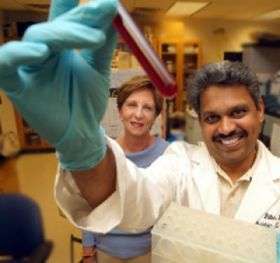
Unique biochemical crosstalk that enables a fetus to get nutrition and oxygen from its mother's blood just may cause common postpartum blues, researchers say.
That crosstalk allows the mother's blood to flow out of the uterine artery and get just a single cell layer away from the fetus' blood, says Dr. Puttur D. Prasad, biochemist in the Medical College of Georgia School of Medicine.
That controlled exchange between the blood of mother and fetus is courtesy of the placenta regulating levels of serotonin, a neurotransmitter commonly associated with depression. But platelets that enable blood clotting also secrete serotonin which prompts platelets to aggregate and the placenta to want to get rid of it.
"If there were no proper control here, blood leaving the mother's blood vessel would trigger release of serotonin, platelets would aggregate, vessels constrict and the fetus wouldn't get what it needs," says Dr. Prasad. An MCG research team led by Dr. Vadivel Ganapathy first reported evidence of serotonin transporter gene expression in the placenta back in 1989 in the Journal of Biological Chemistry. Now they know the gene plays an important role in the crosstalk that forestalls clotting until after birth.
When the fetus and placenta are gone, blood continues flowing from the mother's uterine artery until platelets move in to stop it, Dr. Prasad explains. Serotonin levels begin to rise and interact with receptors on the smooth muscle of the uterus. This stimulates production of interleukin-1 beta which the MCG researchers found regulates expression of serotonin-hoarding transporters. Interleukin-1 beta gets in the mother's bloodstream, crosses the blood brain barrier and creates more serotonin transporters on the neurons when they are not needed.
Until interleukin-1 beta levels normalize, there's too little communication between serotonergic neurons and moms get the blues, says Dr. Prassad. "We believe that 80 percent of women experience postpartum blues because of this effect of interleukin-1 beta. If our hypothesis holds true, lowering interleukin-1 beta levels may be a better treatment option." He notes that while serotonin reuptake inhibitors, commonly used for depression, work well in these women, transferring the drug to the baby during nursing can be problematic.
But there's more. In more serious postpartum depression, polymorphisms or variations of the serotonin transporter gene – which already have been linked to non-pregnancy related depression – appear to make bad matters worse because they are even better at taking up serotonin, he says.
Dr. Prasad, in collaboration with Dr. Sandra Pittman, director of MCGHealth's Healthy Start program, already put the laboratory findings into practice in a small study of 50 women enrolled in the federally funded program for women with high-risk pregnancies in the rural Georgia counties of Burke and McDuffie. The program was a perfect fit for the research. Healthy Start identifies women as early in pregnancy as possible who are at risk because of medical, psychosocial and/or environmental problems, Dr. Pittman says.
"We enroll women who are without housing, who are living from place to place. We often see women who are medically high risk in combination with social and environmental challenges," she says. They complete depression screenings before and after birth and refer for mental health counseling as part of their efforts to help women deal with difficult pregnancies and possibly fragile infants. Depression can make life harder for the mother and impede bonding with a new baby, Dr. Pittman says. Over the last year, when they also looked at the blood of some of these women, they found transiently elevated levels of interleukin-1 beta.
Dr. Prasad recently received a $900,000, three-year grant from the U.S. Department of Health and Human Services' Health Resources and Services Administration that enables the MCG researchers to follow 300 more women to see if their blood also bears out his hypotheses. They'll look at interleukin-1 beta levels before delivery and at certain intervals afterward to see if they increase after delivery, then level off as Dr. Prasad suspects. They'll also analyze DNA to see if women identified with more serious postpartum depression have some of the same variations of the serotonin transporter gene already identified with non-pregnancy related depression.
Many studies have looked at these genetic variations in non-pregnancy-related depression but not in postpartum depression, Dr. Prasad says.
They expect their studies will advance the understanding of the biochemical basis of postpartum blues and depression and point toward ways to better identify and treat it.
Up to 80 percent of women experience at least a few weeks of postpartum blues, 10-15 percent have more serious depression that may last a month or more and 1-5 percent experience severe psychosis that can last up to a year, Dr. Prasad says.
Rapidly changing hormone levels have been blamed for postpartum blues and depression, although hormone therapy doesn't seem to help. "We are thinking that one of the things that is missing immediately following delivery is the placenta, and that this initiates a cascade of events leading to postpartum blues/depression."
Source: Medical College of Georgia


