CERN announces start-up date for Large Hadron Collider
August 7, 2008
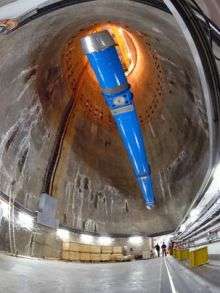
The last of 1746 superconducting magnets is lowered into the LHC tunnel via a specially constructed pit at 12:00 on 26 April. This 15-m long dipole magnet is one of 1232 dipoles positioned around the 27-km circumference of the collider. Dipole magnets produce a magnetic field that bends the particle beams around the circular accelerator. Photo / CERN
CERN has today announced that the first attempt to circulate a beam in the Large Hadron Collider (LHC) will be made on 10 September. This news comes as the cool down phase of commissioning CERN's new particle accelerator reaches a successful conclusion. Television coverage of the start-up will be made available through Eurovision.
The LHC is the world's most powerful particle accelerator, producing beams seven times more energetic than any previous machine, and around 30 times more intense when it reaches design performance, probably by 2010. Housed in a 27-kilometre tunnel, it relies on technologies that would not have been possible 30 years ago. The LHC is, in a sense, its own prototype.
Starting up such a machine is not as simple as flipping a switch. Commissioning is a long process that starts with the cooling down of each of the machine's eight sectors. This is followed by the electrical testing of the 1600 superconducting magnets and their individual powering to nominal operating current. These steps are followed by the powering together of all the circuits of each sector, and then of the eight independent sectors in unison in order to operate as a single machine.
By the end of July, this work was approaching completion, with all eight sectors at their operating temperature of 1.9 degrees above absolute zero (-271°C). The next phase in the process is synchronization of the LHC with the Super Proton Synchrotron (SPS) accelerator, which forms the last link in the LHC's injector chain. Timing between the two machines has to be accurate to within a fraction of a nanosecond. A first synchronization test is scheduled for the weekend of 9 August, for the clockwise-circulating LHC beam, with the second to follow over the coming weeks. Tests will continue into September to ensure that the entire machine is ready to accelerate and collide beams at an energy of 5 TeV per beam, the target energy for 2008. Force majeure notwithstanding, the LHC will see its first circulating beam on 10 September at the injection energy of 450 GeV (0.45 TeV).
Once stable circulating beams have been established, they will be brought into collision, and the final step will be to commission the LHC's acceleration system to boost the energy to 5 TeV, taking particle physics research to a new frontier.
'We're finishing a marathon with a sprint,' said LHC project leader Lyn Evans. 'It's been a long haul, and we're all eager to get the LHC research programme underway.'
The event will be webcast through http://webcast.cern.ch .
Provided by CERN


I don't want to miss it!
Tevatron has already beat the LHC to some discoveries, but I don't read about those in the mainstream press. Luminosity is 30 times higher than Tevatron at Fermi but I don't think that is as important as the collision energy.
http://www.newsci...d=dn7145
http://news.bbc.c...7613.stm
http://unisci.com...1012.htm
Of course, you will always have those who say you can not break the sound barrier, that a nuclear bomb whould ionize the Earths atmoshere, Columbus should of stayed in Europe, why teach the blind to read, etc. etc.
The fact of the matter is LHC will move forward and great science will happen and these doubious doubters of anything science will still be perplexed not understanding the great strides mankind can make from this science......
GO CERN !
That gives me just enough time to start up my cult!
Trains will cause cows' milk to sour....
Yes, they need to let us know, so when can at least flinch. :)
Problem is that the black holes created in the LHC will have close to zero momentum and won't shoot through the earth harmlessly like those created in the atmosphere do. Even so, I SERIOUSLY doubt we're on the edge of doomsday, but to dismiss some of the concerns others have about this project as trivial when even the people building the thing admit they're not 100% sure what's going to happen when they throw the switch is a tad haughty.
I was talking to some of the guys that are putting LHC together and it seems that "fine tuning" LHC is going to be the hard part, but there is no mystery about what's going to happen apart from unforeseen malfunctions :) oh yea, if you believe tiny black holes are created in the atmosphere or LHC or wherever, then you should also believe that the lifetime of such a black hole prevents it from "zooming through the earth" or doing anything interesting for that matter.
America is part of the LHC project, it is not just a Euro project. Personally I find nationalism somewhat childish except as a source of humor. I am far more interested in scientific discoveries than in national boundaries. We all live on the same small piece of rock. Too much energy is wasted on squabiling over lines in the sand. In the future national boundaries as we think of them today will disappear anyway.
...right, that the black holes are created in the first place. If we ever see a tiny black hole then Hawking is correct and there is an infinitesimal chance of doomsday, but if we don't(there are other things that would rule tiny black holes out) then this quantum scale cosmology will need a reworking.
I love it.
I'm not hooked by the black hole mumbo jumbo either,.. but there is a 'slight' difference between a massless photon at the speed of light and say a proton near that speed.