Climate change: When it rains it (really) pours
August 7, 2008 Global Warming Computer Model

Enlarge

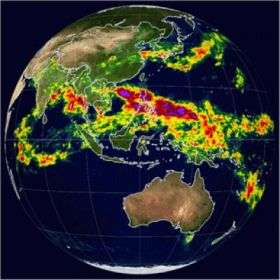
A new study conducted at the University of Miami and the University of Reading (UK) provides the first observational evidence to confirm the link between a warmer climate and more powerful or "extreme" rainstorms. Credit: NASA

Climate models have long predicted that global warming will increase the intensity of extreme precipitation events. A new study conducted at the University of Miami and the University of Reading (U.K.) provides the first observational evidence to confirm the link between a warmer climate and more powerful rainstorms.

One of the most serious challenges humanity will face in response to global warming is adapting to changes in extreme weather events. Of utmost concern is that heavy rainstorms will become more common and more intense in a warmer climate due to the increased moisture available for condensation. More intense rain events increase the risk of flooding and can have substantial societal and economic impacts.

To understand how precipitation responds to a warmer climate, researchers in this study used naturally-driven changes associated with El Niño as a laboratory for testing their hypotheses. Based on 20 years of satellite observations, they found a distinct link between tropical rainfall extremes and temperature, with heavy rain events increasing during warm periods and decreasing during cold periods.

"A warmer atmosphere contains larger amounts of moisture which boosts the intensity of heavy downpours," said Dr. Brian J. Soden, associate professor at the University of Miami Rosenstiel School of Marine & Atmospheric Science.

The report, "Atmospheric Warming and the Amplification of Precipitation Extremes," previewed in Science Express this Thursday, August 7, and published in an upcoming issue of Science, found that both observations and models indicated an increase in heavy rainstorms in response to a warmer climate. However, the observed amplification of rainfall extremes was found to be substantially larger in the observations than what is predicted by current models.

"Comparing observations with results from computer models improves understanding of how rainfall responds to a warming world" said Dr. Richard P. Allan, NERC advance fellow at the University of Reading's Environmental Systems Science Centre. "Differences can relate to deficiencies in the measurements, or the models used to predict future climatic change"

Source: University of Miami


print this article email this article download pdf blog this article bookmark this article     Stumble it Digg this share on Facebook retweet share on Reddit add to delicious
Rate this story - 3 /5 (18 votes)

Rank Filter

Move the slider to adjust rank threshold, so that you can hide some of the comments.


Display comments: newest first

  • jburchel - Aug 07, 2008
    • Rank: 2.1 / 5 (7)
    Please shutup with the climate change propaganda already. Everyone who was going to buy into it already did, and the rest of us are sick of hearing the stupid computer models that are always wrong anyway.
  • menkaur - Aug 07, 2008
    • Rank: 1.7 / 5 (6)
    you know... if you do not understand the system, there is a good chance that your simulations will be incorrect
    start with reviewing the human-caused global warming theory

August 7, 2008 all stories

Comments: 2

3 /5 (18 votes)
  • Stumble this up

  • Digg this

  • share this

  • hide
  • Related Stories

  • A Tale of Planetary Woe (w/ Video)
    created 22 hours ago | popularity not rated yet | comments 0
  • New fossil plant discovery links Patagonia to New Guinea in a warmer past
    created Nov 10, 2009 | popularity not rated yet | comments 0
  • Tackling new Arctic challenges from space
    created Nov 05, 2009 | popularity not rated yet | comments 0
  • Newly drilled ice cores may be the longest taken from the Andes
    created Nov 02, 2009 | popularity not rated yet | comments 0
  • Global warming cycles threaten endangered primate species
    created Oct 27, 2009 | popularity not rated yet | comments 0


  • hide
  • Relevant PhysicsForums posts

  • Rocks
    created 15 hours ago
  • Himalayan glaciers
    created Nov 11, 2009
  • upcoming GRL paper shows CO2 fraction is constant
    created Nov 11, 2009
  • Is there a point to buying organic?
    created Nov 11, 2009
  • More from Physics Forums - Earth

Other News

Greenland ice cap melting faster than ever

Greenland ice cap melting faster than ever

Space & Earth / Earth Sciences

created 40 minutes ago | popularity 4 / 5 (4) | comments 0

Satellite observations and a state-of-the art regional atmospheric model have independently confirmed that the Greenland ice sheet is loosing mass at an accelerating rate, reports a new study in Science.


2 Earth-sized bodies with oxygen rich atmospheres found -- but they're stars not planets

Two Earth-sized bodies with oxygen rich atmospheres found -- but they're stars not planets

Space & Earth / Astronomy

created 36 minutes ago | popularity 5 / 5 (4) | comments 1

Astrophysicists at the University of Warwick and Kiel University have discovered two earth sized bodies with oxygen rich atmospheres - however there is a bit of a disappointing snag for anyone looking for ...


A faraway planet intrigues: Exoplanet with extremely tilted orbit raises new interest in stellar astronomy

A faraway planet intrigues: Exoplanet with extremely tilted orbit raises new interest in stellar astronomy

Space & Earth / Astronomy

created 8 hours ago | popularity 4.9 / 5 (7) | comments 5

(PhysOrg.com) -- Two teams of astronomers have found a planet outside the solar system that might be orbiting backwards compared to its star's rotation, a discovery that could shed light on how unique the ...


Record high temperatures far outpace record lows across US

Record high temperatures far outpace record lows across US (w/ Video)

Space & Earth / Earth Sciences

created 1hour ago | popularity 1.8 / 5 (5) | comments 1

Spurred by a warming climate, daily record high temperatures occurred twice as often as record lows over the last decade across the continental United States, new research shows. The ratio of record highs ...


A glimpse at the Earth's crust deep below the Atlantic

A glimpse at the Earth's crust deep below the Atlantic

Space & Earth / Earth Sciences

created 4 hours ago | popularity 5 / 5 (1) | comments 0

Long-term variations in volcanism help explain the birth, evolution and death of striking geological features called oceanic core complexes on the ocean floor, says geologist Dr Bram Murton of the National ...