Fingerprints provide clues to more than just identity
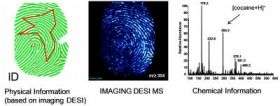
Fingerprints can reveal critical evidence, as well as an identity, with the use of a new technology developed at Purdue University that detects trace amounts of explosives, drugs or other materials left behind in the prints.
The new technology also can distinguish between overlapping fingerprints left by different individuals - a difficult task for current optical forensic methods.
A team led by R. Graham Cooks, Purdue's Henry Bohn Hass Distinguished Professor of Analytical Chemistry, has created a tool that reads and provides an image of a fingerprint's chemical signature. The technology can be used to determine what a person recently handled.
"The classic example of a fingerprint is an ink imprint showing the unique swirls and loops used for identification, but fingerprints also leave behind a unique distribution of molecular compounds," Cooks said. "Some of the residues left behind are from naturally occurring compounds in the skin and some are from other surfaces or materials a person has touched."
The team's research will be detailed in a paper published in Friday's (Aug. 8) issue of Science.
Demian R. Ifa, a Purdue postdoctoral researcher and the paper's lead author, said the technology also can easily uncover fingerprints buried beneath others.
"Because the distribution of compounds found in each fingerprint can be unique, we also can use this technology to pull one fingerprint out from beneath layers of other fingerprints," Ifa said. "By looking for compounds we know to be present in a certain fingerprint, we can separate it from the others and obtain a crystal clear image of that fingerprint. The image could then be used with fingerprint recognition software to identify an individual."
Researchers examined fingerprints in situ or lifted them from different surfaces such as glass, metal and plastic using common clear plastic tape. They then analyzed them with a mass spectrometry technique developed in Cooks' lab.
Mass spectrometry works by first turning molecules into ions, or electrically charged versions of themselves, so their masses can be analyzed. Conventional mass spectrometry requires chemical separations, manipulations of samples and containment in a vacuum chamber for ionization and analysis. Cooks' technology performs the ionization step in the air or directly on surfaces outside of the mass spectrometer's vacuum chamber, making the process much faster and more portable, Ifa said.
The Purdue procedure performs the ionization step by spraying a stream of water in the presence of an electric field to create positively charged water droplets. Water molecules in the droplets contain an extra proton and are called ions. When the charged water droplets hit the surface of the sample being tested, they transfer their extra proton to molecules in the sample, turning them into ions. The ionized molecules are then vacuumed into the mass spectrometer to be measured and analyzed.
Researchers placed a section of tape containing a lifted fingerprint on a moving stage in front of the spectrometer. The spectrometer then sprayed small sections of the sample with the charged water droplets, obtaining data for each section and combining the data sets to create an analysis of the sample as a whole, Ifa said. Software was used to map the information and create an image of the fingerprint from the distribution and intensity of selected ions.
Additional co-authors of the paper are Nicholas E. Manicke and Allison L. Dill, graduate students in Purdue's chemistry department.
Source: Purdue University


