Pheromones enhance sex, slow aging -- in worms
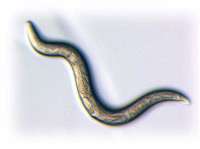
(PhysOrg.com) -- People will pay big bucks for pills that promise to enhance sex or slow aging. Now, a Cornell researcher and colleagues have uncovered a class of small molecules in tiny worms that not only attract mates but also arrest development for months in larvae.
The paper, published online July 23 in Nature, reports that a mixture of molecules called ascarosides, which extend life span in C. elegans worms, also acts as a sex pheromone, thereby connecting the two seemingly disparate life processes of aging and reproduction. This small, normally soil-dwelling nematode is used as a model organism for many diseases as well as aging because its biology is in some regards similar to that of higher organisms, including humans.
While these results are unique to this worm, the study offers new directions for exploring the aging process in humans, says senior author Frank Schroeder, assistant professor at the Boyce Thompson Institute for Plant Research at Cornell. Jagan Srinivasan, a postdoctoral researcher at the California Institute of Technology, is the paper's lead author.
"We won't find the exact same signaling pathway from C. elegans in other organisms," said Schroeder, "but we [humans] have similar genes doing similar things, and one might think that influencing them in analogous ways might have an effect on slowing aging."
Most C. elegans are hermaphrodites -- having both male and female sex organs -- although there are a few rare males. The hermaphrodites use the pheromone to attract males; however, when they release large amounts of pheromone into their surroundings, nearby larvae enter a so-called dauer stage: Their skin thickens, they become highly stress tolerant, they stop eating and stop developing, remaining in a suspended state for months. While C. elegans normally live only a few weeks, these dauer larvae can stay dormant for many months to survive periods of food scarcity or overpopulation. Thus, the release of sex pheromone by the nematodes might increase reproductive success while at the same time slowing down development of the offspring, said Schroeder.
He noted organisms with high reproductive rates usually have short life spans, but the pheromone in the nematodes plays a dual role in both increasing reproduction and extending life.
Schroeder and colleagues isolated and identified the mixture of ascarosides, molecules similar to sugars, in the pheromone. Each ascaroside by itself had only a small effect on the worms, but when two or three were mixed together, they amplified each others' effects dramatically. In addition, certain ascarosides proved to contain properties for attracting mates while other ascarosides triggered the dauer stage.
Schroeder specializes in the study of small molecules in plants, animals and microorganisms that play significant roles in sending signals within and between organisms and that may lead to useful drugs.
Provided by Cornell University


