Cassini Prepares to Swoop by Saturn's Geyser-Spewing Moon
August 7, 2008
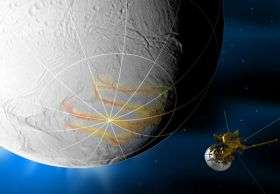
Artist concept of Cassini flying by Enceladus. Image credit: NASA/JPL
(PhysOrg.com) -- Fractures, or "tiger stripes," where icy jets erupt on Saturn's moon Enceladus will be the target of a close flyby by the Cassini spacecraft on Monday, Aug. 11.
Cassini will zoom past the tiny moon a mere 50 kilometers (30 miles) from the surface. Just after closest approach, all of the spacecraft's cameras -- covering infrared wavelengths, where temperatures are mapped, as well as visible light and ultraviolet -- will focus on the fissures running along the moon's south pole. That is where the jets of icy water vapor emanate and erupt hundreds of miles into space. Those jets have fascinated scientists since their discovery in 2005.
"Our main goal is to get the most detailed images and remote sensing data ever of the geologically active features on Enceladus," said Paul Helfenstein, a Cassini imaging team associate at Cornell University in Ithaca, NY. "From this data we may learn more about how eruptions, tectonics, and seismic activity alter the moon's surface. We will get an unprecedented high-resolution view of the active area immediately following the closest approach."
Seeing inside one of the fissures in high resolution may provide more information on the terrain and depth of the fissures, as well as the size and composition of the ice grains inside. Refined temperature data could help scientists determine if water, in vapor or liquid form, lies close to the surface and better refine their theories on what powers the jets.
Imaging sequences will capture stereo views of the north polar terrain, and high resolution images of the south polar region will begin shortly after closest approach to Enceladus. The image resolution will be as fine as 7 meters per pixel (23 feet) and will cover known active spots on three of the prominent "tiger stripe" fractures.
In addition to mapping the moon's surface in visible light as well as infrared and ultraviolet light, Cassini will help determine the size of the ice grains and distinguish other elements mixed in with the ice, such as oxygen, hydrogen, or organics.
"Knowing the sizes of the particles, their rates and what else is mixed in these jets can tell us a lot about what's happening inside the little moon," said Amanda Hendrix, Cassini ultraviolet imaging spectrograph team member at NASA's Jet Propulsion Laboratory, Pasadena, Calif.
Other instruments will measure the temperatures along the fractures, which happen to be some of the hottest spots on the moon's surface.
"We'd like to refine our numbers and see which fracture or stripe is hotter than the rest because these results can offer evidence, one way or the other, for the existence of liquid water as the engine that powers the plumes," said Bonnie Buratti of JPL, team member on Cassini's visual and infrared mapping spectrometer.
Cassini discovered evidence for the geyser-like jets on Enceladus in 2005, finding that the continuous eruptions of ice water create a gigantic halo of ice and gas around Enceladus, which helps supply material to Saturn's E-ring. This marks Cassini's second flyby of Enceladus this year. During Cassini's last flyby of Enceladus in March, the spacecraft snatched up precious samples and tasted comet-like organics inside the little moon. Two more Enceladus flybys are coming up in October, and they may bring the spacecraft even closer to the moon. The Oct. 9 encounter is complimentary to the March one, which was optimized for sampling the plume. The Oct. 31 flyby is similar to this August one, and is again optimized for the optical remote sensing instruments.
Provided by NASA
-
Image: Saturn's rings and Enceladus
6 hours ago |
not rated yet |
0
-
Latest Cassini images of Enceladus on view
Oct 21, 2011 |
5 / 5 (1) |
0
-
Orion's belt lights up Cassini's view of Enceladus
Oct 19, 2011 |
5 / 5 (1) |
0
-
Saturn's geyser moon Enceladus shows off for Cassini
Oct 04, 2011 |
5 / 5 (1) |
1
-
Saturn's moon Enceladus spreads its influence
Sep 22, 2011 |
4.8 / 5 (6) |
13
-
Engineers build first sub-10-nm carbon nanotube transistor
Feb 01, 2012 |
4.9 / 5 (33) |
30
-
Something old, something new: Evolution and the structural divergence of duplicate genes
Jan 31, 2012 |
4.6 / 5 (7) |
1
-
The hidden nanoworld of ice crystals: Revealing the dynamic behavior of quasi-liquid layers
Jan 30, 2012 |
5 / 5 (4) |
1
-
Stock market network reveals investor clustering
Jan 27, 2012 |
3.9 / 5 (23) |
8
-
Of microchemistry and molecules: Electronic microfluidic device synthesizes biocompatible probes
Jan 26, 2012 |
5 / 5 (2) |
0
-
Never ending outer space.....
18 hours ago
-
Neutron Star fragments?
20 hours ago
-
stationary or not?
Feb 11, 2012
-
Scale of the Universe
Feb 10, 2012
-
Titan's lack of impact craters
Feb 09, 2012
-
Real pictures of black hole eating a star?
Feb 08, 2012
- More from Physics Forums - General Astronomy
More news stories
Latin America mining boom clashes with conservation
Latin America is experiencing a mining boom as prices rise fuelled by a hike in global demand, but the region is also being hit by a wave of violent protests, strikes and rallies by environmentalists.
11 hours ago |
5 / 5 (1) |
1
Salvage workers begin pumping fuel from Italian shipwreck
Salvage workers Sunday began pumping fuel from the shipwrecked Italian cruise liner Costa Concordia, a day ahead of schedule, officials said.
3 hours ago |
not rated yet |
0
Political leaders play key role in how worried Americans are by climate change: study
More than extreme weather events and the work of scientists, it is national political leaders who influence how much Americans worry about the threat of climate change, new research finds.
Feb 06, 2012 |
5 / 5 (6) |
73
NASA budget will axe Mars deal with Europe: scientists
US President Barack Obama's budget proposal to be submitted next week for 2013 will cut NASA's budget by 20 percent and eliminate a major partnership with Europe on Mars exploration, scientists said Thursday.
Space & Earth / Space Exploration
Feb 10, 2012 |
5 / 5 (3) |
58
Humans may have helped the decline of African rainforests 3000 years ago
(PhysOrg.com) -- Large areas of rainforests in Central Africa mysteriously disappeared over three thousand years ago, to be replaced by savannas. The prevailing theory has been that the cause was a change ...
Overeating may double risk of memory loss
New research suggests that consuming between 2,100 and 6,000 calories per day may double the risk of memory loss, or mild cognitive impairment (MCI), among people age 70 and older. The study was released today and will be ...
Google might launch Drive for cloud storage soon
(PhysOrg.com) -- Google's next big move, according to the Wall Street Journal, is a cloud storage service called Drive. Hardly first to the plate, Google is simply catching up to introducing its cloud reposi ...
Scientists discover molecular secrets of 2,000-year-old Chinese herbal remedy
For roughly two thousand years, Chinese herbalists have treated Malaria using a root extract, commonly known as Chang Shan, from a type of hydrangea that grows in Tibet and Nepal. More recent studies suggest that halofuginone, ...
New method to examine batteries -- MRI from the inside
There is an ever-increasing need for advanced batteries for portable electronics, such as phones, cameras, and music players, but also to power electric vehicles and to facilitate the distribution and storage of energy derived ...
Lab study raises questions over nano-particle impact
Tests involving chickens have raised questions about the impact on health from engineered nano-particles, the ultra-fine grains commonly used in drugs and processed foods, scientists said on Sunday.
Injured boomers beware: Know when to see doctor
(AP) -- It happened to nurse Jane Byron years after an in-line skating fall, business owner Haralee Weintraub while doing "men's" push-ups, and avid cyclist Gene Wilberg while lifting a heavy box.
Aug 07, 2008
Rank: 1 / 5 (2)
A few days ago Physorg put out a piece about China having more scientist and making more advances then any other country ???????
I have yet to see a Chinese Cassini, or any other great Chiness space exploration. Heck they aren't even part of ISS.
The only thing great by China (not great !) was blowing up a satellite in LEO causing >10,000 fragments to rain in LEO space causing major problems for the rest of the worlds space experiments,, smart.
So how in the heck can China be so advanced ?
I guess the view is in the eye of the beholder and in this beholder's idea America, Europeans, Japanese, and Koreans are light years ahead of other countries in advanced science.
Pounding on ones chest exclaiming loquaciously we are great doesn't make you great, great deeds do !
NASA and the folks working with NASA truly are
great scientist and great people !!
Aug 08, 2008
Rank: 5 / 5 (1)
Aug 08, 2008
Rank: not rated yet
There important problems with the observation, though:
1) Cassini is a NASA and ESA project (remember the days when NASA could do it all itself?)
2) Cassini was launched 11 years ago, and it was developed years before that. I.e., It doesn't represent current NASA or ESA prominence, but the stature they had 15 years ago.
3) The Chinese are moving quickly enough in space that there are already people saying they can get to the moon faster than NASA can, now.
4) China has billions in surplus every year. It wouldn't take long for them to catch up, if they wanted to.
Cassini isn't evidence to be smug, vis-a-vis China.