Kites could provide electricity for 100,000 homes
August 8, 2008 by Lisa Zyga
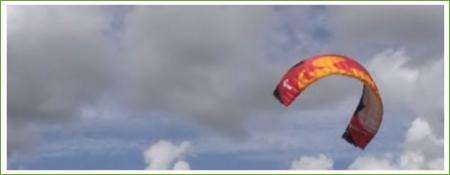
Scientists from TU Delft have demonstrated that flying a 10-square-meter kite could generate 10 kilowatts of power, which could supply electricity for about 10 homes.
High-flying kites tethered to generators could supply as much as 100 megawatts of electricity, enough to power 100,000 homes, according to researchers from the Delft University of Technology in The Netherlands.
The scientists have recently demonstrated that flying a single 10-square-meter kite could produce 10 kilowatts of power, which could supply electricity for about 10 homes.
In their next experiment, the researchers plan to test a 50-kilowatt version, called Laddermill. Eventually, their goal is to build a multi-kite system that could generate a full 100 megawatts.
As project leader and professor of sustainable engineering Wubbo Ockels explains, kites generate power by pulling on their strings that are attached to generators on the ground. After reaching their maximum height, the kites are reeled back down to repeat the process.
Electricity produced by kites in the wind could be inexpensive, too. The researchers predict prices to be comparable with generating electricity using coal power, and half that of using wind turbines.
One advantage of kites is their potential height. Commercial windmills generally reach heights of around 80 meters, where the average wind speed is about 5 meters per second. At higher altitudes, such as 800 meters, the average wind speed is about 7 meters per second. Because the amount of power available from the wind is related to the cube of its speed, blades at higher altitudes could generate up to five times the amount of electricity as at lower altitudes. High-altitude wind is also generally more reliable than ground-level wind.
While building an 800-meter-tall windmill would be impractical, a kite can easily reach that height, and take advantage of the higher wind speeds. The Dutch scientists note that a high-speed jet stream makes countries such as the UK, The Netherlands, Ireland, and Denmark especially good locations for kites.
Using computer models, researchers can determine how to configure kites so that they get the most out of the wind. Ockelsī system used figure-eight flying patterns developed by Allister Furey of the University of Sussex, an arrangement that increases the speed of the air flowing over the kites. Heīs also investigating a yo-yo configuration, where one kites goes up as another falls from the sky like a glider.
"Pretty much anywhere in the UK you could run a kite plant economically, but you couldnīt run a wind turbine economically," said Furey.
Several other scientists are investigating the use of kites to harness energy from the wind - which some researchers estimate provides more than 100 times the amount required to power the entire planet. In 2007, Googleīs philanthropic arm invested about $10 million in a US kite company called Makani. An Italian company called Kitegen has a multi-kite scheme that could generate a gigawatt of power, as much as a standard coal plant.
via: The Guardian and EcoGeek


Out of the mouth of a MENTALIST babe.
Good point. I wonder if they could engineer the kite in a way to let gravity due the work of pulling it down at the desired time.
Only if you kept the kite in the same state (catching air), it should be a trivial matter to built in articulated joints which reduce the surface area of the kite as it comes down.
Trey are using a ai system to change the behaviour of the kite to descent autonomic. It changes the configuration of the kite and makes it a glider.
I went to a showcase here in Holland, The dude is like the only science celebrity we have.
Thanks for the info. I figured it would be a fairly feasible to do such a thing.
I wonder if he got the idea for generating electricity from them after someone told him to 'go fly a kite buddy'. ha
and the best solution to efficient popcorn as well
Actually, fusion power is. One slight problem, though... :-)
I am thinking that the kite could have a string to spill air when you make it descend, like a parachute. This would also be used to adjust the lift and hence pull force as wind speed changed. Very useful in storming/gusty conditions.
Of course the project requires permission from the FAA/CAA/JAA for that altitude. There is also the issue of lightning/static arresters, or could that be an energy source too?
Different winds rain, Hail, Snow would/could collapse the kites. Relibility is huge in power supply.
Random collapses with dying winds...
The energy required to get them back up flying?
Not to mention flying hazards... at least windmills stay in one spot...
Multiple kites tangle together?
Too many factors.. Wish they'd spend more time, money, effort on more feasible studies..
I like how no one addressed this issue. Indeed, what are the long-term consequences? Maybe, for once, we will attempt to answer this question first before the hole we have dug for ourselves gets any deeper, and the walls start to cave in.
This is a solution that doesn't cause a net addition to the amount of heat generated by humanity. If global warming is causing more severe weather -- higher winds -- then harnessing the winds might actually be good. I can dream, can't I?
therefore, multiple kite systems are required. Paired systems would be good then the ascending generator could take up the slack of the descending kite's cable. Other pairs could be operated at various phases to smooth out the power generation. BUT we'd still have to deal with the myriad of problems pointed out in the earlier posts.
It just needs upsizing.
I can imagine using two kites that alternate loft, with one pulling the other through a pulley for a set distance back and forth to turn the generator shaft, but one single kite by itself is hard to imagine continuous power generation.
I can see problems with more than one kite, though. The strings could easily get tangled.
Ruebi - They have done some work on tides and currents generating elec. One was a dam type construct that forced water through a small opening to spin turbines. It was built on a tidal area of a river. As the tide came in the turbines spin one way, on the way out, the other. There were others. On this one, one here and there would be okay, but I'm not sure large areas covered with these would be a good idea.
1) Winding the kite back to Earth requires the same energy generated from raising it, assuming constant wind speeds.
2) What happens when there's no wind? The kites fall to the ground. How would the relaunching of the kites be managed when the wind picks up again?
100,000 homes? That makes me smile.
As for there being no wind at times, at higher altitudes there's just about always wind, which was the point. One needn't lower the kite all the way to the ground every time, especially if you have multiple kites on the same string. You wouldn't even need any AI system to control the rise and fall, you could have an analog system that when you run out of rope, it tugs on the kites "collapse" or "spill air" toggle.
As for lightening... If none of the parts were made of conducting materials then it might not be a big deal, but you could also have kites with metal bits and conducting string near your other kites, not connected to a generator but just acting as a kilometer long lightening rod. If someone did think of a feasible way to capture all that power, then you could convert all the lightening rod kites in the kite power stations (assuming this kite power thing takes off and some time later someone develops a lightening rod power system) to power generators too.
In my opinion you'd want those cables to be conductive, and well grounded.
You do realize, I hope, that such would result in the spinning ball's rate of spin decreasing steadily.
1. Only if the kite always has the same amount of lift the entire time the kite is up in the air, a controller string to operate a lift valve covers that. As mentioned earlier in this thread "like a parachute"
2. This is high altitude, if you go into a skyscraper there is never a day there is not wind hitting it- and these kites go much higher, up into the jet streams which really are constant and very powerfull.
Just a tower on the nodes can provide the juice you seek,but old papa here cant allow that ,cuz the magma needs its peak, or a snowmobile suit you will seek. The magma needs its juice,but light energy will provide your juice. Its gonna take some time,before you get the rhyme.
So tell me how THAT would be more destructive than what we're doing to the planet now...once stopped;
-one side of the planet would constantly have daylight, which would reduce heating and lighting needs for a whole half of the planet (lets make it ours)
-without the spin, the jet stream would be stopped, so hurricanes and typhoons would be a thing of the past
...I DID say that it was an EVIL thought! :)
It appears electric power is generated as the kite moves around an irregular orbit. I could not figure out how the generator works but perhaps someone else could watch and tell me.
http://www.youtub...ctDA9IBU
There is an enormous amount of energy hidden in the winds over our heads. At an altitude of 30.000 feet, the wind energy is twenty times as large as at sea level. The laddermill is a new and novel idea to harness this immense energy resource.
The laddermill consists of a large number of kites on an upward and downward motion. The kites used are of a breed between regular kites and airplanes. Whereas a kite climbs relatively easy, getting a kite down requires a force pulling in the cable. An airplane, on the other hand, requires large engines to gain altitude. Decreasing altitude is much easier, as the aircraft can glide to the ground. The kites used in the laddermill, generally called "kiteplanes", combine the ascension characteristics of kites with the descension characteristics of aircraft. By creating a large loop of kiteplanes ascending and descending, a rotation can be created. In turn, this rotation can be coupled to a generator to create energy. The loop of kiteplanes can ultimately go up to 30.000 feet, which would generate approximately 100MW. The cable is an important part of the system and consists of strong fiber materials such as Dyneema. The kiteplanes themselves need to be both large in surface area as well as light in construction weight. Structural principles such as inflatables are being investigated. The control of the kiteplanes can be done by a pressure differential in the inflatable members. Its control will ultimately be automated using flight computers.
The kites proposed here are "power kites" they generate lift when they "move" through the air. This lift can be controlled by the position of the kite in the sky relative to the anchor point.
These kites are steerable and they generate tremendous lift depending of their speed and angle of attack relative to the wind. This is not exactly like a sail attached to a boat.
The Earth is not a featureless sphere. Mountains, trees and general surface friction are a far greater obstacle to wind than anything we could do with kites.
It seems to me that most of the wind energy will be needed just to suspend those extremely heavy steel cables that high...it would make more sense to build one HUGE tower, filled with wind turbines, all the way up, 30,000 feet high (although I suspect that it wouldn't need to be anywhere near that height!) It could be located near big cities where the demand is greatest. 'Not sure of how much noise something like this would make...probably quite a bit!
Quote from Wikipedia...
Dyneema and Spectra are gel spun through a spinneret to form oriented-strand synthetic fibers of UHMWPE, which have yield strengths as high as 2.4 GPa and density as low as 0.97 kg/l (for Dyneema SK75)[5]. High strength steels have comparable yield strengths, and low carbon steels have yield strengths much lower (around 0.5 GPA). Since steel has a density approximately equal to 7.8 kg/l, this gives strength/weight ratios for these materials in a range from 10 to 100 times higher than for steel. Strength to weight ratios for Dyneema are about 40% higher than for Aramid.
http://img139.ima...3hd8.jpg
Yay mspaint!
You still have wind up all the line that was pulled out by the wind. This would require the same amount of energy as was produced by the kite pulling the line out.